Cavalcanti Daniella Medeiros, de Oliveira Ferreira de Sales Lucas, da Silva Andrea Ferreira, Basterra Elisa Landin, Pena Daiana, Monti Caterina, Barreix Gonzalo, Silva Natanael J, Vaz Paula, Saute Francisco, Fanjul Gonzalo, Bassat Quique, Naniche Denise, Macinko James, Rasella Davide
Institute of Collective Health, Federal University of Bahia, Bahia, Brazil.
ISGlobal, Barcelona, Spain; Facultat de Medicina i Ciències de la Salut, Universitat de Barcelona, Barcelona, Spain.
Lancet. 2025 Jul 19;406(10500):283-294. doi: 10.1016/S0140-6736(25)01186-9. Epub 2025 Jun 30.
The US Agency for International Development (USAID) is the largest funding agency for humanitarian and development aid worldwide. The aim of this study is to comprehensively evaluate the effect of all USAID funding on adult and child mortality over the past two decades and forecast the future effect of its defunding.
In this retrospective impact evaluation integrated with forecasting analysis, we used panel data from 133 countries and territories- including all low-income and middle-income countries (LMICs)-with USAID support ranging from none to very high. First, we used fixed-effects multivariable Poisson models with robust SEs adjusted for demographic, socioeconomic, and health-care factors to estimate the impact of USAID funding on all-age and all-cause mortality from 2001 to 2021. Second, we evaluated its effects by age-specific, sex-specific, and cause-specific groups. Third, we did several sensitivity and triangulation analyses. Lastly, we integrated the retrospective evaluation with validated dynamic microsimulation models to estimate effects up to 2030.
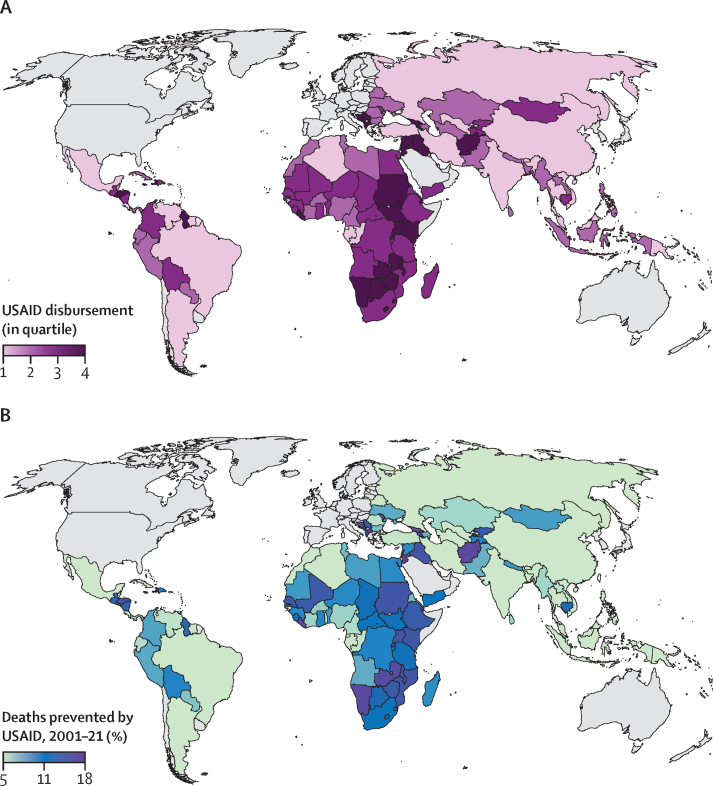
Higher levels of USAID funding-primarily directed toward LMICs, particularly African countries-were associated with a 15% reduction in age-standardised all-cause mortality (risk ratio [RR] 0·85, 95% CI 0·78-0·93) and a 32% reduction in under-five mortality (RR 0·68, 0·57-0·80). This finding indicates that 91 839 663 (95% CI 85 690 135-98 291 626) all-age deaths, including 30 391 980 (26 023 132-35 482 636) in children younger than 5 years, were prevented by USAID funding over the 21-year study period. USAID funding was associated with a 65% reduction (RR 0·35, 0·29-0·42) in mortality from HIV/AIDS (representing 25·5 million deaths), 51% (RR 0·49, 0·39-0·61) from malaria (8·0 million deaths), and 50% (RR 0·50, 0·40-0·62) from neglected tropical diseases (8·9 million deaths). Significant decreases were also observed in mortality from tuberculosis, nutritional deficiencies, diarrhoeal diseases, lower respiratory infections, and maternal and perinatal conditions. Forecasting models predicted that the current steep funding cuts could result in more than 14 051 750 (uncertainty interval 8 475 990-19 662 191) additional all-age deaths, including 4 537 157 (3 124 796-5 910 791) in children younger than age 5 years, by 2030.
USAID funding has significantly contributed to the reduction in adult and child mortality across low-income and middle-income countries over the past two decades. Our estimates show that, unless the abrupt funding cuts announced and implemented in the first half of 2025 are reversed, a staggering number of avoidable deaths could occur by 2030.
The Spanish Ministry of Science and Innovation, UK Medical Research Council, and EU Horizon Europe.
美国国际开发署(USAID)是全球最大的人道主义和发展援助资金机构。本研究的目的是全面评估过去二十年来美国国际开发署所有资金对成人和儿童死亡率的影响,并预测其资金削减的未来影响。
在这项结合预测分析的回顾性影响评估中,我们使用了来自133个国家和地区的面板数据,包括所有低收入和中等收入国家(LMIC),美国国际开发署的支持程度从无到非常高。首先,我们使用固定效应多变量泊松模型,并对人口、社会经济和医疗保健因素调整稳健标准误,以估计2001年至2021年美国国际开发署资金对全年龄段和全病因死亡率的影响。其次,我们按年龄、性别和病因特定组评估其影响。第三,我们进行了多项敏感性和三角测量分析。最后,我们将回顾性评估与经过验证的动态微观模拟模型相结合,以估计到2030年的影响。
美国国际开发署的较高资金水平——主要针对低收入和中等收入国家,特别是非洲国家——与年龄标准化全病因死亡率降低15%(风险比[RR]0.85,95%置信区间0.78 - 0.93)和五岁以下儿童死亡率降低32%(RR 0.68,0.57 - 0.80)相关。这一发现表明,在21年的研究期间,美国国际开发署的资金预防了91839663例(95%置信区间85690135 - 98291626)全年龄段死亡,其中包括30391980例(26023132 - 35482636)五岁以下儿童死亡。美国国际开发署资金与艾滋病毒/艾滋病死亡率降低65%(RR 0.35,0.29 - 0.42)(相当于2550万例死亡)、疟疾死亡率降低51%(RR 0.49,0.39 - 0.61)(800万例死亡)以及被忽视热带病死亡率降低50%(RR 0.50,0.40 - 0.62)(890万例死亡)相关。结核病、营养缺乏、腹泻病、下呼吸道感染以及孕产妇和围产期疾病的死亡率也显著下降。预测模型预测,目前大幅削减资金可能导致到2030年额外增加超过14051750例(不确定区间8475990 - 19662191)全年龄段死亡,其中包括4537