
基于影像组学的预测模型在预测前列腺癌术前淋巴结转移中的应用:一项系统评价和荟萃分析
Application of radiomics-based prediction model to predict preoperative lymph node metastasis in prostate cancer: a systematic review and meta-analysis.
作者信息
Zheng Yanghuang, Du Yuelin, Zhang Biao, Zhang Helin, Shang Panfeng, Hou Zizhen
机构信息
Department of Urology, Lanzhou University Second Hospital, Lanzhou, Gansu, China.
出版信息
Front Oncol. 2025 Jun 20;15:1577794. doi: 10.3389/fonc.2025.1577794. eCollection 2025.
BACKGROUND
This study aims to comprehensively evaluate the accuracy and efficacy of radiomics models based on imaging equipment in predicting prostate cancer (PCa) lymph node metastasis (LNM).
METHODS
We systematically searched PubMed, Embase, Cochrane Library, Web of Science, and Sinomed databases from their establishment until July 2024. The Quality Assessment of Diagnostic Accuracy Studies 2 (QUADAS-2) criteria and the Radiomics Quality Score (RQS) tools were utilized to assess the quality of the studies. Indicators such as the pooled area under the curve (AUC), sensitivity, specificity, positive likelihood ratio, and negative likelihood ratio were computed to evaluate the predictive effect of radiomics technology on LNM of PCa.
RESULTS
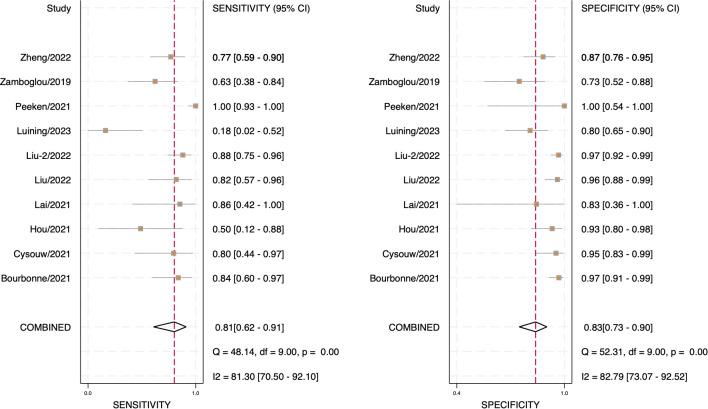
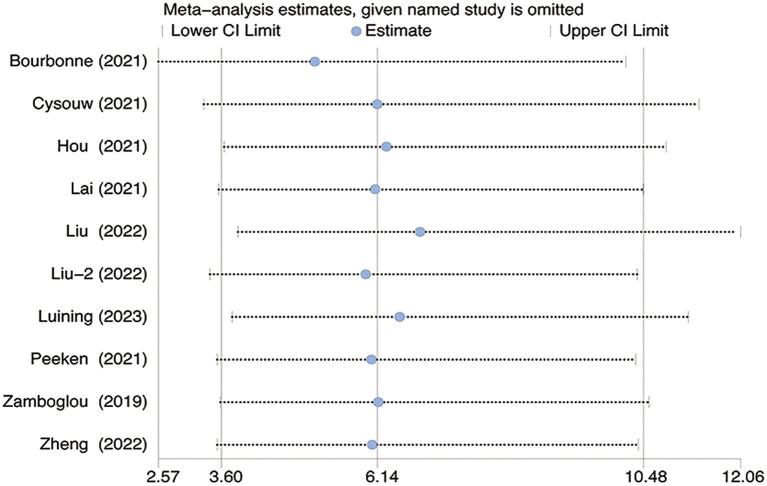
A total of 1860 patients diagnosed with LNM of PCa through histological examination were included in this meta-analysis. The radiomics model for predicting LNM in PCa showed a pooled AUC value of 0.88 (95% confidence interval (CI) [0.85 - 0.91]), with a sensitivity and specificity of 0.81 (95% CI [0.64 - 0.91]) and 0.85 (95% CI [0.75 - 0.91]), respectively. The positive likelihood ratio was 5.43 (95% CI [3.34 - 8.84]), the negative likelihood ratio was 0.22 (95% CI [0.12 - 0.43]), and the diagnostic odds ratio was 24.21 (95% CI [10.59 - 55.32]). The meta-analysis showed significant heterogeneity among the included studies. No threshold effect was detected. The subgroup analysis showed that the least absolute shrinkage and selection operator regression algorithm had the higher diagnostic sensitivity, with a pooled sensitivity of 0.96 (95% CI [0.90 - 1.00]) ( = 0.02), while the random forest algorithm was the opposite, with a pooled sensitivity of 0.48 (95% CI [0.16 - 0.80]) ( = 0.01). Radiomics features without intraclass correlation coefficient preprocessing would lead to a decrease in diagnostic specificity, 0.73 (95% CI [0.53 - 0.92]) ( = 0.04). The pooled specificity with an RQS score≥ 17 was 0.77 (95% CI [0.65 - 0.88]) ( = 0.01), and the higher the score, the lower the diagnostic specificity would be.
CONCLUSIONS
The predictive model based on radiomics features has the potential to serve as an auxiliary approach for predicting preoperative LNM of PCa.
SYSTEMATIC REVIEW REGISTRATION
https://www.crd.york.ac.uk/prospero/, identifier PROSPERO CRD42024575818.
背景
本研究旨在全面评估基于成像设备的放射组学模型在预测前列腺癌(PCa)淋巴结转移(LNM)方面的准确性和有效性。
方法
我们系统检索了PubMed、Embase、Cochrane图书馆、Web of Science和中国生物医学文献数据库,检索时间从建库至2024年7月。采用诊断准确性研究质量评估2(QUADAS-2)标准和放射组学质量评分(RQS)工具评估研究质量。计算合并曲线下面积(AUC)、灵敏度、特异度、阳性似然比和阴性似然比等指标,以评估放射组学技术对PCa患者LNM的预测效果。
结果
本荟萃分析共纳入1860例经组织学检查确诊为PCa伴LNM的患者。预测PCa患者LNM的放射组学模型合并AUC值为0.88(95%置信区间[CI][0.85 - 0.91]),灵敏度和特异度分别为0.81(95%CI[0.64 - 0.91])和0.85(95%CI[0.75 - 0.91])。阳性似然比为5.43(95%CI[3.34 - 8.84]),阴性似然比为0.22(95%CI[0.12 - 0.43]),诊断比值比为24.21(95%CI[10.59 - 55.32])。荟萃分析显示纳入研究间存在显著异质性。未检测到阈值效应。亚组分析显示,最小绝对收缩和选择算子回归算法具有较高的诊断灵敏度,合并灵敏度为0.96(95%CI[0.90 - 1.00])(P = 0.02),而随机森林算法则相反,合并灵敏度为0.48(95%CI[0.16 - 0.80])(P = 0.01)。未进行组内相关系数预处理的放射组学特征会导致诊断特异度降低,为0.73(95%CI[0.53 - 0.92])(P = 0.04)。RQS评分≥17时的合并特异度为0.77(95%CI[0.65 - 0.88])(P = 0.01),评分越高,诊断特异度越低。
结论
基于放射组学特征的预测模型有可能作为预测PCa术前LNM的辅助方法。
系统评价注册
https://www.crd.york.ac.uk/prospero/,标识符PROSPERO CRD42024575818。





 Zotero 插件