
上次生育后的时间与子宫内膜癌风险:观察性研究的荟萃分析。
Time since last birth and the risk of endometrial cancer: A meta-analysis of observational studies.
作者信息
Gu Juan, Lai Yuchen, Shou Huafeng, Wang Liping
机构信息
Department of Gynecology, Zhejiang Provincial People's Hospital and People's Hospital of Hangzhou Medical College, No. 158 Shangtang Road, Hangzhou, Zhejiang, China.
Center for General Practice Medicine, Zhejiang Provincial People's Hospital and People's Hospital of Hangzhou Medical College, No. 158 Shangtang Road, Hangzhou, Zhejiang, China.
出版信息
PLoS One. 2025 Jul 8;20(7):e0325907. doi: 10.1371/journal.pone.0325907. eCollection 2025.
INTRODUCTION
Endometrial cancer, an adenocarcinoma originating from the uterine lining, is the most prevalent cancer of the female genital tract globally.Identifying early risk factors for endometrial cancer is crucial for prevention.Prior research suggests that pregnancy may lower endometrial cancer risk by reducing estrogen exposure.This meta-analysis aims to delve into the existing population-based longitudinal studies to evaluate the association between the time elapsed since the last birth and the risk of endometrial cancer.
METHODS AND ANALYSIS
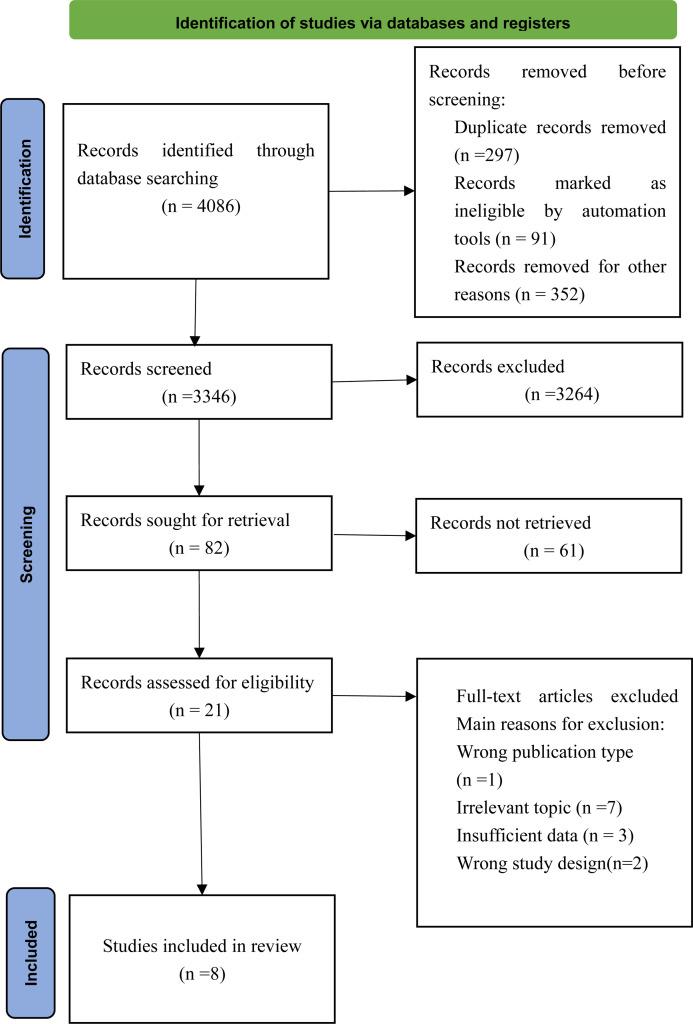
We searched PubMed, Cochrane Library, Embase, and Web of Science for cohort studies published up to June 21, 2024, using relevant medical subject headings (MeSH) and keywords. Statistical analyses were conducted using Stata version 14.0. A fixed-effects model was applied if P > 0.1 and I2 ≤ 50%; otherwise, a random-effects model was used to account for significant heterogeneity Publication bias was assessed using funnel plots and Egger's test. Our meta-analysis included 3 cohort studies and 5 case-control studies with a total of 3,310,734 participants, published between 1994 and 2024. The analysis revealed that time since last birth is associated with endometrial cancer risk. Specifically, a period of 0-10 years since the last birth was linked to a reduced risk of endometrial cancer (OR= 0.431; 95% CI: 0.351-0.530). A period of 10-20 years since the last birth also showed a decreased risk (OR=0.867; 95% CI:0.747-1.007), whereas more than 20 years since the last birth was associated with an increased risk (OR = 1.304; 95% CI: 1.111-1.530).
CONCLUSIONS
Our meta-analysis indicates that a shorter time since the last birth is protective against endometrial cancer, whereas a longer interval increases risk. Further research is needed to clarify the underlying mechanisms of this association. These findings are crucial for developing new strategies for endometrial cancer prevention and treatment.
引言
子宫内膜癌是一种起源于子宫内膜的腺癌,是全球女性生殖道最常见的癌症。识别子宫内膜癌的早期风险因素对预防至关重要。先前的研究表明,怀孕可能通过减少雌激素暴露来降低子宫内膜癌风险。本荟萃分析旨在深入研究现有的基于人群的纵向研究,以评估自上次生育以来的时间与子宫内膜癌风险之间的关联。
方法与分析
我们在PubMed、Cochrane图书馆、Embase和科学网中检索截至2024年6月21日发表的队列研究,使用相关医学主题词(MeSH)和关键词。使用Stata 14.0版本进行统计分析。如果P>0.1且I2≤50%,则应用固定效应模型;否则,使用随机效应模型来处理显著的异质性。使用漏斗图和Egger检验评估发表偏倚。我们的荟萃分析包括3项队列研究和5项病例对照研究,共有3310734名参与者,发表于1994年至2024年之间。分析表明,自上次生育以来的时间与子宫内膜癌风险相关。具体而言,自上次生育以来0至10年的时间段与子宫内膜癌风险降低相关(OR=0.431;95%CI:0.351-0.530)。自上次生育以来10至20年的时间段也显示风险降低(OR=0.867;95%CI:0.747-1.007),而自上次生育以来超过20年则与风险增加相关(OR = 1.304;95%CI:1.111-1.530)。
结论
我们的荟萃分析表明,自上次生育以来的时间越短对子宫内膜癌具有保护作用,而间隔时间越长则风险增加。需要进一步研究以阐明这种关联的潜在机制。这些发现对于制定子宫内膜癌预防和治疗的新策略至关重要。



 Zotero 插件