Bao Dongjun, Bao Kunming, Fu Xiaoxian, Xie Xueping, Ma Xin, Huang Zhidong, Que Rongcai, Gu Wenjun, Lu Shengyou
The Second Hospital of Longyan City, Longyan, China.
Longyan First Affiliated Hospital of Fujian Medical University, Longyan, China.
Front Nutr. 2025 Jun 24;12:1593720. doi: 10.3389/fnut.2025.1593720. eCollection 2025.
The role of sleep disturbances in gallstone disease risk remains unclear. We aimed to examine the associations between sleep disturbances and gallstone disease risk.
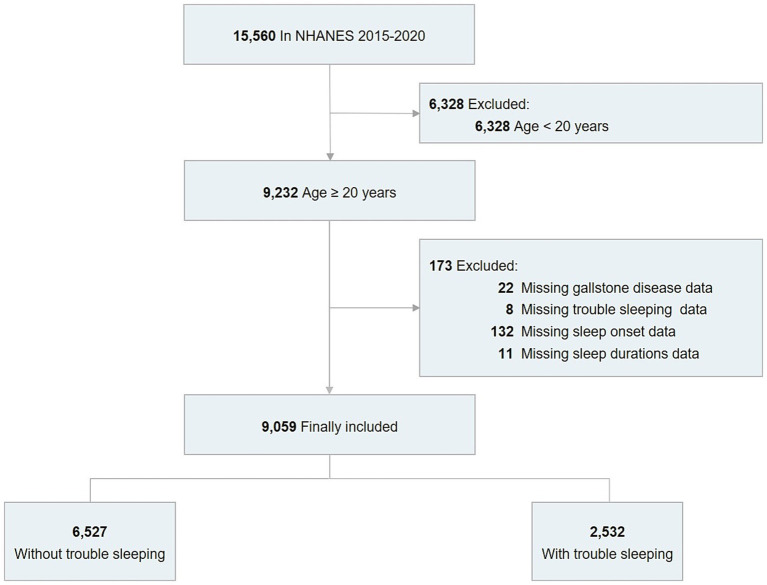
We analyzed data from 9,059 participants in the NHANES survey (2017-2020). The primary outcome of this study was gallstone disease. Sleep disturbances included trouble sleeping, early or late sleep onset time, and long or short sleep duration. Multivariate logistic regression analysis was employed to evaluate the associations between sleep disturbances and gallstone disease risk.
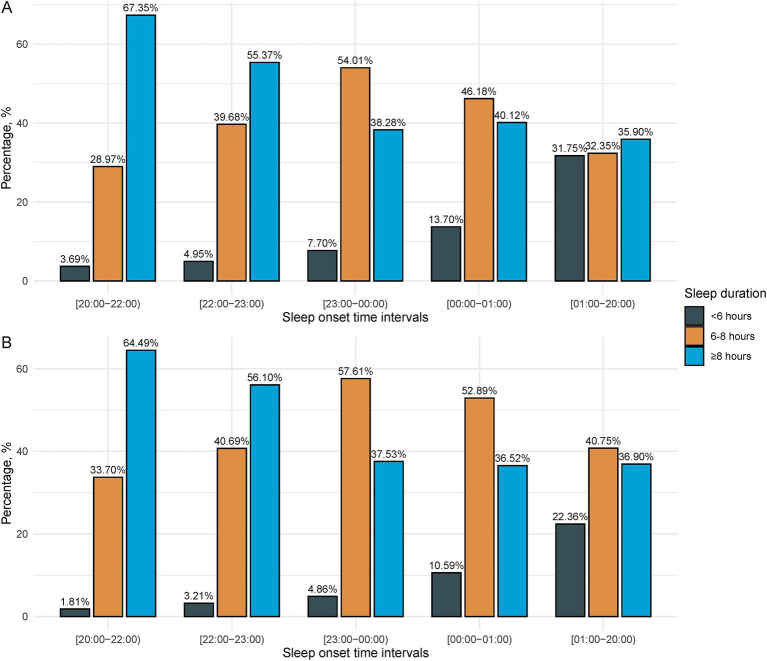
After adjusting for confounding factors, trouble sleeping was associated with an elevated risk of gallstone disease, with the odds ratio (OR) of 1.47 (95% confidence interval [CI]: 1.01-2.15), compared to those without trouble sleeping. In further stratified analysis, among individuals with trouble sleeping, no significant associations were found between different sleep onset intervals, sleep duration and gallstone disease risk. Among participants without trouble sleeping, the sleep onset interval of 23:00 to 00:00 was associated with a significantly increased gallstone disease risk compared to the reference sleep onset interval of 22:00-23:00, with an OR of 1.61 (95% CI: 1.06-2.45). Short sleep duration (<6 h) was associated with a significantly reduced gallstone disease risk compared to the reference sleep duration of 6-8 h, with the OR of 0.43 (95% CI: 0.25-0.75).
This study demonstrates that trouble sleeping increases the risk of gallstone formation, independent of sleep onset time and sleep duration. Among those without trouble sleeping, a sleep onset time between 23:00-00:00 is associated with a higher risk, while short sleep duration (< 6 h) appears protective.
睡眠障碍在胆结石疾病风险中的作用仍不明确。我们旨在研究睡眠障碍与胆结石疾病风险之间的关联。
我们分析了美国国家健康与营养检查调查(2017 - 2020年)中9059名参与者的数据。本研究的主要结局是胆结石疾病。睡眠障碍包括入睡困难、入睡时间过早或过晚以及睡眠时间过长或过短。采用多因素逻辑回归分析来评估睡眠障碍与胆结石疾病风险之间的关联。
在调整混杂因素后,与没有入睡困难的人相比,入睡困难与胆结石疾病风险升高相关,比值比(OR)为1.47(95%置信区间[CI]:1.01 - 2.15)。在进一步的分层分析中,在入睡困难的个体中,不同的入睡间隔、睡眠时间与胆结石疾病风险之间未发现显著关联。在没有入睡困难的参与者中,与参考入睡间隔22:00 - 23:00相比,入睡间隔为23:00至00:00与胆结石疾病风险显著增加相关,OR为1.61(95%CI:1.06 - 2.45)。与参考睡眠时间6 - 8小时相比,短睡眠时间(<6小时)与胆结石疾病风险显著降低相关,OR为0.43(95%CI:0.25 - 0.75)。
本研究表明,入睡困难会增加胆结石形成的风险,且独立于入睡时间和睡眠时间。在没有入睡困难的人群中,入睡时间在23:00 - 00:00之间与较高风险相关,而短睡眠时间(<6小时)似乎具有保护作用。