
林下灌木多样性:对于促进森林生产力而言,与上层树木多样性同等重要。
Understory shrub diversity: equally vital as overstory tree diversity to promote forest productivity.
作者信息
Chen Chen, Yan Guoyong, Schmid Bernhard, Li Yi, Bongers Franca J, Bruelheide Helge, Huang Yuanyuan, Li Shan, von Oheimb Goddert, Tang Ting, Verheyen Kris, Yang Bo, Ma Keping, Liu Xiaojuan
机构信息
State Key Laboratory of Forage Breeding-by-Design and Utilization, Key Laboratory of Vegetation and Environmental Change, Institute of Botany, Chinese Academy of Sciences, Beijing 100093, China.
China National Botanical Garden, Beijing 100093, China.
出版信息
Natl Sci Rev. 2025 Mar 13;12(7):nwaf093. doi: 10.1093/nsr/nwaf093. eCollection 2025 Jul.
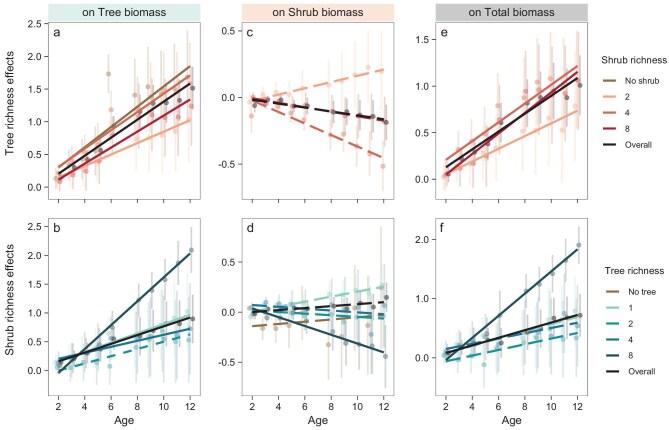
Biodiversity-ecosystem functioning relationships have been extensively studied, particularly within the primary layers of producers in terrestrial ecosystems. In multilayer ecosystems such as forests, the contribution of diversity in the secondary layer, i.e. shrubs, to ecosystem functioning is still largely unknown. Here we used 11-year growth data from a forest biodiversity experiment with factorially crossed manipulations of tree and shrub species richness to assess their effects on forest productivity. We found that shrub species richness had positive effects on tree and total woody biomass (sum of tree and shrub biomass), with effect sizes similar in magnitude to those of tree species richness: increasing tree or shrub species richness from two to eight promoted tree biomass by 73.1% or 53.9% and total woody biomass by 46.7% or 37.1%, respectively. The positive effects of tree or shrub species richness on tree and total woody biomass became larger over time. Shrub biomass was reduced by tree species richness. The effects of tree and shrub species richness can be partially explained by their increased functional diversity. Our study provides the first evidence that understory diversity can significantly increase forest productivity and should not be neglected in forest restoration to promote ecosystem functioning.
生物多样性与生态系统功能的关系已得到广泛研究,尤其是在陆地生态系统生产者的初级层次内。在森林等多层生态系统中,第二层(即灌木层)的多样性对生态系统功能的贡献仍很大程度上未知。在此,我们利用一项森林生物多样性实验的11年生长数据,该实验对树木和灌木物种丰富度进行了析因交叉操纵,以评估它们对森林生产力的影响。我们发现,灌木物种丰富度对树木和总木质生物量(树木和灌木生物量之和)有积极影响,效应大小与树木物种丰富度的效应大小相似:将树木或灌木物种丰富度从2种增加到8种,分别使树木生物量提高73.1%或53.9%,总木质生物量提高46.7%或37.1%。树木或灌木物种丰富度对树木和总木质生物量的积极影响随时间推移而增大。树木物种丰富度会降低灌木生物量。树木和灌木物种丰富度的影响可部分由其功能多样性增加来解释。我们的研究提供了首个证据,表明林下多样性可显著提高森林生产力,在促进生态系统功能的森林恢复中不应被忽视。


 Zotero 插件