Zhang Jianfeng, Cao Guilian, Li Feng, Tang Siyu, Wu Chenxi, Jiang Min, Ye Jingxin, Ju Shaoqing, Qian Fei, Ding Weifeng
Department of Laboratory Medicine; Department of Gastroenterology, Affiliated Hospital of Nantong University, Medical School of Nantong University, Nantong, Jiangsu Province, China.
Department of Laboratory Medicine, The Third People's Hospital of Changzhou, Changzhou, Jiangsu Province, China.
Cell Death Dis. 2025 Jul 9;16(1):506. doi: 10.1038/s41419-025-07820-9.
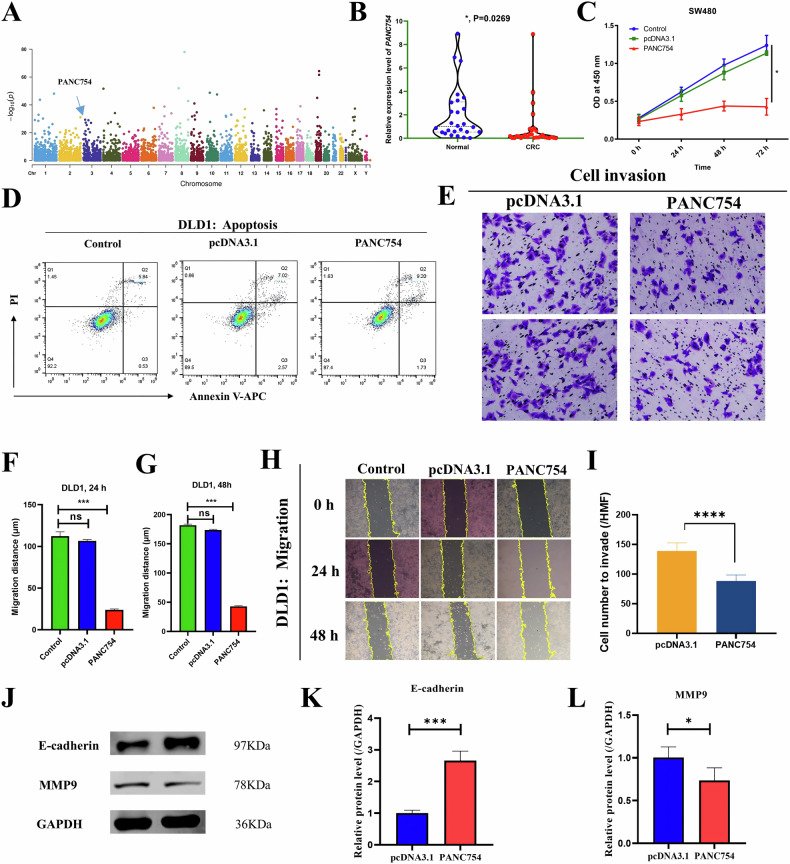
Non-coding RNAs (ncRNAs) have important regulatory functions similar to traditional oncogenes or tumor suppressor genes. Our previous research found a novel pan-cancer downexpressed ncRNA, PANC754. However, its function and underlying mechanism remain obscure in colorectal cancer (CRC). In this study, in vitro and in vivo experiments were performed to determine the function of PANC754. Loss and gain of function experiments, molecular docking experiments, and bioinformatic analysis were utilized to visualize its pathway. Co-culture system was leveraged to explore its effect on synergetic immune checkpoint blockage against CRC. Through a series of studies, we found that overexpressed PANC754 significantly inhibited cell viability, migration, and metastasis and induced notable apoptosis in CRC. The mechanical research found that PANC754 was the nuclear-located and its expression was regulated by mA modification via METTL3 enzyme, which bound with its RBP PSPC1, then interacted with H3K4me1 to chromatin-accessible inhibit immune evasive molecule LGALS7 and led to suppress CRC progress. Furthermore, we confirmed that prominent upregulation of the immune checkpoint inhibitory (ICI) capability of anti-NKG2A, monalizumab when it was combined with PANC754 overexpression. Collectively, our study revealed that PANC754 is a tumor-suppressing ncRNA to form an ncRNA/RBP/histone repression complex with mA-dependence, which can enhance the immune therapeutics effect of ICI, suggesting a promising therapeutic target. PANC754 is a novel pan-tumor suppressing non-coding RNA which is m6A-dependent and regulated by METTL3 modification enzyme. PANC754 is located at cellular nuclear and interacts with its RNA binding protein (RBP) PSPC1 and chromatin accessible histone H3K4me1, then can enhance immunotherapy capability of ICB anti-NKG2A against colorectal cancer through the immune evasive molecule LGALS7 signaling. Effect is that novel nuclear PANC754/PSPC1/H3K4me1 repression complex down-regulates the level "Don't eat me" signal LGALS7 to improve the immune efficiency of ICB and induce NK or CTL cell to release perforin and cytokine to kill tumor cells. (Created by Figdraw).
非编码RNA(ncRNAs)具有与传统癌基因或肿瘤抑制基因相似的重要调控功能。我们之前的研究发现了一种新的泛癌下调ncRNA,即PANC754。然而,其在结直肠癌(CRC)中的功能及潜在机制仍不清楚。在本研究中,我们进行了体外和体内实验以确定PANC754的功能。利用功能缺失和获得实验、分子对接实验及生物信息学分析来阐明其作用途径。借助共培养系统探究其对协同免疫检查点阻断治疗CRC的影响。通过一系列研究,我们发现过表达PANC754可显著抑制CRC细胞的活力、迁移和转移,并诱导明显的细胞凋亡。机制研究发现,PANC754定位于细胞核,其表达受METTL3酶介导的m⁶A修饰调控,该酶与RNA结合蛋白(RBP)PSPC1结合,进而与染色质可及的H3K4me1相互作用,抑制免疫逃逸分子LGALS7,从而抑制CRC进展。此外,我们证实当抗NKG2A单克隆抗体与PANC754过表达联合时,其免疫检查点抑制(ICI)能力显著上调。总的来说,我们的研究表明PANC754是一种肿瘤抑制性ncRNA,可形成依赖m⁶A的ncRNA/RBP/组蛋白抑制复合物,增强ICI的免疫治疗效果,提示其为一个有前景的治疗靶点。PANC754是一种新的泛肿瘤抑制性非编码RNA,依赖m⁶A并受METTL3修饰酶调控。PANC754定位于细胞核,与RNA结合蛋白(RBP)PSPC1及染色质可及的组蛋白H3K4me1相互作用,进而通过免疫逃逸分子LGALS7信号增强ICB抗NKG2A对结直肠癌的免疫治疗能力。作用机制是新的核内PANC754/PSPC1/H3K4me1抑制复合物下调“别吃我”信号LGALS7水平,提高ICB免疫效率,诱导NK或CTL细胞释放穿孔素和细胞因子以杀伤肿瘤细胞。(由Figdraw创建)