Burke Isabelle J M, Chesser Courtney, Brown Christopher P K, Watkins Rachel, Butterworth Peter, Olofsson Jonas K, Laver Kate, Hampstead Benjamin M, Bahar-Fuchs Alex
School of Psychology, Faculty of Health Deakin University Burwood Victoria Australia.
Perception and Psychotropics, Department of Psychology, Faculty of Social Sciences Stockholm University Stockholm Sweden.
Alzheimers Dement (N Y). 2025 Jul 9;11(3):e70120. doi: 10.1002/trc2.70120. eCollection 2025 Jul-Sep.
Olfactory-based cognitive training may be of benefit to individuals at risk of dementia given the strong association between olfactory impairment and cognitive decline. The Mind Your Nose (MYN) trial compared an olfactory-based memory training protocol (OMT) to a visually-based memory training protocol (VMT) among older adults with subjective cognitive decline.
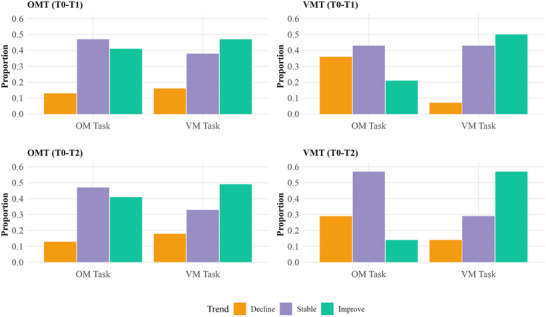
Participants ( = 53; 17 males; M= 72.77, standard deviation [SD] = 6.12) were randomly assigned in a 2:1 ratio to daily OMT ( = 36) or VMT ( = 17) intervention for 20 days. Outcomes were evaluated at baseline (T0), post-intervention (T1), and 1-month follow-up (T2) and included standardized measures of global olfaction (Sniffin' Sticks) and cognition (National Institutes of Health Toolbox), as well as performance on the olfactory memory (OM) and the visual memory (VM) tasks, and measures of mood and meta-cognition.
A significant interaction was found between treatment allocation, time, and modality of memory task at T1(β = -37.50, = 0.008) and T2(β = -28.75, = 0.041). Post-hoc comparisons revealed improvement in trained tasks; OMT led to improvement on the OM task (T1; = 0.71, = 0.036; T2; = 0.72, = 0.035), and VMT led to improvement on the VM task (T1; = 1.22, = 0.011; T2; = 1.29, = 0.006). Improvement on the untrained memory task only occurred in OMT (VM task, T1; g = 0.63, = 0.071; T2; = 0.74, = 0.033). No interaction between treatment allocation and time was observed post intervention or at follow-up for global olfactory ability (T1; β = 0.27, = 0.871; T2; β = -1.27, = 0.296).
Consistent with previous research, transfer gains from the OMT condition to an untrained VM task suggest that olfaction may contribute to a-modal representations of memory. We argue that memory-based olfactory training offers a new frontier for cognitive interventions among those at risk of dementia.
Relatively few cognitive training programs engage the olfactory sense.Olfactory memory training offers a new frontier of cognitive training for older adults.Olfaction may contribute to improved performance on trained and untrained tasks.The functional impact of olfactory training should be further explored.
鉴于嗅觉障碍与认知衰退之间存在密切关联,基于嗅觉的认知训练可能对有患痴呆症风险的个体有益。“关注你的鼻子”(MYN)试验在有主观认知衰退的老年人中,将基于嗅觉的记忆训练方案(OMT)与基于视觉的记忆训练方案(VMT)进行了比较。
参与者(n = 53;17名男性;M = 72.77,标准差[SD] = 6.12)以2:1的比例被随机分配到每日OMT组(n = 36)或VMT组(n = 17),进行为期20天的干预。在基线(T0)、干预后(T1)和1个月随访(T2)时评估结果,包括嗅觉整体(Sniffin' Sticks)和认知(美国国立卫生研究院工具箱)的标准化测量,以及嗅觉记忆(OM)和视觉记忆(VM)任务的表现,还有情绪和元认知测量。
在T1(β = -37.50,p = 0.008)和T2(β = -28.75,p = 0.041)时,发现治疗分配、时间和记忆任务模式之间存在显著交互作用。事后比较显示训练任务有改善;OMT导致OM任务改善(T1;g = 0.71,p = 0.036;T2;g = 0.72,p = 0.035),VMT导致VM任务改善(T1;g = 1.22,p = 0.011;T2;g = 1.29,p = 0.006)。未训练的记忆任务的改善仅出现在OMT中(VM任务,T1;g = 0.63,p = 0.071;T2;g = 0.74,p = 0.033)。干预后或随访时,未观察到治疗分配和时间之间在嗅觉整体能力方面的交互作用(T1;β = 0.27,p = 0.871;T2;β = -1.27,p = 0.296)。
与先前研究一致,从OMT条件到未训练的VM任务的迁移增益表明嗅觉可能有助于记忆的跨模态表征。我们认为基于记忆的嗅觉训练为有患痴呆症风险的人群的认知干预提供了一个新领域。
相对较少的认知训练项目涉及嗅觉。嗅觉记忆训练为老年人的认知训练提供了一个新领域。嗅觉可能有助于提高训练和未训练任务的表现。嗅觉训练的功能影响应进一步探索。