Hagen Andrew C, Whittier Tyler T, Stephens Jaclyn A, Fling Brett W
Department of Health and Exercise Science, Colorado State University, Fort Collins, CO 80523, USA.
Department of Food Systems, Nutrition and Kinesiology, Montana State University, Bozeman, MT 59717, USA.
Brain Commun. 2025 Jun 25;7(4):fcaf255. doi: 10.1093/braincomms/fcaf255. eCollection 2025.
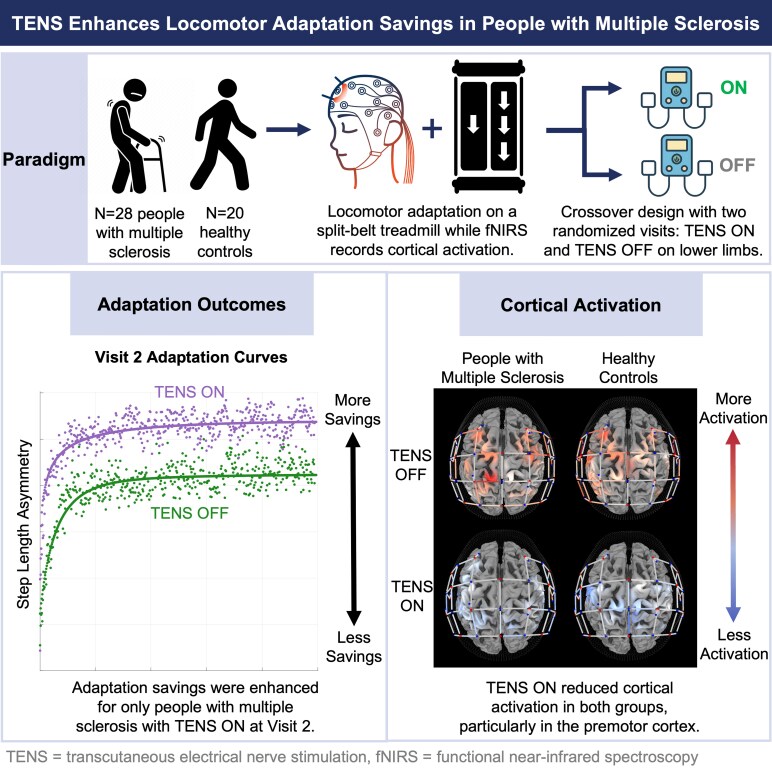
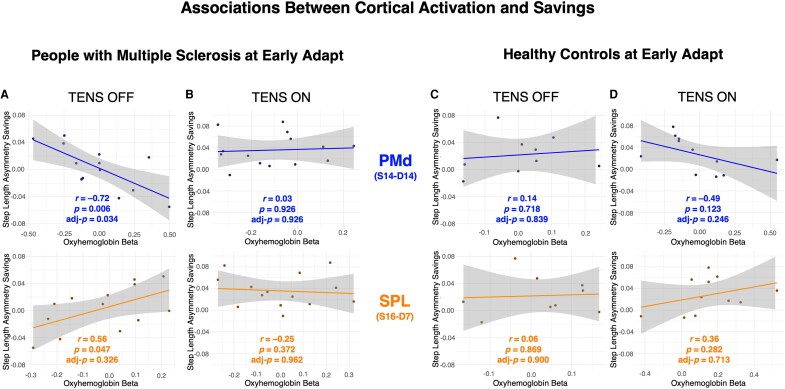
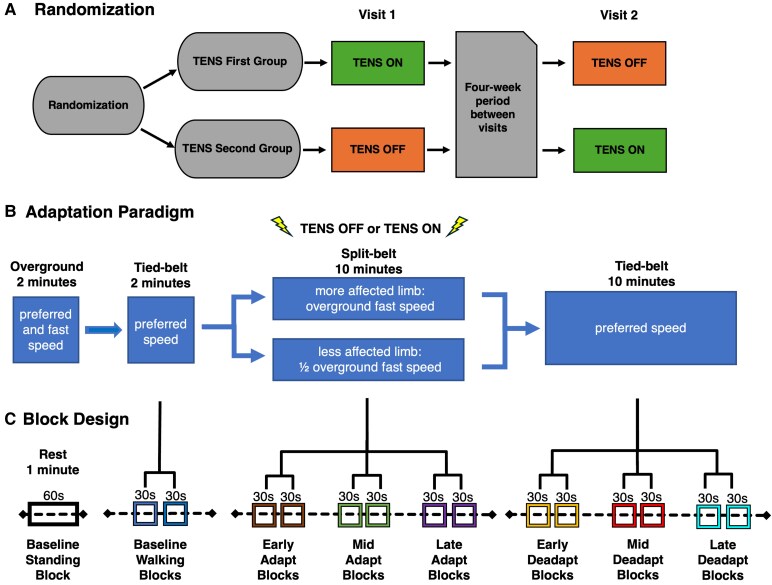
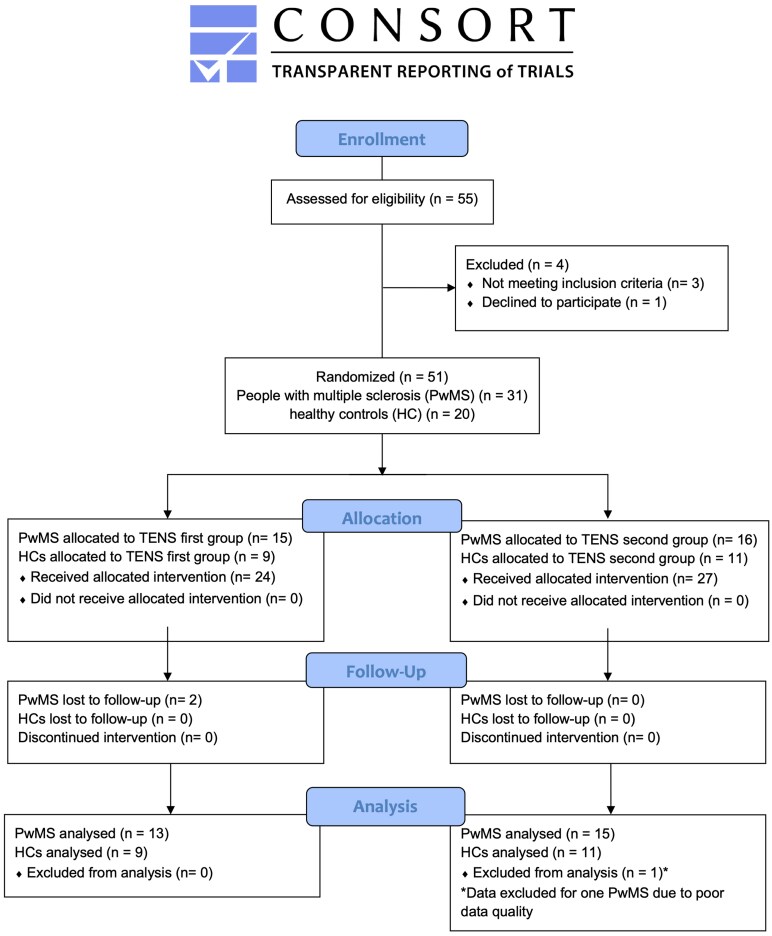
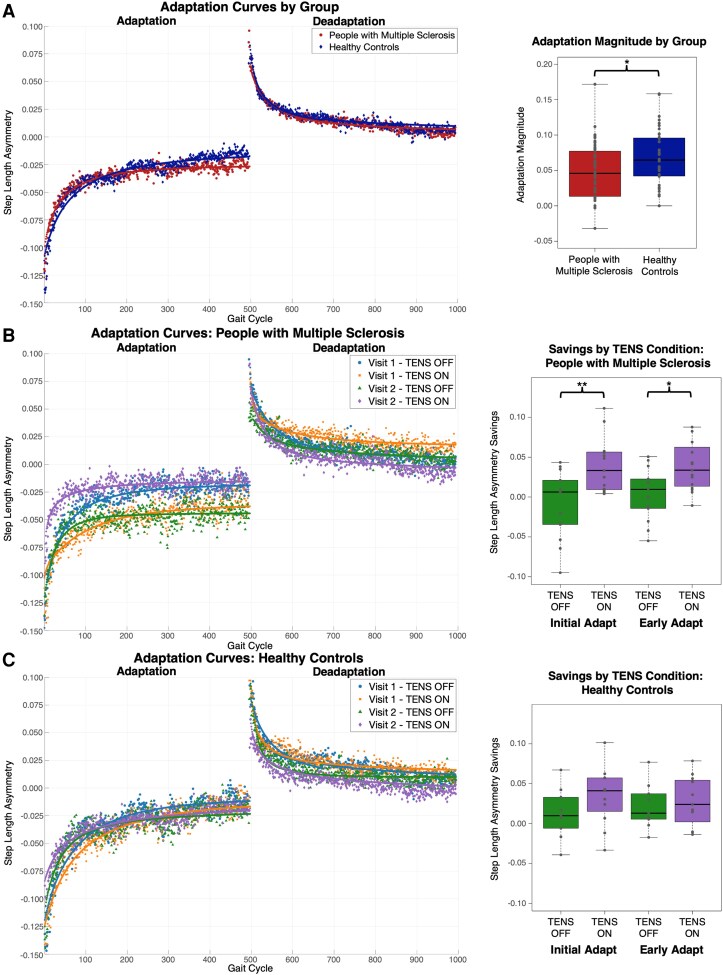
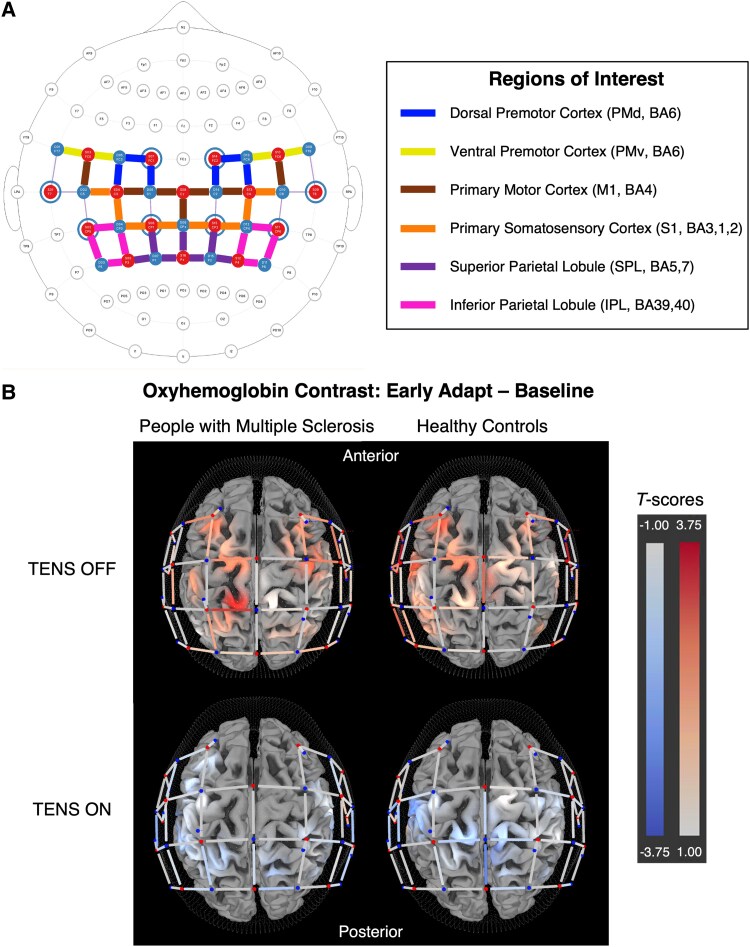
Locomotor adaptation on a split-belt treadmill can improve gait symmetry across various clinical populations, including people with multiple sclerosis (PwMS). As many PwMS experience sensory impairments, mobility interventions relying on sensory prediction errors may be less effective. Transcutaneous electrical nerve stimulation (TENS) has been shown to amplify sensorimotor function in PwMS and healthy controls, but its influence on motor learning remains unexplored. This randomized crossover trial investigated the effects of TENS on locomotor adaptation and cortical activation in PwMS. In total, 28 PwMS and 20 age- and sex-matched healthy controls completed two locomotor adaptation sessions, one with active TENS and one with inactive TENS. Locomotor adaptation was evaluated using step length asymmetry, quantified across four outcome metrics: adaptation magnitude, early change, after-effect and savings. Functional near-infrared spectroscopy recorded cortical activation, and linear mixed-effect models assessed group, visit and TENS condition effects on behavioural and cortical activation outcomes. PwMS exhibited reduced adaptation magnitude compared with healthy controls. TENS did not influence early change (representing adaptation rate) but significantly improved adaptation savings for PwMS who received TENS during their second visit only (initial savings: adj- = 0.005, = 1.35; early savings: adj- = 0.014, = 1.13). Additionally, both PwMS and healthy controls exhibited decreased cortical activation during locomotor adaptation with TENS, particularly in the dorsal premotor cortex for PwMS (adj- = 0.019, = 0.84). These findings indicate that TENS promotes the retention of prior locomotor adaptation, enhancing the efficiency of relearning. Additionally, reduced cortical activation with TENS in both groups indicates reduced cortical reliance during adaptation. Together, these effects suggest that TENS could have broader utility for enhancing motor learning in populations with sensory impairments, potentially leading to amplified retention and automaticity during motor rehabilitation paradigms.
在分带式跑步机上进行运动适应可改善包括多发性硬化症患者(PwMS)在内的各种临床人群的步态对称性。由于许多PwMS患者存在感觉障碍,依赖感觉预测误差的运动干预可能效果较差。经皮电刺激神经(TENS)已被证明可增强PwMS患者和健康对照者的感觉运动功能,但其对运动学习的影响仍未得到探索。这项随机交叉试验研究了TENS对PwMS患者运动适应和皮层激活的影响。共有28名PwMS患者和20名年龄及性别匹配的健康对照者完成了两次运动适应训练,一次是在TENS激活状态下,一次是在TENS非激活状态下。使用步长不对称性评估运动适应情况,通过四个结果指标进行量化:适应幅度、早期变化、后效应和节省量。功能近红外光谱记录皮层激活情况,线性混合效应模型评估组、访视和TENS状态对行为和皮层激活结果的影响。与健康对照者相比,PwMS患者的适应幅度降低。TENS对早期变化(代表适应率)没有影响,但仅在第二次访视时接受TENS的PwMS患者中显著改善了适应节省量(初始节省量:调整后p = 0.005,β = 1.35;早期节省量:调整后p = 0.014,β = 1.13)。此外,PwMS患者和健康对照者在TENS状态下进行运动适应时均表现出皮层激活减少,尤其是PwMS患者的背侧运动前皮层(调整后p = 0.019,β = 0.84)。这些发现表明,TENS促进了先前运动适应的保留,提高了再学习的效率。此外,两组在TENS状态下皮层激活减少表明在适应过程中皮层依赖性降低。总之,这些效应表明TENS在增强感觉障碍人群的运动学习方面可能具有更广泛的应用,可能会在运动康复模式中导致更大的保留和自动化。