Ghate Manisha, Rekhadevi Kangjam, Sen Abhik, Sharma Saurabh, Shidhaye Pallavi, Nair Saritha, Kumar Ashish, Jayesh Pournami, Patil Sandip, Gurav Shraddha, Aggarwal Sumit
National AIDS Research Institute, Pune, India.
Regional Medical Research Centre (ICMR), Dibrugarh, India.
Front Public Health. 2025 Jun 25;13:1513419. doi: 10.3389/fpubh.2025.1513419. eCollection 2025.
It is well recognized that parents play a central role in making decisions for their children. Understanding willingness of parents to vaccinate their children against COVID-19 is important as it helps to develop effective strategies for maximizing vaccination coverage. We aimed to evaluate parental acceptance regarding COVID-19 vaccination for children between 6 and 12 years of age in India.
A mixed-method study (March-September 2023) employed a structured questionnaire and in-depth interviews with parents of school-going and non-school-going children across five purposively selected Indian states. Multistage random sampling was used for districts, schools, and students, while convenience sampling was applied for qualitative data. Multivariable logistic regression assessed factors influencing parental acceptance of COVID-19 vaccination, and qualitative analysis identified barriers and facilitators.
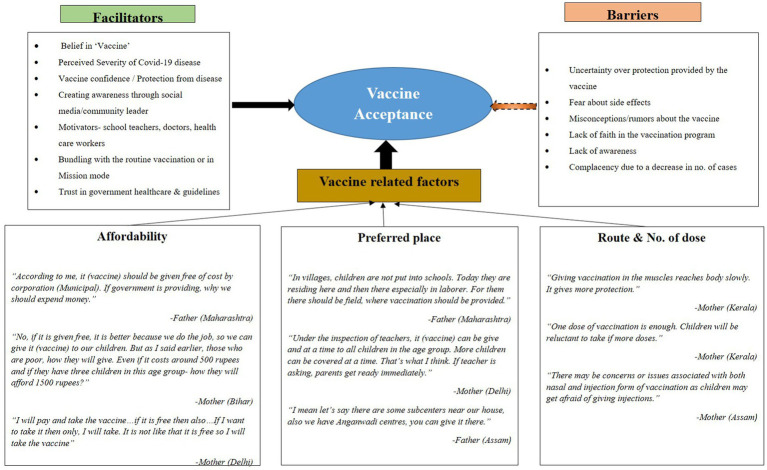
A total of 2017 parents participated in the study. The overall parental acceptance to vaccinate their children against COVID-19 was 76.4%. Multivariate logistic regression analysis showed that parents who were literate ( = 0.004), not vaccinated against COVID-19 ( = 0.012), had less than or equal to four family members ( < 0.001) and a history of COVID-19 infection in the family ( = 0.036) were less likely to accept the COVID-19 vaccine for their children. Key barriers to vaccination included uncertainty over the protection provided by the vaccine, fear about side effects, and misconceptions about the vaccine whereas belief in the vaccine, perceived severity of COVID-19 disease, and bundling with routine vaccination were the key facilitators.
These findings highlight the importance of increasing adult COVID-19 vaccination. Developing policies focusing on parents with higher literacy, staying in smaller families, and previous COVID-19 infection among family members will help to increase the vaccine uptake among children. Interventions for the integration of these vaccines with routine immunization or availability at schools may help in increasing COVID-19 vaccine acceptance.
众所周知,父母在为子女做决定方面起着核心作用。了解父母为其子女接种新冠疫苗的意愿很重要,因为这有助于制定有效策略以最大限度提高疫苗接种覆盖率。我们旨在评估印度6至12岁儿童的父母对新冠疫苗接种的接受情况。
一项混合方法研究(2023年3月至9月)采用结构化问卷,并对印度五个有目的地选定邦的学龄儿童和非学龄儿童的父母进行深入访谈。对地区、学校和学生采用多阶段随机抽样,而定性数据采用便利抽样。多变量逻辑回归评估影响父母对新冠疫苗接种接受度的因素,定性分析确定障碍和促进因素。
共有2017名父母参与了该研究。父母总体上愿意为其子女接种新冠疫苗的比例为76.4%。多变量逻辑回归分析表明,识字的父母(=0.004)、未接种新冠疫苗的父母(=0.012)、家庭成员少于或等于四人的父母(<0.001)以及家庭中有新冠感染病史的父母(=0.036)为其子女接种新冠疫苗的可能性较小。疫苗接种的主要障碍包括对疫苗提供的保护存在不确定性、对副作用的恐惧以及对疫苗的误解,而对疫苗的信任、对新冠疾病严重程度的认知以及与常规疫苗接种捆绑则是主要促进因素。
这些发现凸显了提高成人新冠疫苗接种率的重要性。制定针对识字率较高、家庭规模较小以及家庭成员曾感染新冠的父母的政策,将有助于提高儿童的疫苗接种率。将这些疫苗与常规免疫整合或在学校提供的干预措施可能有助于提高对新冠疫苗的接受度。