Hsu Shih-Ping, Chien Chiang-Ting
Department of Internal Medicine, Far Eastern Memorial Hospital, New Taipei, Taiwan.
School of Life Science, National Taiwan Normal University, Taipei, Taiwan.
Ren Fail. 2025 Dec;47(1):2522975. doi: 10.1080/0886022X.2025.2522975. Epub 2025 Jul 10.
Renal recovery after acute kidney injury (AKI) significantly improves outcomes. This cohort study explored the efficacy of six urinary biomarkers and the spot urine creatinine-to-osmolality ratio (sUCr/Osm) in predicting renal recovery 3 months after in-hospital AKI.
Data from the Assessment, Serial Evaluation, and Subsequent Sequelae of Acute Kidney Injury study, involving 744 patients with in-hospital AKI, were analyzed. The urinary biomarker with the highest area under the receiver operating characteristic curve (AUC) was selected as the representative for comparison. Renal recovery was defined as an absolute increase of <26.5 μmol/L or a relative elevation of <20% from the baseline serum creatinine (SCr) level at three months postdiagnosis.
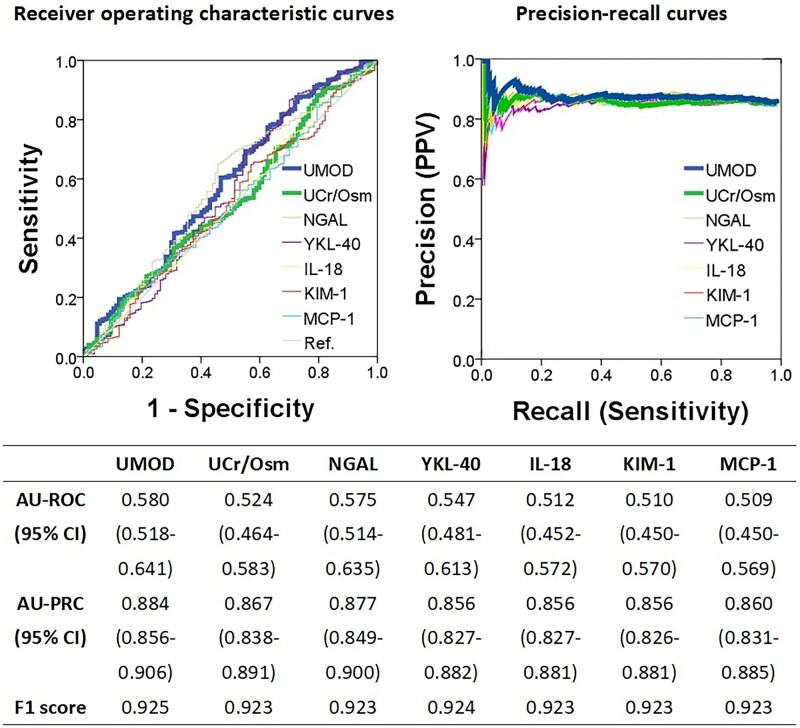
Among the 744 patients, 85.6% achieved renal recovery. Uromodulin demonstrated a greater AUC of 0.580 (95% CI: 0.518-0.641) than the other five biomarkers did. With a cutoff of 1,360 ng/mL, uromodulin sensitivity was 0.774 (95% CI: 0.741-0.806). The sUCr/Osm test exhibited high sensitivity (0.881; 95% CI: 0.856-0.906) with a cutoff of 8.84 (sUCr/Osm8.84) and high specificity (0.785; 95% CI: 0.707-0.863) with a cutoff of 21.22 (sUCr/Osm21.22). The positive predictive values of the three methods were approximately 0.880. The performance of these tests in predicting renal recovery based on both criteria in 298 patients with chronic kidney disease was also comparable.
Urinary biomarkers, especially uromodulin, and the sUCr/Osm test may be effective in predicting renal recovery three months after in-hospital AKI. The sUCr/Osm test may offer a more accessible approach for routine use, with sUCr/Osm8.84 demonstrating high sensitivity for screening and sUCr/Osm21.22 exhibiting high specificity for further discrimination.
急性肾损伤(AKI)后的肾脏恢复可显著改善预后。这项队列研究探讨了六种尿液生物标志物及随机尿肌酐与渗透压比值(sUCr/Osm)对预测住院期间发生AKI后3个月肾脏恢复情况的有效性。
分析了急性肾损伤评估、系列评估及后续后遗症研究中的数据,该研究纳入了744例住院AKI患者。选择受试者工作特征曲线(AUC)下面积最大的尿液生物标志物作为代表进行比较。肾脏恢复定义为诊断后3个月时血清肌酐(SCr)水平较基线水平的绝对增加值<26.5μmol/L或相对升高<20%。
744例患者中,85.6%实现了肾脏恢复。尿调节蛋白的AUC为0.580(95%CI:0.518 - 0.641),高于其他五种生物标志物。尿调节蛋白的临界值为1360 ng/mL时,敏感性为0.774(95%CI:0.741 - 0.806)。sUCr/Osm检测临界值为8.84(sUCr/Osm8.84)时敏感性高(0.881;95%CI:0.856 - 0.906),临界值为21.22(sUCr/Osm21.22)时特异性高(0.785;95%CI:0.707 - 0.863)。三种方法的阳性预测值约为0.880。在298例慢性肾脏病患者中,这些检测方法基于两种标准预测肾脏恢复情况的表现也具有可比性。
尿液生物标志物,尤其是尿调节蛋白,以及sUCr/Osm检测可能有助于预测住院期间发生AKI后3个月的肾脏恢复情况。sUCr/Osm检测可能为常规应用提供更便捷的方法,sUCr/Osm8.84对筛查具有高敏感性,sUCr/Osm21.22对进一步鉴别具有高特异性。