Nguyen Angie, Ustick Lucas J, Larkin Alyse A, Martiny Adam C
Department of Biological Chemistry, University of California Irvine School of Medicine, Irvine, California, USA.
Department of Ecology and Evolutionary Biology, University of California Irvine, Irvine, California, USA.
mSphere. 2025 Jul 29;10(7):e0024525. doi: 10.1128/msphere.00245-25. Epub 2025 Jul 11.
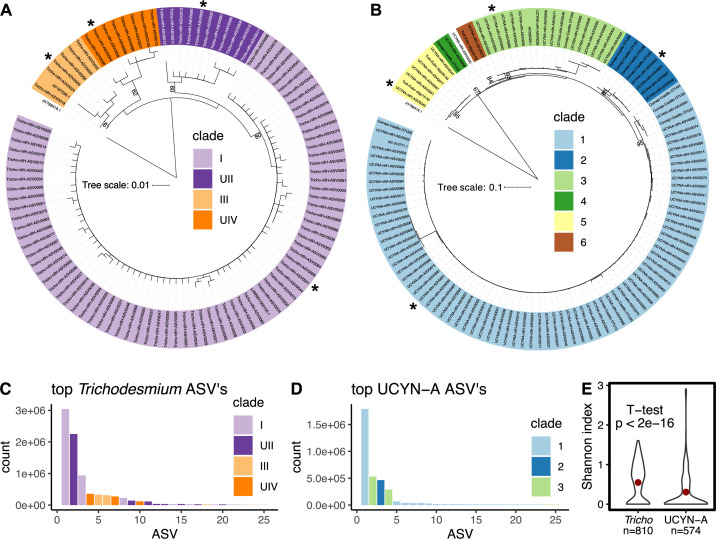
Photoautotrophic diazotrophs, specifically the genera and UCYN-A, play a pivotal role in marine nitrogen cycling through their capacity for nitrogen fixation. Despite their global distribution, the microdiversity and environmental drivers of these diazotrophs remain underexplored. This study provides a comprehensive analysis of the global diversity and distribution of and UCYN-A using the nitrogenase gene () as a genetic marker. We sequenced 954 samples from the Pacific, Atlantic, and Indian Oceans as part of the Bio-GO-SHIP project. Our results reveal significant phylogenetic and biogeographic differences between and within the two genera. exhibited greater microdiversity compared to UCYN-A, with clades showing region-specific distribution. clades were primarily influenced by temperature and nutrient availability. They were particularly frequent in regions of phosphorus stress. In contrast, UCYN-A was most frequently observed in regions experiencing iron stress. UCYN-A clades demonstrated more homogeneous distributions, with a single sequence variant within the UCYN-A1 clade dominating across varied environments. The biogeographic patterns and environmental correlations of and UCYN-A highlight the role of microdiversity in their ecological adaptation and reflect their different ecological strategies. These findings underscore the importance of characterizing the global patterns of fine-scale genetic diversity to better understand the functional roles and distribution of marine nitrogen-fixing photoautotrophs.IMPORTANCEThis study provides insights into the global diversity and distribution of nitrogen-fixing photoautotrophs, specifically and UCYN-A. We sequenced 954 oceanic samples of the nitrogenase gene and uncovered significant differences in microdiversity and environmental associations between these genera. showed high levels of sequence diversity and region-specific clades influenced by temperature and nutrient availability. In contrast, UCYN-A exhibited a more uniform distribution, thriving in iron-stressed regions. Quantifying these fine-scale genetic variations enhances our knowledge of their ecological roles and adaptations, emphasizing the need to characterize the genetic diversity of marine nitrogen-fixing prokaryotes.
光合自养固氮生物,特别是 属和UCYN - A属,通过其固氮能力在海洋氮循环中发挥着关键作用。尽管它们分布于全球,但这些固氮生物的微观多样性和环境驱动因素仍未得到充分探索。本研究以固氮酶基因( )作为遗传标记,对 属和UCYN - A属的全球多样性和分布进行了全面分析。作为生物地球化学海洋学全球观测研究计划(Bio - GO - SHIP)项目的一部分,我们对来自太平洋、大西洋和印度洋的954个样本进行了测序。我们的结果揭示了这两个属之间以及属内存在显著的系统发育和生物地理差异。与UCYN - A相比, 表现出更大的微观多样性,其分支显示出区域特异性分布。 分支主要受温度和养分可用性的影响。它们在磷胁迫区域尤为常见。相比之下,UCYN - A在铁胁迫区域最为常见。UCYN - A分支显示出更均匀的分布,UCYN - A1分支内的单个序列变体在不同环境中占主导地位。 和UCYN - A的生物地理模式及与环境的相关性突出了微观多样性在其生态适应中的作用,并反映了它们不同的生态策略。这些发现强调了表征精细尺度遗传多样性的全球模式对于更好地理解海洋光合自养固氮生物的功能作用和分布的重要性。
重要性
本研究深入探讨了光合自养固氮生物,特别是 和UCYN - A的全球多样性和分布。我们对954个海洋样本的固氮酶基因进行了测序,发现这些属之间在微观多样性和与环境的关联方面存在显著差异。 显示出高水平的序列多样性,其区域特异性分支受温度和养分可用性的影响。相比之下,UCYN - A表现出更均匀的分布,在铁胁迫区域繁茂生长。量化这些精细尺度的遗传变异增强了我们对它们生态作用和适应性的认识,强调了表征海洋固氮原核生物遗传多样性的必要性。