Department of Earth System Science, University of California at Irvine, Irvine, CA, USA.
Department of Ecology and Evolutionary Biology, University of California at Irvine, Irvine, CA, USA.
Sci Data. 2021 Apr 16;8(1):107. doi: 10.1038/s41597-021-00889-9.
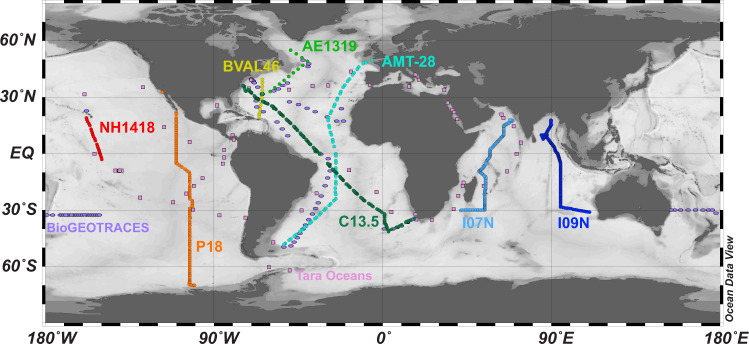
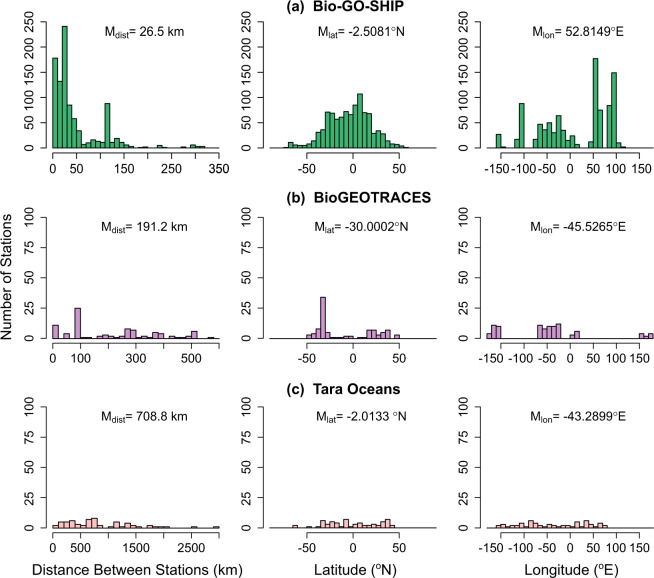
Detailed descriptions of microbial communities have lagged far behind physical and chemical measurements in the marine environment. Here, we present 971 globally distributed surface ocean metagenomes collected at high spatio-temporal resolution. Our low-cost metagenomic sequencing protocol produced 3.65 terabases of data, where the median number of base pairs per sample was 3.41 billion. The median distance between sampling stations was 26 km. The metagenomic libraries described here were collected as a part of a biological initiative for the Global Ocean Ship-based Hydrographic Investigations Program, or "Bio-GO-SHIP." One of the primary aims of GO-SHIP is to produce high spatial and vertical resolution measurements of key state variables to directly quantify climate change impacts on ocean environments. By similarly collecting marine metagenomes at high spatiotemporal resolution, we expect that this dataset will help answer questions about the link between microbial communities and biogeochemical fluxes in a changing ocean.
海洋环境中,微生物群落的详细描述远远落后于物理和化学测量。在这里,我们展示了 971 个分布在全球范围内的海洋表层宏基因组,这些样本是在高时空分辨率下采集的。我们的低成本宏基因组测序方案产生了 36.5 太字节的数据,每个样本的平均碱基对数量为 34.1 亿。采样站之间的平均距离为 26 公里。本文描述的这些宏基因组文库是作为全球海洋船载海洋学调查计划(“Bio-GO-SHIP”)生物计划的一部分收集的。GO-SHIP 的主要目标之一是对关键状态变量进行高时空分辨率的测量,以直接量化气候变化对海洋环境的影响。通过同样以高时空分辨率采集海洋宏基因组,我们期望这个数据集将有助于回答关于变化的海洋中微生物群落与生物地球化学通量之间联系的问题。