Gesell Daniela, Hodiamont Farina, Bausewein Claudia, Grill Eva, Koller Daniela
Institute of Medical Data Processing, Biometrics and Epidemiology (IBE), Faculty of Medicine, LMU Munich, Munich, Germany.
Department of Palliative Medicine, LMU University Hospital, LMU Munich, Munich, Germany.
Res Health Serv Reg. 2025 Jul 11;4(1):8. doi: 10.1007/s43999-025-00070-4.
Demographic change and the increasing prevalence of chronic illnesses lead to a higher demand for palliative care. Currently, little is known about potential need for palliative care at a small-area level in Germany. However, this is crucial for the planning of services. We aimed to calculate the proportion of the population potentially in need of palliative care on a small-area level and to illustrate the nationwide variations.
Retrospective cross-sectional study based on causes of death statistics in Germany. Causes of death of all adult deceased in Germany in 2022 were included. The potential need for palliative care was identified based on Murtagh et al. (2014) using ICD-10-codes. Geographic variation was analyzed on district level.
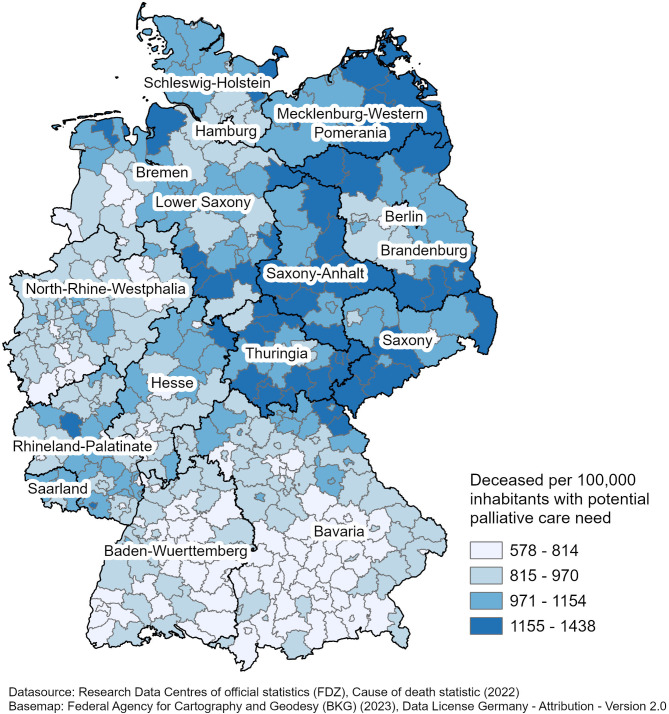
1,062,452 persons were documented in the causes of death statistics, of which 752,643 died with a potential palliative care need (70.8%). Overall mean age was 79.5 years (SD 12.7), 50.1% were female (n = 532,248). Most deaths were due to neoplasms (23,675; 22.6%) and cardiovascular diseases (230,338, 21.7%). The numbers of deceased with potential need per 100,000 inhabitants varied between districts from 578 to 1,438, with highest values in districts in Saxony, Thuringia, Saxony-Anhalt, and lowest in Bavaria and Baden-Wuerttemberg.
Our definition of potential palliative care need included both deaths due to oncological diseases, who commonly receive palliative care, and non-oncological conditions. The findings highlight the regional differences in potential palliative care need on small-area level and the importance of comprehensive healthcare planning adapted to the specific needs of individuals.
人口结构变化和慢性病患病率上升导致对姑息治疗的需求增加。目前,德国小区域层面姑息治疗的潜在需求情况鲜为人知。然而,这对服务规划至关重要。我们旨在计算小区域层面可能需要姑息治疗的人口比例,并说明全国范围内的差异。
基于德国死亡原因统计的回顾性横断面研究。纳入2022年德国所有成年死者的死亡原因。根据莫尔塔格等人(2014年)的研究,使用国际疾病分类第十版(ICD - 10)编码确定姑息治疗的潜在需求。在地区层面分析地理差异。
死亡原因统计记录了1,062,452人,其中752,643人死亡时有姑息治疗的潜在需求(70.8%)。总体平均年龄为79.5岁(标准差12.7),50.1%为女性(n = 532,248)。大多数死亡原因是肿瘤(23,675例;22.6%)和心血管疾病(230,338例,21.7%)。每10万居民中潜在需求死者人数在各地区之间从578到1,438不等,萨克森州、图林根州、萨克森 - 安哈尔特州的地区数值最高,巴伐利亚州和巴登 - 符腾堡州最低。
我们对姑息治疗潜在需求的定义既包括通常接受姑息治疗的肿瘤疾病导致的死亡,也包括非肿瘤疾病情况。研究结果突出了小区域层面姑息治疗潜在需求的地区差异以及根据个体具体需求进行全面医疗规划的重要性。