Giulia Bommarito, Alessandra Griffa, Patrik Michel, Caroline Hall, Paolo Salvioni Chiabotti, Silvia Pistocchi, Yasser Alemán-Gómez, Daniel Damian, Mario Jreige, John O Prior, Vincent Dunet, Olivier Rouaud, Patric Hagmann, Gilles Allali
Leenaards Memory Center, Department of clinical neurosciences, Lausanne University Hospital and University of Lausanne (CHUV-UNIL), chem. de Mont-Paisible, 16, Lausanne, 1011, Switzerland.
Medical Image Processing Laboratory, Neuro-X Institute, École Polytechnique Fédérale De Lausanne (EPFL), Chemin des Mines 9, Geneva, 1202, Switzerland.
Alzheimers Res Ther. 2025 Jul 12;17(1):154. doi: 10.1186/s13195-025-01805-8.
Cerebral small vessel disease (CSVD) is a common co-pathology in patients with dementia with Lewy bodies (DLB) and Alzheimer's disease (AD). A comprehensive characterization of CSVD load in DLB and AD patients referred to a memory center is lacking.
In this retrospective study, we collected data from patients with a clinical DLB diagnosis or clinico-biological AD diagnosis, evaluated at our memory center. They were assessed for CSVD MRI features, including enlarged perivascular spaces (PVS), presence of cerebral amyloid angiopathy (CAA) and hypertensive arteriopathy (HTNA). Differences in CSVD features between AD and DLB and across clinical stages were investigated. Regression models were used to evaluate the association between (i) cerebrovascular risk factors (CVRF) and HTNA, and (ii) CSVD features and cognition as expressed by Montreal Cognitive Assessment (MoCA).
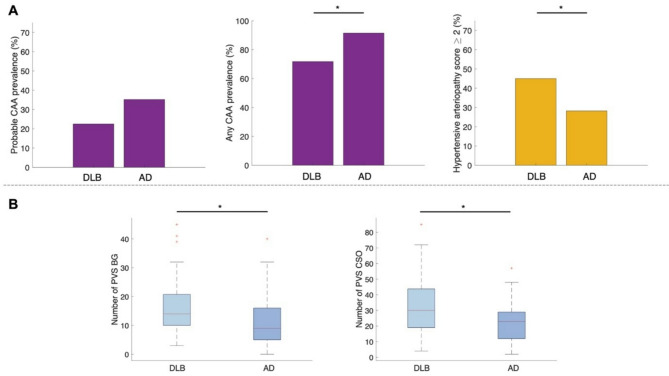
We included 71 DLB (76.8 ± 7.4 years old, 25 females) and 71 age- and sex-matched AD patients (and 75.2 ± 5.3 years old, 27 females). Probable CAA, according to current Boston 2.0 criteria, was observed in 22.5% of DLB and 35.2% of AD patients, while any (probable + possible) CAA rate was higher in the two groups (71.8% and 91.5%, respectively). A moderate/severe HTNA was present in 45% of DLB and 28.2% of AD patients. When comparing the two groups, DLB presented with higher HTNA score (p =.012), while AD patients had higher prevalence of any CAA (p =.002). Patients with DLB had a greater PVS burden in the basal ganglia (p =.011) and centrum semiovale (p =.004) and higher number of deep microbleeds (p =.004). Certain HTNA-related features were more pronounced at dementia stage, with respect to mild cognitive impairment. No association was observed between CVRF and HTNA. Regarding the association between CSVD and cognition, only deep microbleeds count was related to MoCA in DLB patients.
DLB or AD patients present with high CSVD burden and differ in terms of features and subtype. Patients with DLB present with increased HTNA, PVS load and deep microbleeds, while patients with AD present with a higher any CAA prevalence. CSVD might impact global cognition.
脑小血管病(CSVD)是路易体痴呆(DLB)和阿尔茨海默病(AD)患者常见的共同病理改变。目前缺乏对转诊至记忆中心的DLB和AD患者CSVD负荷的全面特征描述。
在这项回顾性研究中,我们收集了在我们记忆中心接受评估的临床诊断为DLB或临床生物学诊断为AD的患者的数据。对他们进行CSVD的MRI特征评估,包括血管周围间隙(PVS)增宽、脑淀粉样血管病(CAA)和高血压性动脉病(HTNA)的存在情况。研究了AD和DLB之间以及不同临床阶段CSVD特征的差异。使用回归模型评估(i)脑血管危险因素(CVRF)与HTNA之间的关联,以及(ii)CSVD特征与蒙特利尔认知评估(MoCA)所表达的认知之间的关联。
我们纳入了71例DLB患者(年龄76.8±7.4岁,女性25例)和71例年龄及性别匹配的AD患者(年龄75.2±5.3岁,女性27例)。根据当前波士顿2.0标准,22.5%的DLB患者和35.2%的AD患者存在可能的CAA,而两组中任何(可能+疑似)CAA的发生率更高(分别为71.8%和91.5%)。45%的DLB患者和28.2%的AD患者存在中度/重度HTNA。比较两组时,DLB患者的HTNA评分更高(p = 0.012),而AD患者中任何CAA的患病率更高(p = 0.002)。DLB患者在基底节(p = 0.011)和半卵圆中心(p = 0.004)的PVS负担更重,深部微出血数量更多(p = 0.004)。与轻度认知障碍相比,某些与HTNA相关的特征在痴呆阶段更为明显。未观察到CVRF与HTNA之间的关联。关于CSVD与认知之间的关联,在DLB患者中只有深部微出血计数与MoCA相关。
DLB或AD患者的CSVD负担较高,且在特征和亚型方面存在差异。DLB患者的HTNA、PVS负荷和深部微出血增加,而AD患者中任何CAA的患病率更高。CSVD可能会影响整体认知。