Li Zixin, Hu Yao, Lan Haihui, Xia Huicong
School of Materials Science and Engineering, Zhengzhou University, Zhengzhou 450001, China.
Materials Science and Engineering Program, Texas Materials Institute, The University of Texas at Austin, Austin, TX 78712, USA.
Molecules. 2025 Jul 1;30(13):2831. doi: 10.3390/molecules30132831.
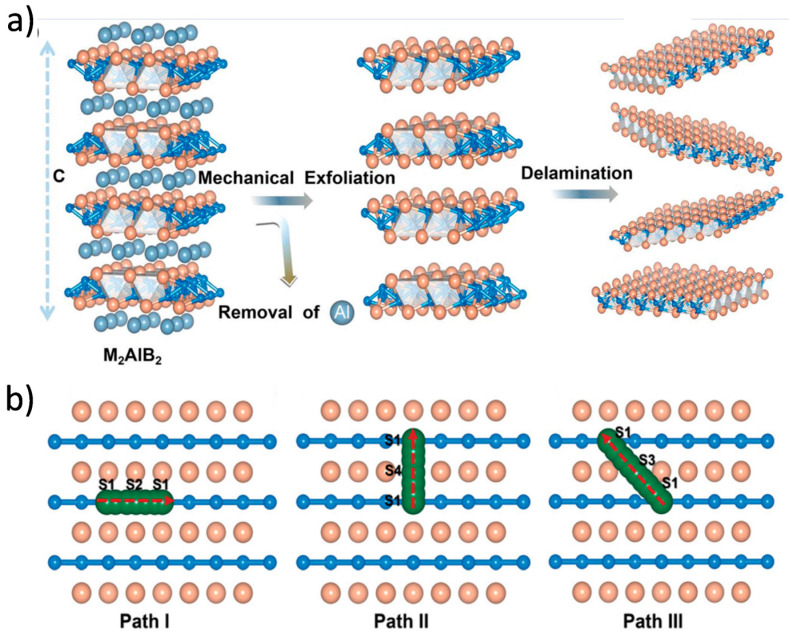
MBenes, an emerging family of two-dimensional transition metal boride materials, are gaining prominence in alkali metal-ion battery research owing to their distinctive stratified architecture, enhanced charge transport properties, and exceptional electrochemical durability. This analysis provides a comprehensive examination of morphological characteristics and fabrication protocols for MBenes, with particular focus on strategies for optimizing energy storage metrics through controlled adjustment of interlayer distance and tailored surface modifications. The discussion highlights these materials' unique capability to host substantial alkali metal ions, translating to exceptional longevity during charge-discharge cycling and remarkable high-current performance in both lithium and sodium battery systems. Current obstacles to materials development are critically evaluated, encompassing precision control in nanoscale synthesis, reproducibility in large-scale production, enhancement of thermodynamic stability, and eco-friendly processing requirements. Prospective research pathways are proposed, including sustainable manufacturing innovations, atomic-level structural tailoring through computational modeling, and expansion into hybrid energy storage-conversion platforms. By integrating fundamental material science principles with practical engineering considerations, this work seeks to establish actionable frameworks for advancing MBene-based technologies toward next-generation electrochemical storage solutions with enhanced energy density and operational reliability.
MBenes是一类新兴的二维过渡金属硼化物材料,由于其独特的分层结构、增强的电荷传输特性和出色的电化学耐久性,在碱金属离子电池研究中日益受到关注。本分析全面审视了MBenes的形态特征和制备方案,特别关注通过控制层间距离的调整和定制表面改性来优化储能指标的策略。讨论突出了这些材料容纳大量碱金属离子的独特能力,这转化为在充放电循环期间的超长寿命以及在锂和钠电池系统中卓越的高电流性能。对材料开发当前面临的障碍进行了批判性评估,包括纳米级合成中的精确控制、大规模生产中的可重复性、热力学稳定性的增强以及环保加工要求。提出了未来的研究途径,包括可持续制造创新、通过计算建模进行原子级结构定制以及扩展到混合储能转换平台。通过将基础材料科学原理与实际工程考虑相结合,这项工作旨在建立可操作的框架,推动基于MBene的技术朝着具有更高能量密度和运行可靠性的下一代电化学储能解决方案发展。