Toth Michael J, Savage Patrick D, Snoke Deena B, Bellefleur Emma R, DeSarno Michael, Tourville Timothy W, Blankstein Michael, Keeble Alexander R, Gonzalez-Velez Sara, Fry Christopher S, Stevens-Lapsley Jennifer, Nelms Nathaniel J
Department of Medicine, University of Vermont College of Medicine, Burlington, VT, United States of America; Department of Orthopaedics and Rehabilitation, University of Vermont College of Medicine, Burlington, VT, United States of America.
Department of Medicine, University of Vermont College of Medicine, Burlington, VT, United States of America.
Exp Gerontol. 2025 Oct 1;209:112831. doi: 10.1016/j.exger.2025.112831. Epub 2025 Jul 11.
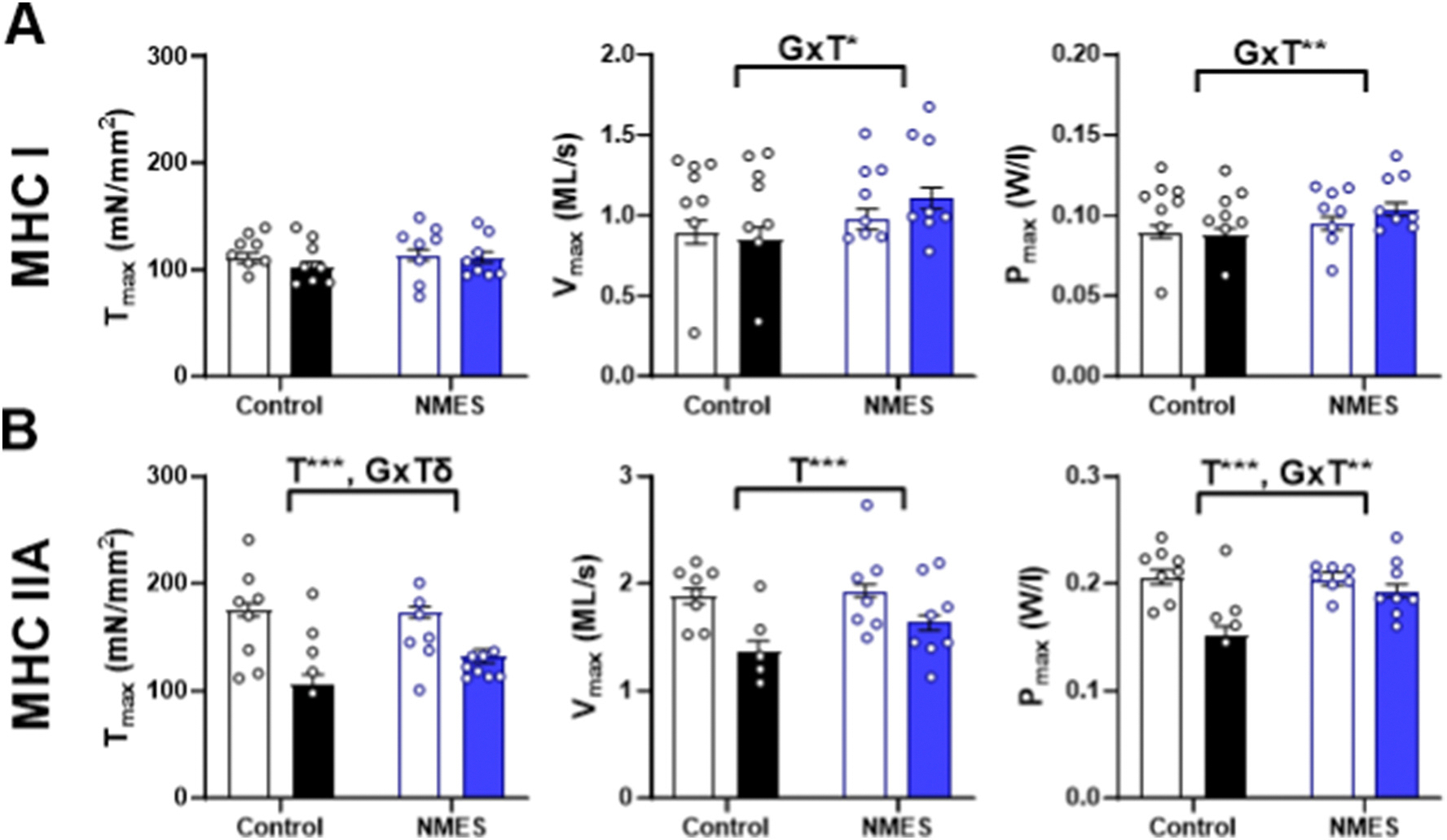
Knee osteoarthritis (OA) is the leading cause of physical disability in older adults. Total knee arthroplasty (TKA) is a common treatment for advanced stage knee OA that alleviates knee pain, but it is associated with precipitous reductions in physical function early after surgery that can take months or years to recover. Sustaining neuromuscular activation after surgery with neuromuscular electrical stimulation (NMES) can improve recovery of physical function, but the mechanisms underlying its benefits are unclear. To examine the unique effects of NMES on skeletal muscle, we randomized older adult patients (70 % female) to early NMES (n = 11) or no intervention (n = 12) for 5 weeks after surgery. We measured skeletal muscle (vastus lateralis) fiber size, contractility, mitochondrial content, and mRNA abundance pre-surgery and 5 weeks post-surgery. NMES diminished TKA-induced muscle fiber atrophy in fast-twitch, myosin heavy chain (MHC) IIA fibers and improved or preserved single muscle fiber contractility in MHC I and MHC IIA fibers, respectively. In MHC IIA fibers, the beneficial effects of NMES to sustain fiber force production were explained at the molecular level by preservation of strongly bound, myosin-actin crossbridges. Additionally, TKA-induced increases in markers of denervation (CHRNA1 and MYOG) in controls were prevented by NMES. Our results identify beneficial effects of sustaining neuromuscular activation early, post-TKA with NMES on skeletal muscle fiber size and function and potential molecular mechanisms underlying these effects.
膝关节骨关节炎(OA)是老年人身体残疾的主要原因。全膝关节置换术(TKA)是治疗晚期膝关节OA的常见方法,可缓解膝关节疼痛,但术后早期身体功能会急剧下降,可能需要数月或数年才能恢复。术后通过神经肌肉电刺激(NMES)维持神经肌肉激活可改善身体功能的恢复,但其有益作用的潜在机制尚不清楚。为了研究NMES对骨骼肌的独特作用,我们将老年患者(70%为女性)随机分为术后早期接受NMES组(n = 11)或无干预组(n = 12),持续5周。我们在术前和术后5周测量了骨骼肌(股外侧肌)纤维大小、收缩性、线粒体含量和mRNA丰度。NMES减少了TKA诱导的快肌、肌球蛋白重链(MHC)IIA型纤维的肌纤维萎缩,并分别改善或保留了MHC I型和MHC IIA型纤维的单肌纤维收缩性。在MHC IIA型纤维中,NMES维持纤维力量产生的有益作用在分子水平上通过保留紧密结合的肌球蛋白 - 肌动蛋白横桥来解释。此外,NMES可防止对照组中TKA诱导的去神经支配标志物(CHRNA1和MYOG)增加。我们的研究结果确定了TKA术后早期通过NMES维持神经肌肉激活对骨骼肌纤维大小和功能的有益作用以及这些作用的潜在分子机制。