Lin Ying-Li, Wang Shiow-Ing, Wei James Cheng-Chung
Department of Family Medicine, Changhua Christian Hospital, Changhua, Taiwan.
Institute of Medicine, Chung Shan Medical University, Taichung, Taiwan.
EClinicalMedicine. 2025 Jun 25;85:103319. doi: 10.1016/j.eclinm.2025.103319. eCollection 2025 Jul.
Patients with rheumatoid arthritis (RA) are at increased risk of developing herpes zoster (HZ). This study aimed to assess the effectiveness of recombinant zoster vaccine (RZV) in reducing both the incidence of HZ and all-cause mortality among individuals with RA.
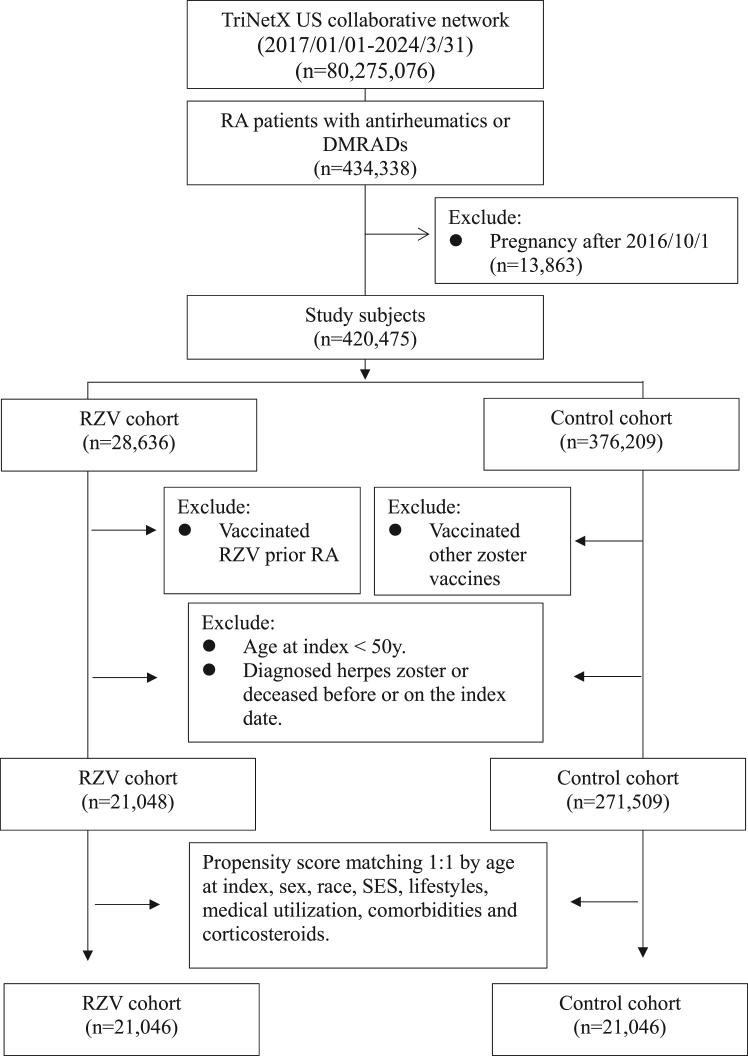
We conducted a retrospective cohort study using data from the TriNetX U.S. Collaborative Network between October 1, 2017 and March 31, 2024. The study population consisted of patients with RA who received RZV (RA-RZV cohort) and those who did not (RA control cohort). Propensity score matching (PSM) was employed to balance baseline characteristics between the groups, accounting for demographics, social economic status, lifestyles, medical utilization, comorbidities, and medications. The primary outcomes were the risk of HZ and all-cause mortality. PSM-adjusted hazard ratios (HRs) were calculated using Cox proportional hazards regression models. Kaplan-Meier curves and Log-Rank tests were used to evaluate survival differences.
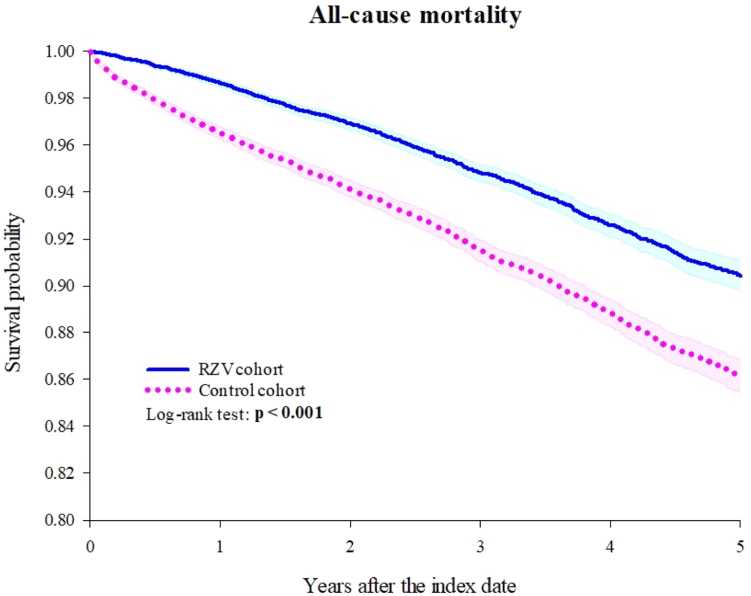
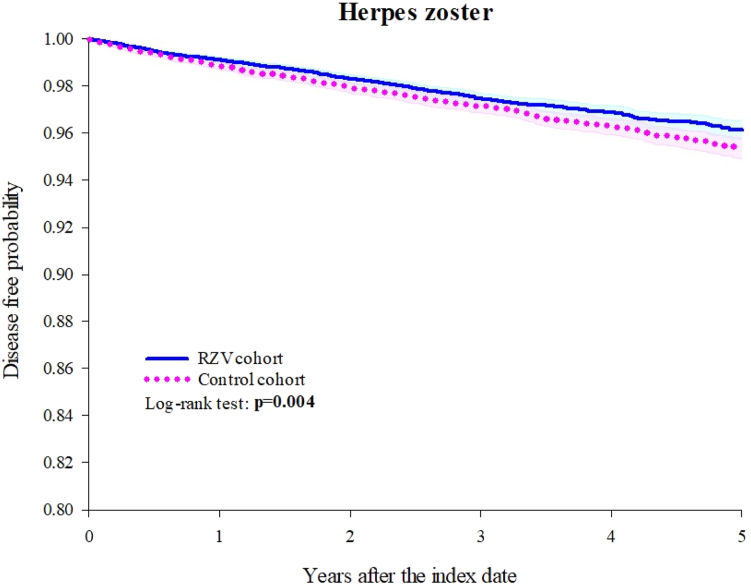
After PSM, each cohort included 21,046 individuals. The RA-RZV group demonstrated significantly lower risks of HZ (HR: 0.836, 95% CI: 0.738-0.947) and all-cause mortality (HR: 0.606, 95% CI: 0.561-0.654). The HZ risk reduction was more pronounced in patients aged 50-64 years (HR: 0.731, 95% CI: 0.610-0.876), females (HR: 0.791, 95% CI: 0.684-0.915), White (HR: 0.808, 95% CI: 0.696-0.937), and Black/African American participants (HR: 0.685; 95% CI: 0.481-0.976).
RZV vaccination is associated with a reduced risk of HZ among patients with RA aged 50 years and older. While we observed a reduction in all-cause mortality among RZV recipients, this finding should be interpreted with caution, as the effect size may not be entirely attributable to HZ prevention alone. Given the established efficacy of RZV in preventing HZ and its potential to reduce mortality, vaccination should be prioritized among eligible patients with RA.
There is no funding.
类风湿关节炎(RA)患者发生带状疱疹(HZ)的风险增加。本研究旨在评估重组带状疱疹疫苗(RZV)在降低RA患者HZ发病率和全因死亡率方面的有效性。
我们利用2017年10月1日至2024年3月31日期间TriNetX美国协作网络的数据进行了一项回顾性队列研究。研究人群包括接受RZV的RA患者(RA-RZV队列)和未接受RZV的患者(RA对照队列)。采用倾向评分匹配(PSM)来平衡两组之间的基线特征,考虑人口统计学、社会经济状况、生活方式、医疗利用、合并症和药物治疗情况。主要结局是HZ风险和全因死亡率。使用Cox比例风险回归模型计算PSM调整后的风险比(HRs)。采用Kaplan-Meier曲线和对数秩检验来评估生存差异。
PSM后,每个队列包括21,046人。RA-RZV组的HZ风险(HR:0.836,95%CI:0.738-0.947)和全因死亡率(HR:0.606,95%CI:0.561-0.654)显著降低。在50-64岁的患者(HR:0.731,95%CI:0.610-0.876)、女性(HR:0.791,95%CI:0.684-0.915)、白人(HR:0.808,95%CI:0.696-0.937)和黑人/非裔美国参与者(HR:0.685;95%CI:0.481-0.976)中,HZ风险降低更为明显。
RZV疫苗接种与50岁及以上RA患者HZ风险降低相关。虽然我们观察到RZV接种者的全因死亡率有所降低,但这一发现应谨慎解读,因为效应大小可能并非完全仅归因于HZ预防。鉴于RZV在预防HZ方面已确立的疗效及其降低死亡率的潜力,对于符合条件的RA患者应优先进行疫苗接种。
无资金支持。