Li Bingyu, Lin Weishan, Hu Ruomeng, Bai Songjie, Ruan Yejiao, Fan Yushi, Qiao Shuya, Wen Xuehuan, Liu Ruishan, Chen Heyu, Cui Wei, Cai Zhijian, Zhang Gensheng
Department of Critical Care Medicine, Second Affiliated Hospital, Zhejiang University School of Medicine, Hangzhou, 310009, China.
Spine Center, Xinhua Hospital Affiliated to Shanghai Jiao Tong University School of Medicine, Shanghai, 200092, China.
Ann Intensive Care. 2025 Jul 14;15(1):97. doi: 10.1186/s13613-025-01513-4.
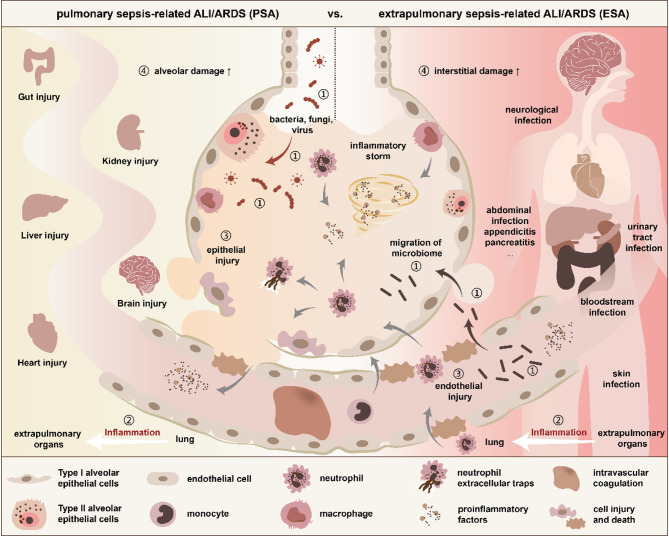
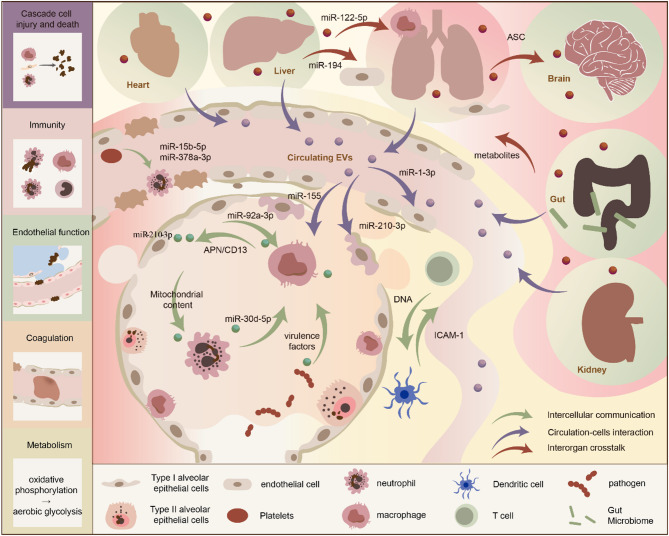
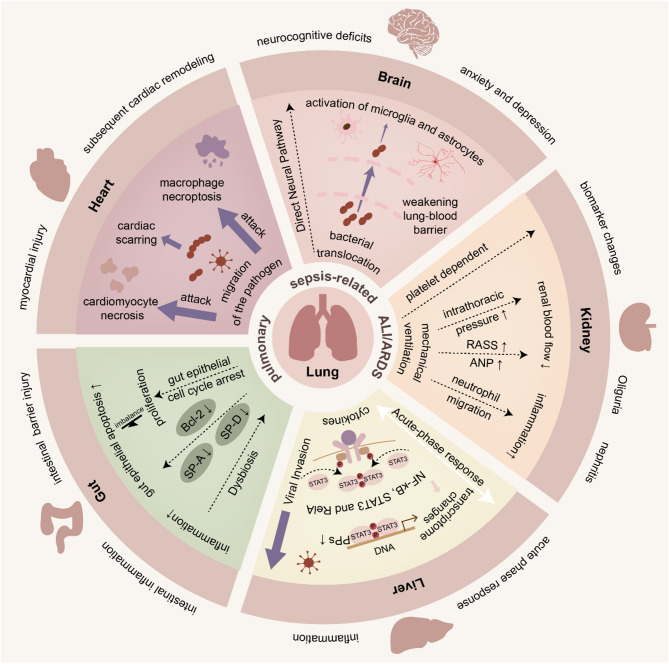
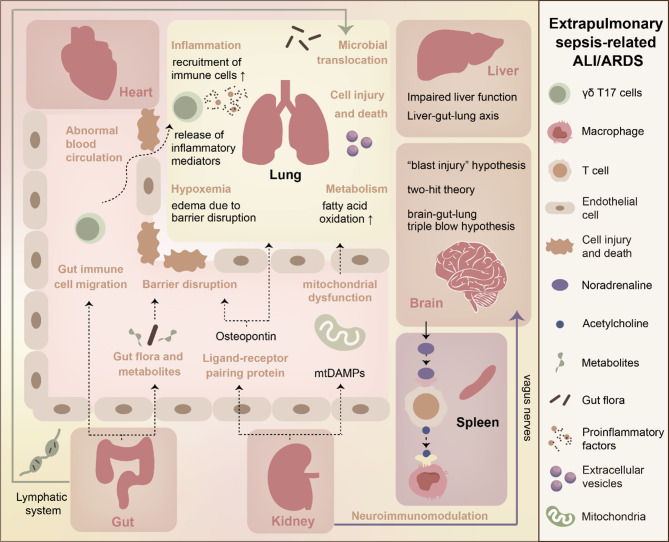
Sepsis-related acute lung injury/acute respiratory distress syndrome (ALI/ARDS) is associated with considerable morbidity and mortality, yet the efficacy of current treatments is limited. Previous studies have predominantly focused on the lung itself as an isolated organ, whereas the role of organ crosstalk in the pathogenesis of sepsis-related ALI/ARDS cannot be overlooked. Meanwhile, neglecting the discussion of heterogeneity in sepsis caused by different sources of infection may be another important obstacle to translating previous studies into clinical efficacy. In this review, we initially delineated the distinctions in pathogenesis between pulmonary and extrapulmonary sepsis-related ALI/ARDS in microbial species, pathogenesis, host response, and clinical manifestations. Additionally, systemic organ crosstalk mechanisms are summarized, including the commonality and specificity of systemic inflammation, lung and gut microbiome, as well as cascade cell injury and death in distant organs. Subsequently, organ crosstalk between lung and extrapulmonary in pulmonary sepsis and extrapulmonary sepsis-related ALI/ARDS are discussed by organs, including immunity, neuroendocrine, metabolism, and so forth. Furthermore, extracellular vesicles represent a promising avenue of research as potential players and targets in organ-lung crosstalk in sepsis. While the complexity of multi-organ interactions and the heterogeneity of septic patients present significant challenges, these issues are expected to be addressed by the emergence of organ-on-a-chip platforms, 3D organoid cultures, and multi-omics techniques.
脓毒症相关急性肺损伤/急性呼吸窘迫综合征(ALI/ARDS)具有相当高的发病率和死亡率,然而目前治疗方法的疗效有限。以往的研究主要集中在将肺作为一个孤立的器官,而器官间相互作用在脓毒症相关ALI/ARDS发病机制中的作用不容忽视。同时,忽视对不同感染源引起的脓毒症异质性的讨论可能是将以往研究转化为临床疗效的另一个重要障碍。在本综述中,我们首先阐述了肺部和肺外脓毒症相关ALI/ARDS在微生物种类、发病机制、宿主反应和临床表现方面发病机制的差异。此外,总结了全身器官间相互作用机制,包括全身炎症、肺和肠道微生物群的共性和特异性,以及远处器官的级联细胞损伤和死亡。随后,按器官讨论了肺部脓毒症和肺外脓毒症相关ALI/ARDS中肺与肺外器官间的相互作用,包括免疫、神经内分泌、代谢等方面。此外,细胞外囊泡作为脓毒症中器官与肺相互作用的潜在参与者和靶点,是一个有前景的研究方向。虽然多器官相互作用的复杂性和脓毒症患者的异质性带来了重大挑战,但随着芯片器官平台、3D类器官培养和多组学技术的出现,这些问题有望得到解决。