
脂质浸润在人类冠状动脉粥样硬化早期病变中促进血管平滑肌细胞向巨噬细胞样细胞转分化。
Lipid infiltration promotes trans-differentiation of vascular smooth muscle cells into macrophage-like cells in early lesions of human coronary atherosclerosis.
作者信息
Hao Junhai, Liu Jiang, Zhou Jiahui, Liang Yuanfeng, Chen Wanwen, Wu Yueheng, Lin Zhanyi
机构信息
School of Medicine, South China University of Technology, Guangzhou, 510006, China.
Department of Intensive Care Unit of Cardiac Surgery, Guangdong Cardiovascular Institute, Guangdong Provincial People's Hospital (Guangdong Academy of Medical Sciences), Southern Medical University, Guangzhou, 510080, China.
出版信息
Lipids Health Dis. 2025 Jul 14;24(1):239. doi: 10.1186/s12944-025-02662-y.
BACKGROUND
The trans-differentiation of vascular smooth muscle cells (VSMCs) into macrophage-like phenotypes contributes substantially to the advancement of atherosclerotic lesions. However, it remains uncertain whether this trans-differentiation is involved in the early pathogenesis of human coronary atherosclerosis. Given that lipid deposition is a pathological hallmark of early-stage atheroma and that single-cell evidence implicates lipid-processing signatures in VSMC trans-differentiation, it was hypothesized that lipid infiltration critically triggers this process during the early stages of coronary atherosclerosis.
METHODS
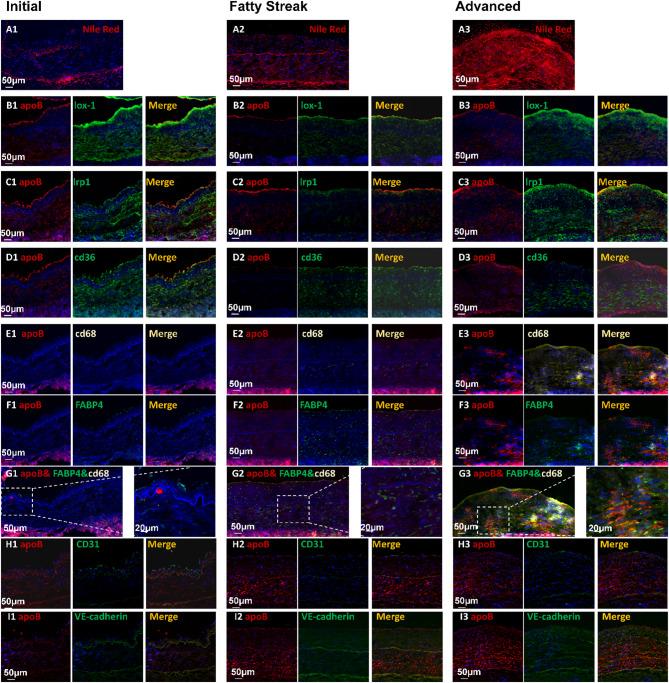
Clinical information and lipid profiles were collected from 38 heart transplant recipients. Coronary artery specimens were obtained from their explanted hearts and classified as initial lesions, fatty streaks, or advanced lesions. Immunohistochemical (IHC) staining and immunofluorescence (IF) analyses were performed on the tissue samples to assess lipid infiltration, VSMC phenotype, and trans-differentiation.
RESULTS
Lipid infiltration and VSMC phenotype switching were observed at the initial lesion stage. IHC and semi-quantitative analysis showed that with increasing lipid infiltration, the densities of foam cells, fatty acid binding protein 4 (FABP4) SMCs, CD248 cells, and CD68 cells rose significantly, correlating with lesion severity. Moreover, the density of FABP4 SMCs was positively associated with intimal thickness as well as the densities of CD248 cells, foam cells, and CD68 cells.
CONCLUSIONS
Lipid infiltration begins in the early stages of human coronary artery atherosclerotic lesions and may promote trans-differentiation of intimal SMCs into macrophage-like cells, as indicated by expression of the macrophage-associated protein FABP4. These findings provide novel insight into early atherogenesis and may help identify potential targets for timely prevention and intervention in cardiovascular disease.
背景
血管平滑肌细胞(VSMC)向巨噬细胞样表型的转分化在动脉粥样硬化病变进展中起重要作用。然而,这种转分化是否参与人类冠状动脉粥样硬化的早期发病机制仍不确定。鉴于脂质沉积是早期动脉粥样瘤的病理标志,且单细胞证据表明脂质处理特征与VSMC转分化有关,因此推测脂质浸润在冠状动脉粥样硬化早期阶段关键触发了这一过程。
方法
收集38例心脏移植受者的临床信息和血脂谱。从其切除的心脏获取冠状动脉标本,并分为初始病变、脂肪条纹或晚期病变。对组织样本进行免疫组织化学(IHC)染色和免疫荧光(IF)分析,以评估脂质浸润、VSMC表型和转分化。
结果
在初始病变阶段观察到脂质浸润和VSMC表型转换。IHC和半定量分析显示,随着脂质浸润增加,泡沫细胞、脂肪酸结合蛋白4(FABP4)平滑肌细胞、CD248细胞和CD68细胞的密度显著升高,与病变严重程度相关。此外,FABP4平滑肌细胞的密度与内膜厚度以及CD248细胞、泡沫细胞和CD68细胞的密度呈正相关。
结论
脂质浸润在人类冠状动脉粥样硬化病变早期就已开始,并可能促进内膜平滑肌细胞向巨噬细胞样细胞的转分化,巨噬细胞相关蛋白FABP4的表达表明了这一点。这些发现为早期动脉粥样硬化发生提供了新的见解,并可能有助于确定心血管疾病及时预防和干预的潜在靶点。


 Zotero 插件