Zhang Li, Wu Hongyu, Wang Mengshi, Zhou Xianjin, Cui Ruiguo, Song Lijun, Liu Fengjuan
College of Food Science and Technology, Hebei Normal University of Science and Technology, Qinhuangdao, China.
Hebei Key Laboratory of Natural Products Activity Components and Function, Hebei Normal University of Science and Technology, Qinhuangdao, China.
Front Nutr. 2025 Jun 30;12:1619072. doi: 10.3389/fnut.2025.1619072. eCollection 2025.
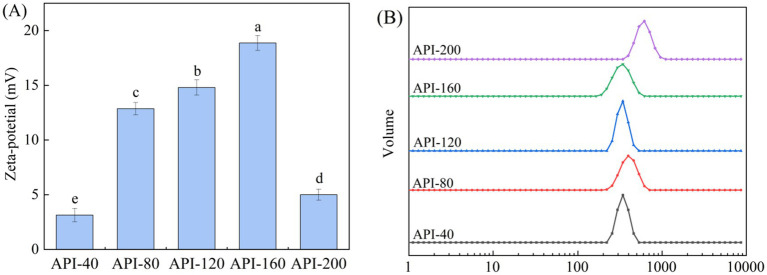
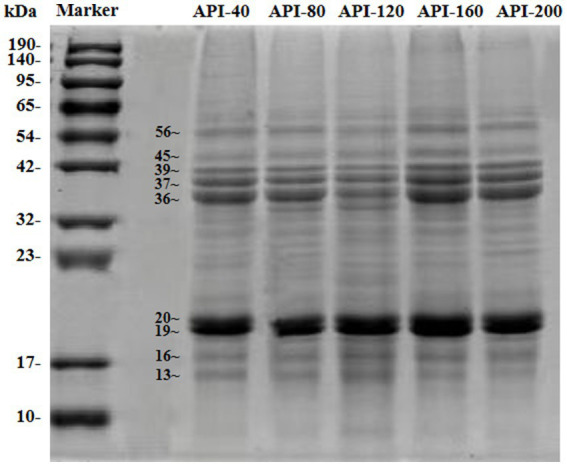
This study aimed to investigate the effect of screw-pressing temperature on the quality of apricot kernel protein isolates (API). The API values at different screw-pressing temperatures (40-200°C) were obtained, and the functional and structural properties of different API samples were comparatively studied. The results revealed that the total polyphenol content (TPC), total flavonoid content (TFC), and antioxidant activities (DPPH and FRAP assays) increased significantly with increasing temperature. High-temperature pressing also increased the surface hydrophobicity and emulsification of API. SDS-PAGE confirmed the preservation of the primary structure of API, with molecular weights ranging from 13 to 20 kDa and 36-56 kDa. Circular dichroism (CD) spectroscopy analysis revealed that the -helix content increased (by 4-8%) and the -sheet content decreased (by 2-5%) when the samples were pressed at high temperatures. The decrease in fluorescence intensity and the fluorescence spectral shift indicated changes in the tertiary structure. Multivariate statistical analysis revealed that the antioxidant activities were positively correlated to protein carbonyls, free sulfhydryl groups, surface hydrophobicity, TPC, and TFC. Mechanistically, thermally-induced protein conformational changes and surface hydrophobicity modulation drove the observed enhancements in functional properties. These findings will collectively serve as a theoretical basis for the efficient preparation and application of API.
本研究旨在探究螺旋压榨温度对杏仁分离蛋白(API)品质的影响。获取了不同螺旋压榨温度(40 - 200°C)下的API值,并对不同API样品的功能和结构特性进行了比较研究。结果表明,总多酚含量(TPC)、总黄酮含量(TFC)以及抗氧化活性(DPPH和FRAP测定)均随温度升高而显著增加。高温压榨还提高了API的表面疏水性和乳化性。SDS - PAGE证实了API一级结构的保留,分子量范围为13至20 kDa和36 - 56 kDa。圆二色性(CD)光谱分析表明,高温压榨样品时,α - 螺旋含量增加(4 - 8%),β - 折叠含量降低(2 - 5%)。荧光强度的降低和荧光光谱的位移表明三级结构发生了变化。多变量统计分析表明,抗氧化活性与蛋白质羰基、游离巯基、表面疏水性、TPC和TFC呈正相关。从机制上讲,热诱导的蛋白质构象变化和表面疏水性调节推动了所观察到的功能特性增强。这些发现将共同为API的高效制备和应用提供理论依据。