Zhang Xue, Li Liang, Sun Tao, Yang Ning, Liu Hui, Chu Jin, Xue Junlong, Lü Guodong, Aji Tuerganaili, Bi Xiaojuan, Lin Renyong
State Key Laboratory of Pathogenesis, Prevention and Treatment of High Incidence Diseases in Central Asia, Clinical Medical Research Institute, The First Affiliated Hospital of Xinjiang Medical University, Urumqi, China.
Xinjiang Key Laboratory of Echinococcosis, Clinical Medical Research Institute, The First Affiliated Hospital of Xinjiang Medical University, Urumqi, China.
Front Microbiol. 2025 Jul 1;16:1624387. doi: 10.3389/fmicb.2025.1624387. eCollection 2025.
Alveolar echinococcosis (AE) is a life-threatening zoonotic parasitic disease caused by the metacestode stage of , characterized by granulomatous lesions and liver fibrosis. Immune exhaustion is the key mechanism by which evades host immune responses and maintains long-term parasitism. Although CD155 is recognized as an immune checkpoint molecule, its specific role and underlying mechanism in AE remain unclear.
A mouse model of infection was used to investigate the role of CD155 in AE progression. Flow cytometry, immunohistochemistry, and immunofluorescence were employed to assess CD155 expression and analyze T-cell function. In addition, liver weight, lesion size, lesion number, inflammation index, collagen deposition (via Masson staining), and stellate cell activation (via α-SMA immunohistochemistry) were statistically quantified in the CD155 hepatocyte knockout mice. Each experimental group included five mice ( = 5).
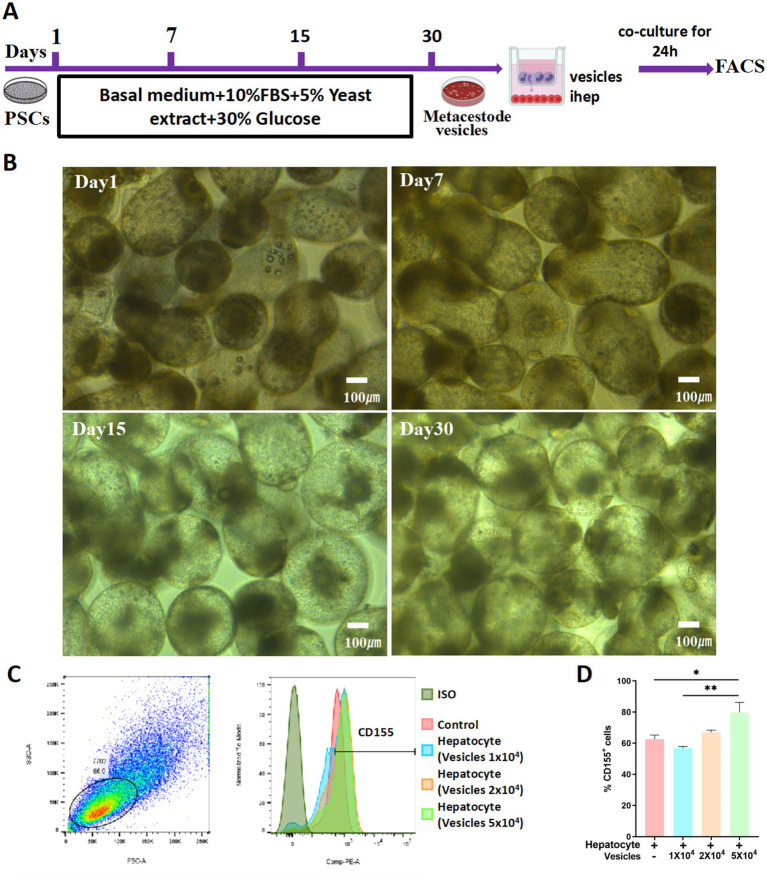
CD155 expression in hepatocytes was significantly increased-approximately 2-fold compared to Sham controls-and predominantly localized near lesion sites. The infected group showed significantly reduced percentages of functional CD4IFN-γ, CD4CD107a, and CD8CD107a T cells ( < 0.05), along with enrichment of exhausted TIGIT T cells adjacent to CD155 hepatocytes. , CD155 expression in hepatocytes was upregulated in a dose-dependent manner when co-cultured with metacestode vesicles, reaching 1.5-fold that of the control. Notably, hepatocyte-specific CD155 knockout in infected mice restored CD4 and CD8 T-cell function and reduced liver damage, as indicated by decreased lesion burden.
In the infection mouse model, excretory/secretory products from metacestode vesicles upregulated CD155 expression in hepatocytes, contributing to an immunosuppressive microenvironment and T-cell exhaustion. Targeting CD155 reverses this immunosuppression and mitigates hepatic pathology, highlighting CD155 as a promising therapeutic target for AE.
泡型包虫病(AE)是一种由多房棘球绦虫的幼虫期引起的危及生命的人畜共患寄生虫病,其特征为肉芽肿性病变和肝纤维化。免疫耗竭是多房棘球绦虫逃避宿主免疫反应并维持长期寄生的关键机制。尽管CD155被认为是一种免疫检查点分子,但其在AE中的具体作用和潜在机制仍不清楚。
使用多房棘球绦虫感染的小鼠模型来研究CD155在AE进展中的作用。采用流式细胞术、免疫组织化学和免疫荧光法评估CD155表达并分析T细胞功能。此外,对CD155肝细胞敲除小鼠的肝脏重量、病变大小、病变数量、炎症指数、胶原沉积(通过Masson染色)和星状细胞活化(通过α-SMA免疫组织化学)进行统计学定量。每个实验组包括五只小鼠(n = 5)。
与假手术对照组相比,肝细胞中CD155表达显著增加,约为2倍,且主要定位于病变部位附近。感染组功能性CD4IFN-γ、CD4CD107a和CD8CD107a T细胞的百分比显著降低(P < 0.05),同时与CD155肝细胞相邻的耗竭性TIGIT T细胞富集。此外,与多房棘球绦虫囊泡共培养时,肝细胞中CD155表达呈剂量依赖性上调,达到对照组的1.5倍。值得注意的是,感染小鼠中肝细胞特异性CD155敲除恢复了CD4和CD8 T细胞功能,并减少了肝脏损伤,病变负担减轻表明了这一点。
在多房棘球绦虫感染小鼠模型中,多房棘球绦虫囊泡的排泄/分泌产物上调了肝细胞中CD155表达,导致免疫抑制微环境和T细胞耗竭。靶向CD155可逆转这种免疫抑制并减轻肝脏病理,突出了CD155作为AE有前景的治疗靶点。