Reichl Jun, Miller Julia M, Randhawa Harpreet, Castillo Lesly M Palacios, Akin Orkun
Neuroscience Interdepartmental Graduate Program, University of California, Los Angeles, Los Angeles, CA, USA.
Department of Neurobiology, David Geffen School of Medicine at UCLA, University of California, Los Angeles, Los Angeles, CA, USA.
bioRxiv. 2025 Jun 28:2025.06.26.661770. doi: 10.1101/2025.06.26.661770.
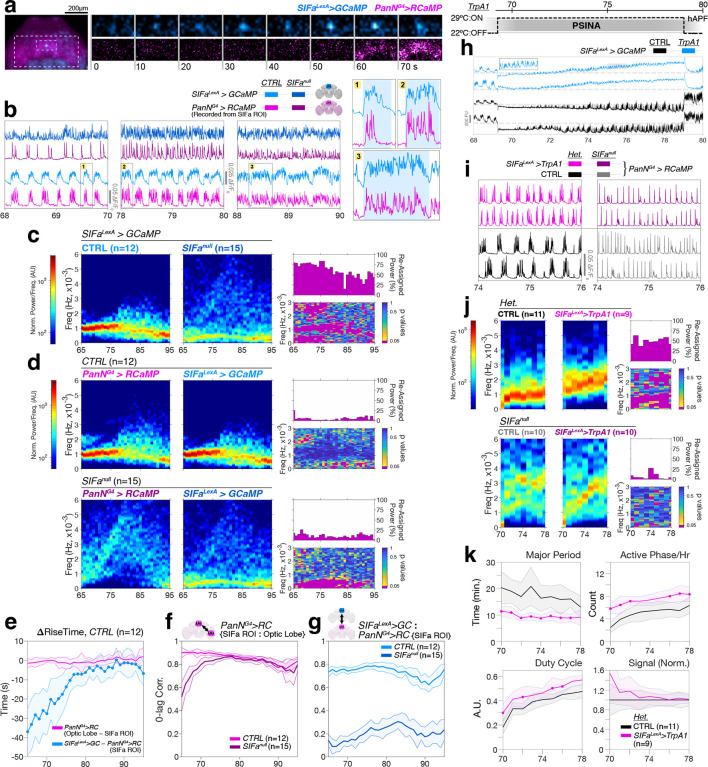
In both vertebrates and invertebrates, the developing brain becomes electrically active before it is ready to process sensory input. During neural circuit maturation, developmental activity is thought to refine synaptic connections by driving neuronal co-activation in rhythmic patterns. Here we describe cellular interactions that shape brainwide developmental activity and their molecular basis. In , patterned stimulus independent neural activity (PSINA) engages the entire brain in highly stereotyped, globally coordinated cycles of activity. A molecularly-defined population of ~2,000 neurons (Transient Receptor Potential Gamma, neurons) act as an activity template for PSINA. We show that this activity template is patterned by four neurons expressing the neuropeptide SIFamide (SIFa). Signaling through the SIFa Receptor, SIFa modulates the activity of both SIFa and neurons to establish the brainwide activity cycles of PSINA. In turn, neurons sustain SIFa neuron activity through a recurrent interaction. Neuropeptides modulate neuronal activity through synapse-free, or wireless, signaling; a fitting mode of communication for a process tasked with refining on-going synapse formation. By placing neuropeptide signaling at the core of developmental activity, this work highlights the rich neurophysiological potential of the chemical connectome in shaping the developing brain.
在脊椎动物和无脊椎动物中,发育中的大脑在准备好处理感觉输入之前就开始产生电活动。在神经回路成熟过程中,发育活动被认为通过驱动神经元以节律性模式共同激活来优化突触连接。在这里,我们描述了塑造全脑发育活动的细胞相互作用及其分子基础。在[具体情况未提及]中,模式化刺激独立神经活动(PSINA)使整个大脑参与高度刻板、全局协调的活动周期。一群约2000个分子定义的神经元(瞬时受体电位γ神经元)作为PSINA的活动模板。我们表明,这种活动模板由四个表达神经肽SIFamide(SIFa)的神经元形成模式。通过SIFa受体发出信号,SIFa调节SIFa神经元和γ神经元的活动,以建立PSINA的全脑活动周期。反过来,γ神经元通过反复相互作用维持SIFa神经元的活动。神经肽通过无突触或无线信号调节神经元活动;这是一种适合于优化正在进行的突触形成过程的通信模式。通过将神经肽信号置于发育活动的核心,这项工作突出了化学连接组在塑造发育中的大脑方面丰富的神经生理潜力。