Carbia Carina, Almeida-Antunes Natália, Vasconcelos Margarida, López-Caneda Eduardo
Louvain Experimental Psychopathology Research Group (UCLEP), Psychological Sciences Research Institute (IPSY), UCLouvain, Ottignies-Louvain-la-Neuve, Belgium.
RISE-Health, Center for Translational Health and Medical Biotechnology Research (TBIO), ESS, Polytechnic of Porto, Porto, Portugal.
Sci Rep. 2025 Jul 16;15(1):25704. doi: 10.1038/s41598-025-10741-4.
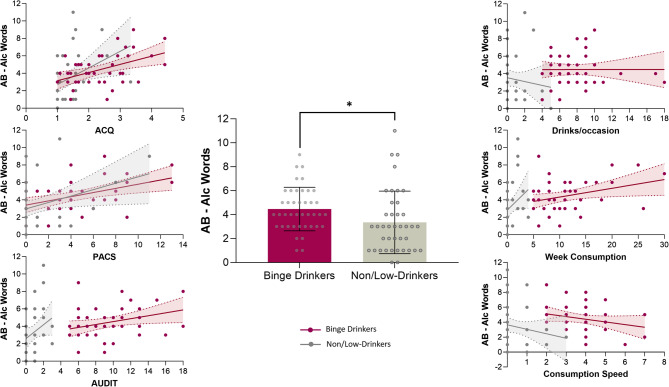
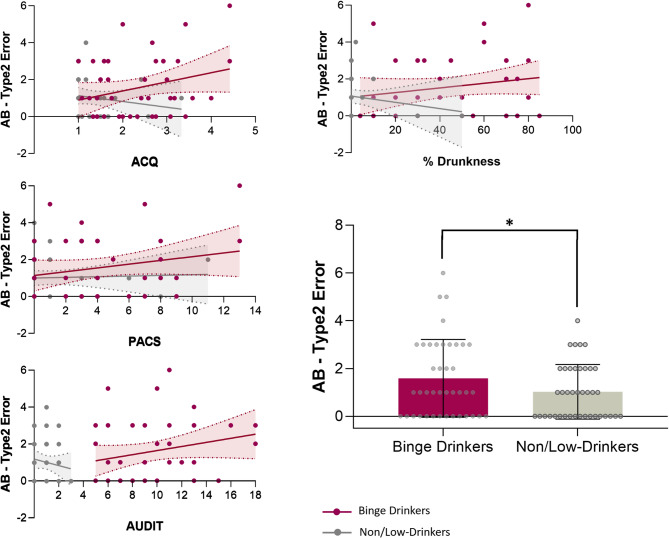
Craving and alcohol-related bias play a central role in addiction development. Previous research suggests that individuals with alcohol misuse exhibit heightened alcohol bias and deficits in inhibitory control, contributing to increased craving and sustained consumption. However, this relationship remains poorly understood in young binge drinkers, particularly regarding a specific form of bias known as semantic alcohol bias (heightened automatic accessibility of alcohol-related concepts), which may influence craving and drinking behavior. The present study is aimed at addressing this gap. A total of 81 college students (41 Binge Drinkers and 40 Non/Low Drinkers) completed craving questionnaires and the Alcohol Hayling task, a sentence-completion paradigm designed to measure semantic alcohol bias and inhibitory control. Results revealed that young binge drinkers generated more alcohol-related words in drinking-context sentences, committed more errors (i.e., producing alcohol-related words when they should have generated unrelated words), and displayed slower response times when inhibiting alcohol-related responses. A positive correlation was observed between craving and the frequency of alcohol-related words. These findings suggest that young binge drinkers exhibit a semantic accessibility bias towards alcohol-related concepts and difficulties inhibiting alcohol-related content. This study highlights the role of alcohol-related semantic networks in craving states, providing new insights into how alcohol biases may contribute to binge drinking behaviors among youth.
渴望和与酒精相关的偏差在成瘾发展中起着核心作用。先前的研究表明,酒精滥用者表现出更高的酒精偏差和抑制控制缺陷,这导致渴望增加和持续饮酒。然而,在年轻的暴饮者中,这种关系仍未得到充分理解,特别是关于一种被称为语义酒精偏差(与酒精相关概念的自动可及性增强)的特定偏差形式,它可能会影响渴望和饮酒行为。本研究旨在填补这一空白。共有81名大学生(41名暴饮者和40名非/低饮酒者)完成了渴望问卷和酒精海林任务,这是一种旨在测量语义酒精偏差和抑制控制的句子完成范式。结果显示,年轻的暴饮者在饮酒情境句子中生成了更多与酒精相关的词汇,犯了更多错误(即在应该生成无关词汇时生成了与酒精相关的词汇),并且在抑制与酒精相关的反应时反应时间较慢。在渴望与与酒精相关词汇的频率之间观察到正相关。这些发现表明,年轻的暴饮者对与酒精相关的概念表现出语义可及性偏差以及抑制与酒精相关内容的困难。本研究强调了与酒精相关的语义网络在渴望状态中的作用,为酒精偏差如何导致青少年暴饮行为提供了新的见解。