Zhou Baihua, Yan Jun, Wang Qin, He Qiwei, Ao Wei, Yang Ying, Ren Yanjiao
Department of Cardiovascular Medicine, Yueyang People's Hospital, Yueyang, Hunan, 414000, People's Republic of China.
Patient Prefer Adherence. 2025 Jul 11;19:2015-2025. doi: 10.2147/PPA.S529753. eCollection 2025.
To explore the influencing factors of cardiac rehabilitation compliance in elderly patients with acute myocardial infarction (AMI) and to construct a nomogram prediction model.
A retrospective study was conducted on 239 elderly AMI patients admitted to our hospital from April 2022 to April 2024. The patients were randomly assigned into a modeling group (167 cases) and a validation group (72 cases) in a 7:3 ratio. The modeling group was separated into a good compliance group and a poor compliance group based on their compliance with cardiac rehabilitation.
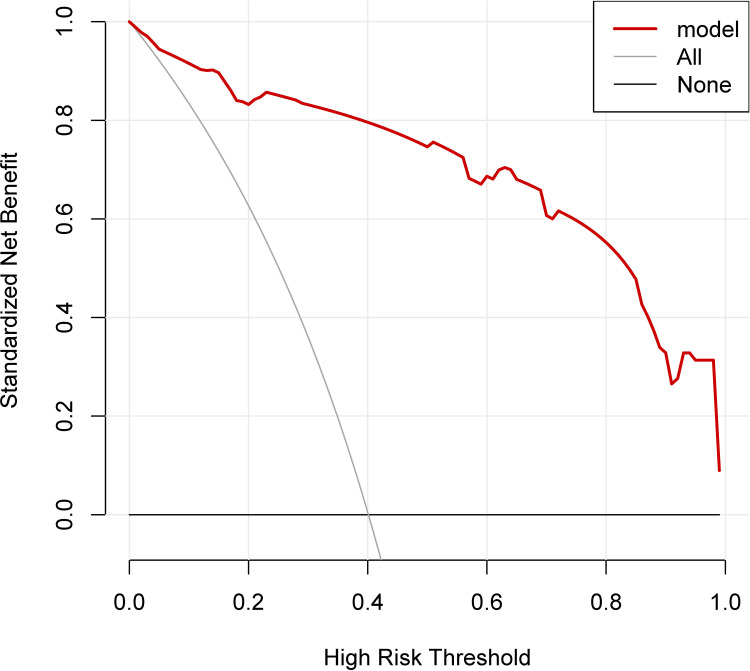
Among the 167 patients in the modeling group, 67 had poor compliance, with an incidence rate of 40.12%. Multivariate logistic regression revealed that age, educational level, perception of disease, anxiety and depression, social support, and medical staff supervision were risk factors for cardiac rehabilitation compliance in elderly AMI patients (P<0.05). The AUC values of the modeling and validation groups were 0.955 and 0.937, respectively. The slope of the calibration curve was close to 1, and the H-L test showed =7.863 and 7.453, with P=0.789 and 0.775, indicating good consistency. DCA curve showed that when the high-risk threshold probability was between 0.08 and 0.93, the nomogram model had a high clinical value.
Age, educational level, perception of the disease, anxiety and depression, social support, and medical staff supervision are the influencing factors of cardiac rehabilitation compliance in elderly AMI patients. The nomogram model constructed based on this has good discrimination and consistency, and can predict cardiac rehabilitation compliance.
探讨老年急性心肌梗死(AMI)患者心脏康复依从性的影响因素,并构建列线图预测模型。
对2022年4月至2024年4月我院收治的239例老年AMI患者进行回顾性研究。患者按7:3的比例随机分为建模组(167例)和验证组(72例)。建模组根据心脏康复依从性分为依从性好组和依从性差组。
建模组167例患者中,67例依从性差,发生率为40.12%。多因素logistic回归显示,年龄、文化程度、疾病认知、焦虑抑郁、社会支持及医护人员监督是老年AMI患者心脏康复依从性的危险因素(P<0.05)。建模组和验证组的AUC值分别为0.955和0.937。校准曲线斜率接近1,H-L检验显示=7.863和7.453,P=0.789和0.775,表明一致性良好。DCA曲线显示,当高危阈值概率在0.08至0.93之间时,列线图模型具有较高的临床价值。
年龄、文化程度、疾病认知、焦虑抑郁、社会支持及医护人员监督是老年AMI患者心脏康复依从性的影响因素。基于此构建的列线图模型具有良好的区分度和一致性,可预测心脏康复依从性。