Yang Na, Deng Ying
Department of Thoracic Surgery, Shengjing Hospital of China Medical University, Shenyang, China.
Department of Anesthesiology, Shengjing Hospital of China Medical University, Shenyang, China.
J Gastrointest Oncol. 2025 Jun 30;16(3):922-936. doi: 10.21037/jgo-2024-897. Epub 2025 Jun 18.
Anastomotic leakage (AL), a major postoperative complication following laparoscopic gastrectomy (LG), presents a critical diagnostic challenge in elderly patients, often resulting in life-threatening outcomes. This study aimed to develop and validate a risk prediction model to facilitate the early identification of AL in this population.
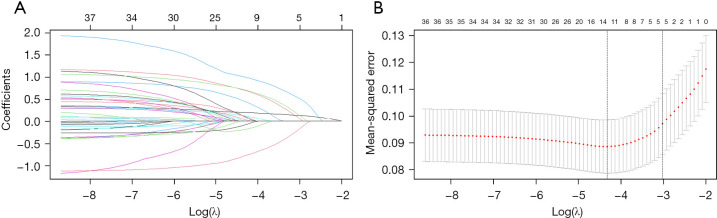
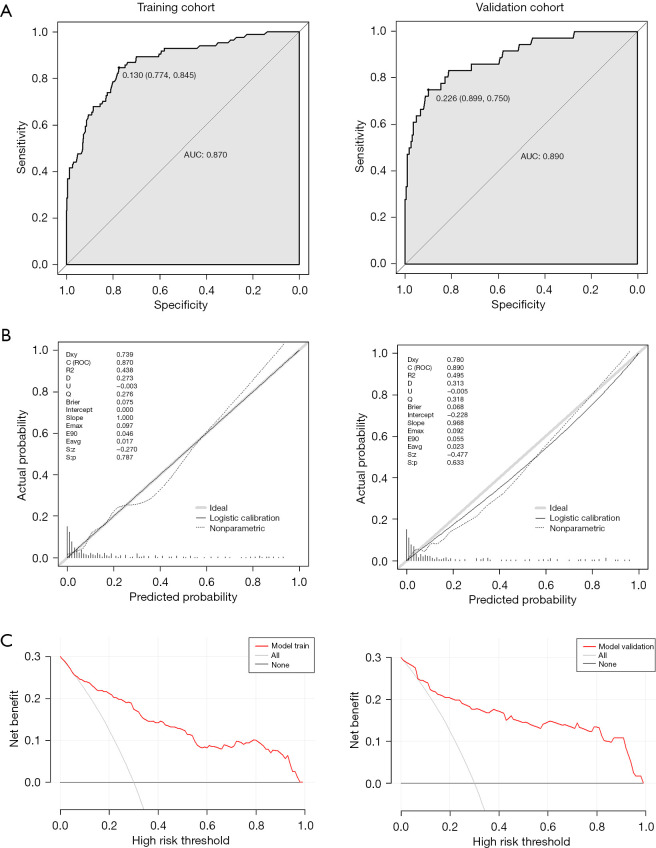
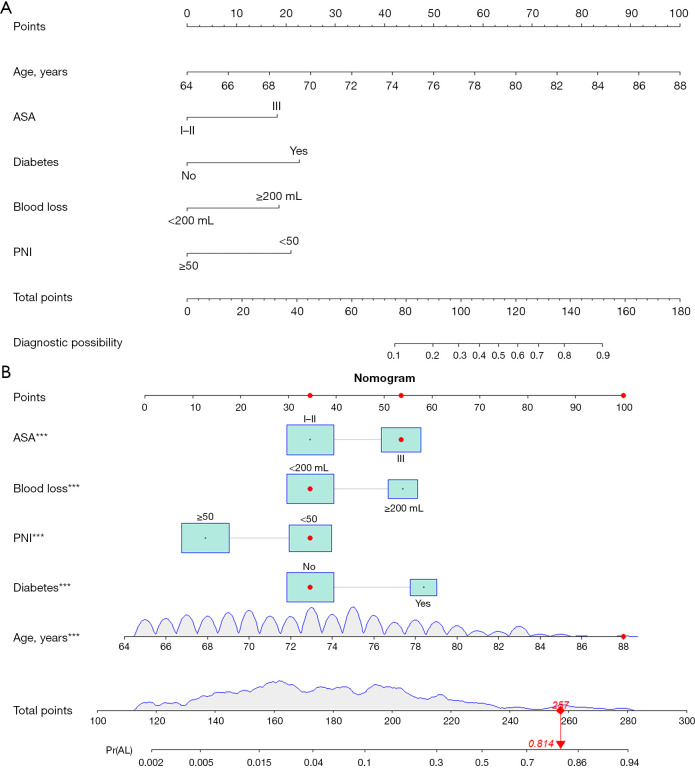
Retrospective data from 884 elderly patients diagnosed with gastric cancer who underwent LG were analyzed. The patients were randomly divided into training and validation cohorts in a 7:3 ratio. Clinically relevant predictors of AL were identified using least absolute shrinkage and selection operator (LASSO) regression and multivariate logistic regression analyses. A nomogram model was subsequently developed using these predictors. Model performance was evaluated and validated using the area under the curve (AUC) for discrimination, the Hosmer-Lemeshow test and calibration curve for accuracy, and decision curve analysis (DCA) for clinical applicability.
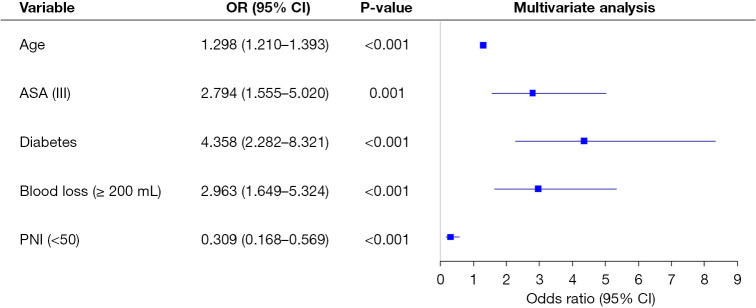
The incidence rate of AL in the cohort was 13.6% (120/884). Five variables emerged as independent predictors of AL, including age, American Society of Anesthesiologists (ASA), diabetes, intraoperative blood loss, and prognostic nutritional index (PNI). The nomogram exhibited robust predictive accuracy, with AUC values of 0.870 [95% confidence interval (CI): 0.826-0.913] and 0.890 (95% CI: 0.828-0.952) in the training and validation cohorts, respectively. Calibration curves demonstrated a strong concordance between predicted and observed outcomes. DCA further indicated favorable clinical utility across a wide range of risk thresholds.
This study developed a LASSO-derived nomogram that incorporates five routinely assessed perioperative variables (age, ASA score, diabetes, intraoperative blood loss, and PNI) as a reliable tool for predicting AL risk in elderly patients undergoing LG. The model demonstrated satisfactory accuracy, discrimination, and clinical efficacy, thus enabling early risk identification to guide targeted preventive interventions.
吻合口漏(AL)是腹腔镜胃切除术(LG)后的一种主要术后并发症,对老年患者来说是一项严峻的诊断挑战,常常导致危及生命的后果。本研究旨在开发并验证一种风险预测模型,以促进对该人群中AL的早期识别。
分析了884例接受LG的老年胃癌患者的回顾性数据。患者按7:3的比例随机分为训练队列和验证队列。使用最小绝对收缩和选择算子(LASSO)回归及多变量逻辑回归分析确定AL的临床相关预测因素。随后使用这些预测因素建立了列线图模型。使用曲线下面积(AUC)进行区分度评估、Hosmer-Lemeshow检验和校准曲线进行准确性评估以及决策曲线分析(DCA)进行临床适用性评估来评价和验证模型性能。
该队列中AL的发生率为13.6%(120/884)。五个变量成为AL的独立预测因素,包括年龄、美国麻醉医师协会(ASA)分级、糖尿病、术中失血和预后营养指数(PNI)。列线图显示出强大的预测准确性,训练队列和验证队列中的AUC值分别为0.870 [95%置信区间(CI):0.826 - 0.913]和0.890(95% CI:0.828 - 0.952)。校准曲线显示预测结果与观察结果之间具有很强的一致性。DCA进一步表明在广泛的风险阈值范围内具有良好的临床实用性。
本研究开发了一种源自LASSO的列线图,该列线图纳入了五个常规评估的围手术期变量(年龄、ASA评分、糖尿病、术中失血和PNI),作为预测接受LG的老年患者AL风险的可靠工具。该模型显示出令人满意的准确性、区分度和临床疗效,从而能够进行早期风险识别以指导有针对性的预防干预。