Kurtaliaj Iden, Kunes Jennifer, Li Shicheng, Rowley Michael, Forrester Lynn Ann, Golman Mikhail, Swartz Sharon M, Levine William N, Genin Guy M, Thomopoulos Stavros
Department of Biomedical Engineering, Columbia University, New York, NY, USA.
Department of Orthopaedic Surgery, Columbia University, New York, NY.
bioRxiv. 2025 Jul 8:2025.07.04.663211. doi: 10.1101/2025.07.04.663211.
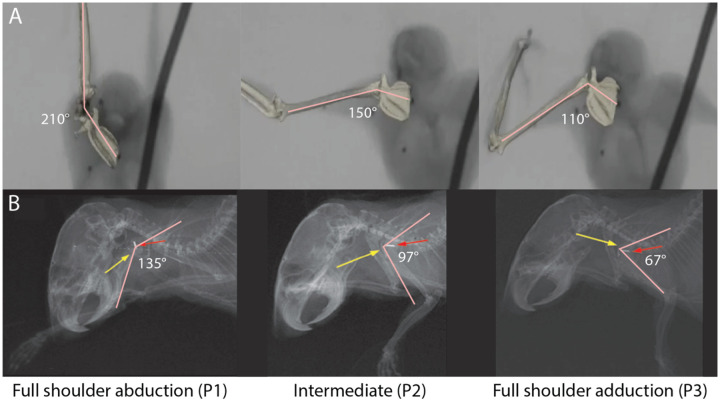
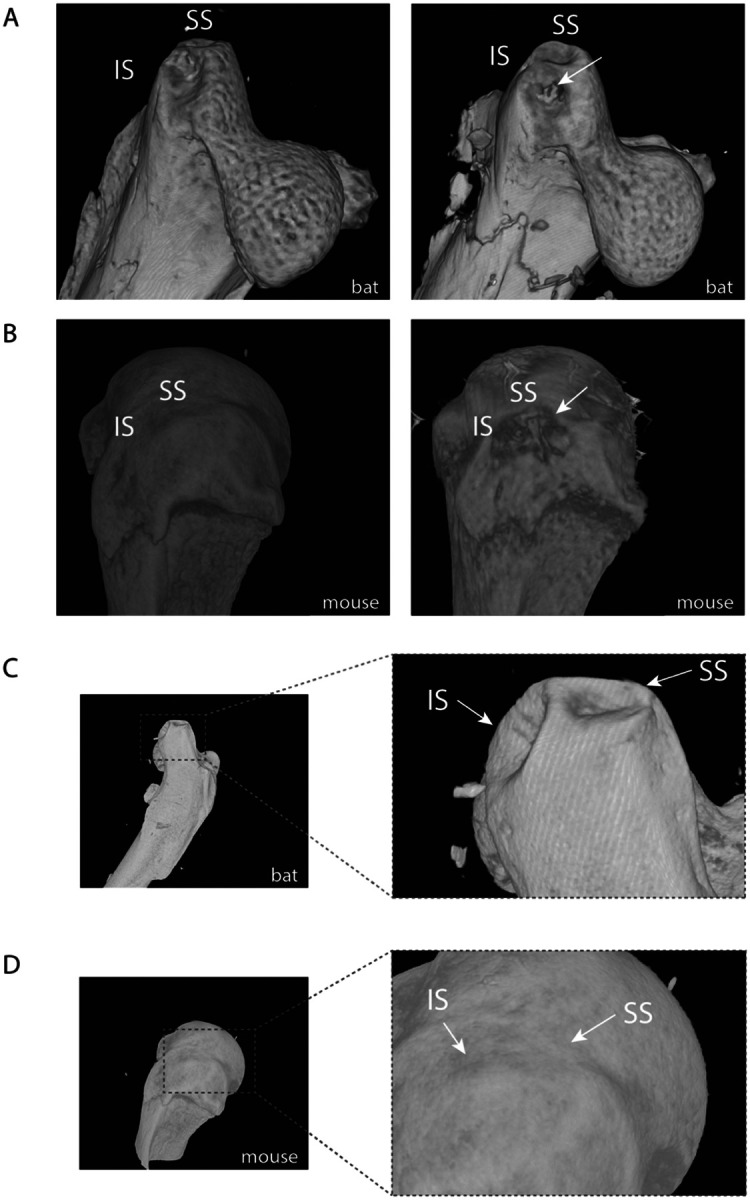
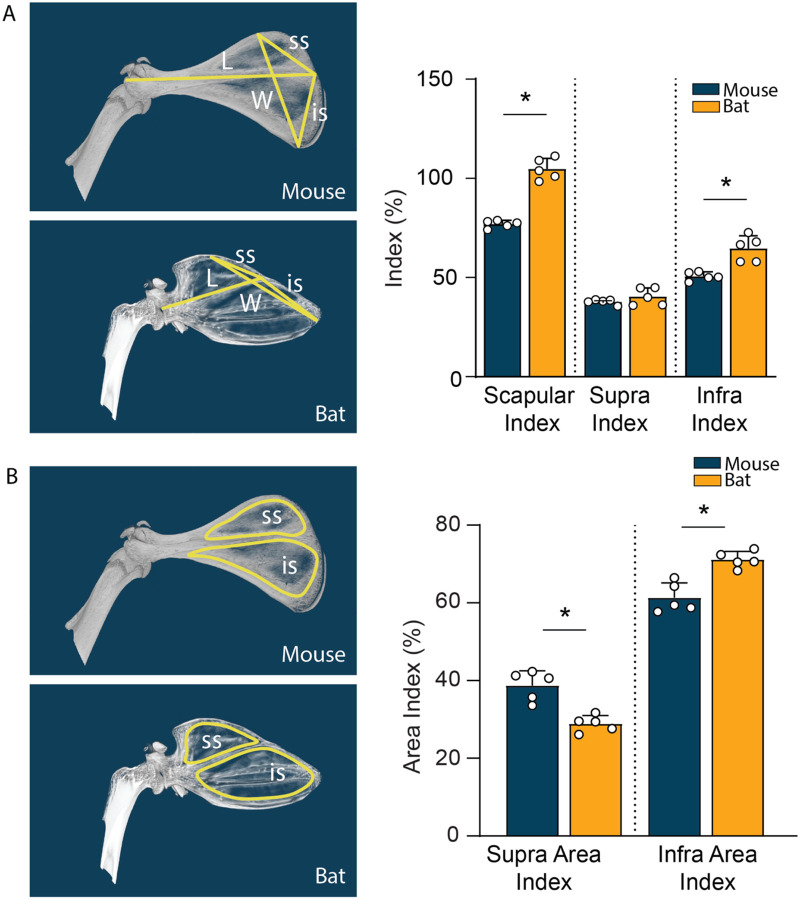
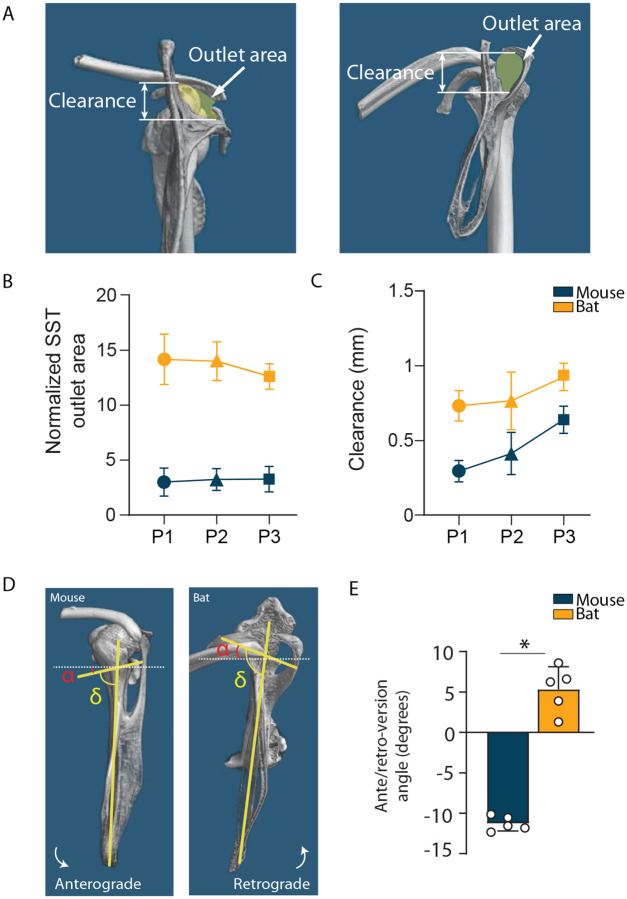
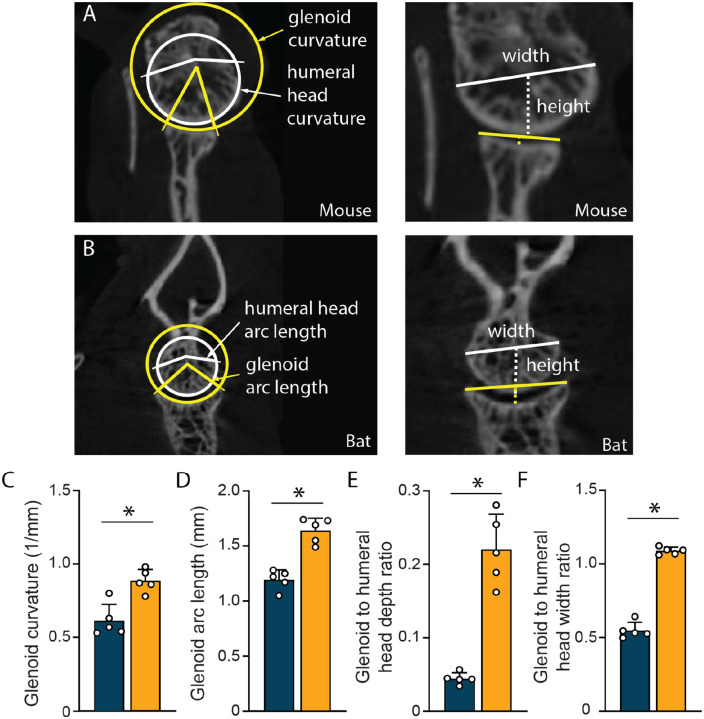
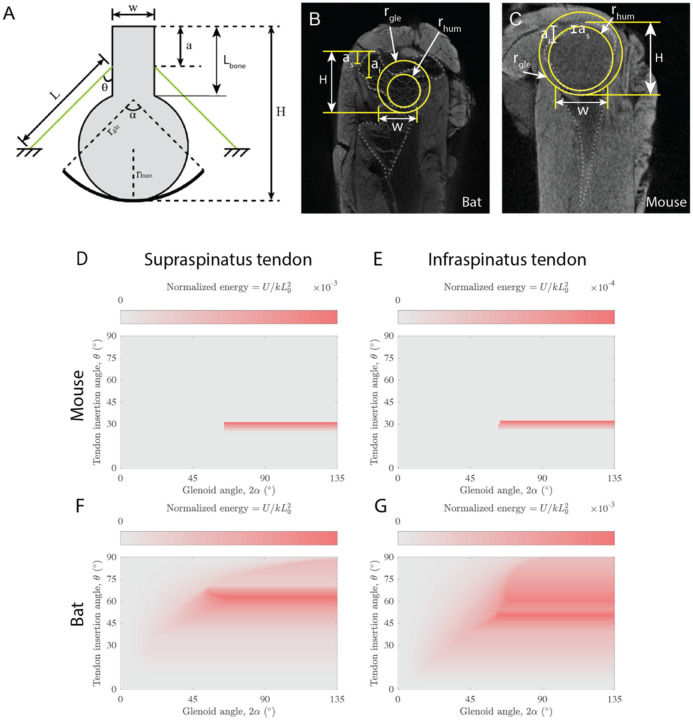
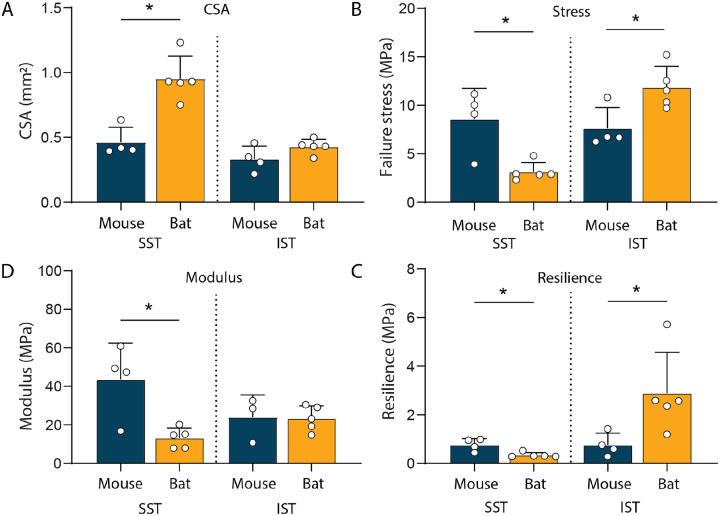
Overhead motion in humans often leads to shoulder injuries, a consequence of the evolutionary trade-off in glenohumeral joint anatomy that balances stability with mobility. Bats consistently engage in overhead motion during flight, subjecting their shoulders to substantial loading throughout their relatively long lifespan. Remarkably, despite the demands placed on a bat's shoulder, instability and rotator cuff tears, which could be fatal to bats in short order, are not observed in nature. We were thus inspired to study functional adaptations in the shoulders of bats that enable this overhead motion. Comparative anatomical studies of the shoulders of bats and mice, similarly-sized quadrupeds, were performed and interpreted using a mathematical model. Scapular anatomy indicated a more prominent role for the infraspinatus muscle in the bat compared to the mouse. Measurements of bat and mice shoulders revealed that the bat glenoid had a larger curvature and arc length than that of mice, providing a larger articulating surface area with and deeper enclosing surface of the humeral head. Modeling results predicted that the bat shoulder is stable over a dramatically larger range of angles compared to the mouse shoulder. These results suggested that adaptations to constraints imposed by the bony anatomy and rotator cuff tendons of the shoulder may contribute to the ability of bats to sustain overhead motion in a high stress, repeated loading environment without injury. Results suggest that bats have evolved unique adaptations in their glenohumeral bony anatomy that reduce stress on the supraspinatus, enhance joint stability, and optimize strength across a broad range of motion.
人类的上肢运动常常会导致肩部受伤,这是肩胛盂肱关节解剖结构进化权衡的结果,该结构在稳定性和灵活性之间取得平衡。蝙蝠在飞行过程中持续进行上肢运动,在其相对较长的寿命中,肩部承受着巨大的负荷。值得注意的是,尽管蝙蝠的肩部承受着如此大的压力,但在自然界中并未观察到可能会迅速对蝙蝠致命的肩部不稳定和肩袖撕裂现象。因此,我们受到启发,研究蝙蝠肩部的功能适应性,正是这些适应性使其能够进行这种上肢运动。我们对蝙蝠和体型相似的四足动物小鼠的肩部进行了比较解剖学研究,并使用数学模型进行解释。肩胛解剖表明,与小鼠相比,蝙蝠的冈下肌作用更为突出。对蝙蝠和小鼠肩部的测量显示,蝙蝠的肩胛盂曲率和弧长比小鼠的更大,为肱骨头提供了更大的关节表面面积和更深的包容表面。建模结果预测,与小鼠肩部相比,蝙蝠肩部在更大的角度范围内保持稳定。这些结果表明,对肩部骨骼解剖结构和肩袖肌腱所施加限制的适应性可能有助于蝙蝠在高压力、反复负荷的环境中持续进行上肢运动而不受伤。结果表明,蝙蝠在肩胛盂肱关节骨骼解剖结构方面进化出了独特的适应性,这些适应性能够减轻冈上肌的压力、增强关节稳定性,并在广泛的运动范围内优化力量。