Cui Ruichen, Hao Xiaohu, Cheng Jiahan, Rogado Jacobo, Pu Qiang, Zhu Yunke
Institute of Thoracic Oncology and Department of Thoracic Surgery, West China Hospital, Sichuan University, Chengdu, China.
Medical Oncology Department, Hospital Universitario de La Princesa, Madrid, Spain.
Transl Lung Cancer Res. 2025 Jun 30;14(6):2227-2238. doi: 10.21037/tlcr-2025-490. Epub 2025 Jun 23.
Small-cell lung cancer (SCLC) is a highly aggressive malignancy predominantly treated with chemotherapy or chemoradiotherapy. The role of surgical intervention in SCLC, however, remains inadequately defined. This study aimed to retrospectively analyze the clinical data of patients with SCLC who underwent surgical treatment to assess the impact of surgery combined with perioperative adjuvant therapy on long-term prognosis, with the goal of informing future treatment strategies.
This study included patients with SCLC who underwent surgical treatment at West China Hospital, Sichuan University, between 2005 and 2021. Prognostic factors influencing overall survival (OS) and disease-free survival (DFS) were analyzed using univariate and multivariate Cox regression models, in conjunction with the Kaplan-Meier method.
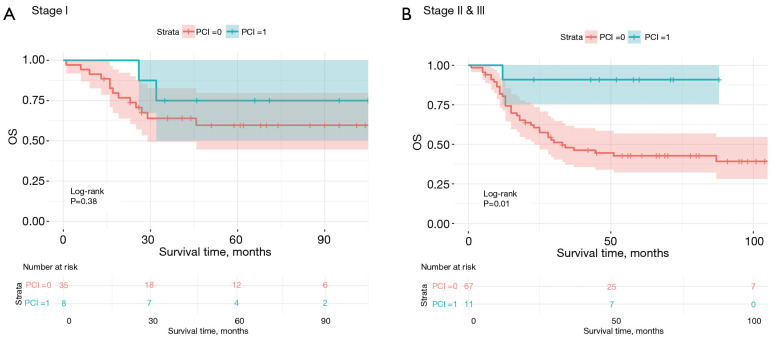
A cohort of 121 patients with SCLC who underwent surgical treatment was included. Multivariate Cox regression analysis indicated that postoperative adjuvant chemotherapy [hazard ratio (HR) =0.45; 95% confidence interval (CI): 0.24-0.85] was significantly associated with improved OS, whereas a smoking index exceeding 400 (HR =1.0011; 95% CI: 1.0004-1.0018) was identified as an independent adverse prognostic factor. Pathological stratification showed that prophylactic cranial irradiation (PCI) was significantly associated with improved OS in stage II/III patients (P<0.05) but had not in stage I patients (P>0.05). Regarding DFS, preoperative neoadjuvant chemotherapy was associated with significantly prolonged DFS (HR =0.44; 95% CI: 0.21-0.94), while lymph node metastasis was identified as a negative predictor (HR =1.97; 95% CI: 1.16-3.36).
Surgical intervention combined with perioperative adjuvant therapy provides significant survival benefits for patients with SCLC. Notably, preoperative neoadjuvant chemotherapy and postoperative adjuvant chemotherapy were associated with prolonged DFS and OS. For early-stage patients, the application of PCI should be approached cautiously. Further prospective studies are warranted to better balance its potential risks and benefits.
小细胞肺癌(SCLC)是一种侵袭性很强的恶性肿瘤,主要采用化疗或放化疗进行治疗。然而,手术干预在小细胞肺癌中的作用仍未得到充分明确。本研究旨在回顾性分析接受手术治疗的小细胞肺癌患者的临床资料,以评估手术联合围手术期辅助治疗对长期预后的影响,为未来的治疗策略提供参考。
本研究纳入了2005年至2021年期间在四川大学华西医院接受手术治疗的小细胞肺癌患者。使用单因素和多因素Cox回归模型,并结合Kaplan-Meier方法,分析影响总生存期(OS)和无病生存期(DFS)的预后因素。
共纳入121例接受手术治疗的小细胞肺癌患者。多因素Cox回归分析表明术后辅助化疗[风险比(HR)=0.45;95%置信区间(CI):0.24-0.85]与OS改善显著相关,而吸烟指数超过400(HR =1.0011;95%CI:1.0004-1.0018)被确定为独立的不良预后因素。病理分层显示,预防性颅脑照射(PCI)在II/III期患者中与OS改善显著相关(P<0.05),但在I期患者中无此关联(P>0.05)。关于DFS,术前新辅助化疗与DFS显著延长相关(HR =0.44;95%CI:0.21-0.94),而淋巴结转移被确定为阴性预测因素(HR =1.97;95%CI:1.16-3.36)。
手术干预联合围手术期辅助治疗为小细胞肺癌患者提供了显著的生存获益。值得注意的是,术前新辅助化疗和术后辅助化疗与DFS和OS延长相关。对于早期患者,PCI的应用应谨慎。有必要进行进一步的前瞻性研究,以更好地平衡其潜在风险和益处。