Zhang Jie, Wu Haipeng, Ren Xinxin, Chen Zhuoshi, Ye Siyu, Chen Shuchang, Fang Jie, Wu Qirou, Zhao Tiejun
Key Laboratory of Novel Targets and Drug Study for Neural Repair of Zhejiang Province, School of Medicine, Hangzhou City University, Hangzhou, China.
College of Pharmaceutical Science, Zhejiang University, Hangzhou, China.
Front Cell Dev Biol. 2025 Jul 2;13:1595362. doi: 10.3389/fcell.2025.1595362. eCollection 2025.
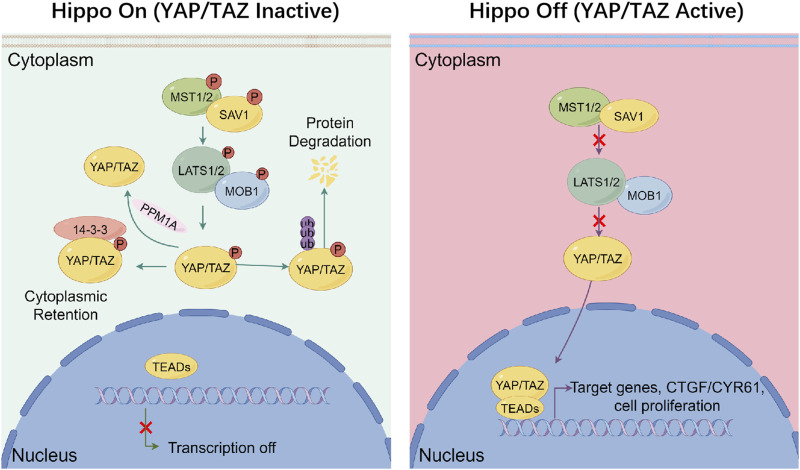
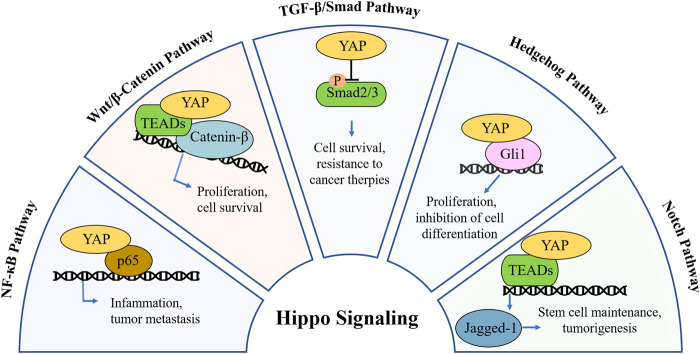
The Hippo/yes-associated protein (YAP) signaling is an evolutionarily conserved regulator in organ size control, which plays pivotal roles in cell proliferation, differentiation, apoptosis, and tissue regeneration. In cancer, dysregulation of Hippo/YAP signaling is typically recognized as one of the crucial drivers in tumorigenesis. However, beyond its canonical transcriptional targets, Hippo/YAP signaling engages in extensive crosstalk with multiple pathways to form an intricate regulatory network, thereby giving rise to its content-dependent influence on tumor initiation, progression and metastasis. This review focuses on the molecular mechanisms underlying the interplay between Hippo/YAP and pivotal signaling pathways such as nuclear factor kappa-light-chain-enhancer of activated B cells (NF-κB), wingless-type (Wnt)/β-catenin signaling pathway, transforming growth factor-beta (TGF-β), Hedgehog, Notch and other signaling pathways, as well as their implications in cancer biology. Ultimately, exploiting these mechanisms may represent promising therapeutic strategies for cancer.
河马/Yes相关蛋白(YAP)信号通路是一种在器官大小控制中进化保守的调节因子,在细胞增殖、分化、凋亡和组织再生中起关键作用。在癌症中,河马/YAP信号通路的失调通常被认为是肿瘤发生的关键驱动因素之一。然而,除了其经典的转录靶点外,河马/YAP信号通路还与多种途径进行广泛的串扰,形成一个复杂的调控网络,从而对肿瘤的起始、进展和转移产生与其内容相关的影响。本综述重点关注河马/YAP与关键信号通路(如活化B细胞核因子κB轻链增强子(NF-κB)、无翅型(Wnt)/β-连环蛋白信号通路、转化生长因子-β(TGF-β)、刺猬信号通路、Notch信号通路和其他信号通路)之间相互作用的分子机制,以及它们在癌症生物学中的意义。最终,利用这些机制可能代表着有前景的癌症治疗策略。