Garyudanefi Nadilla, Susetyo Puranto Budi
Ophthalmology Training Program, Gatot Soebroto Central Army Hospital, Mandala Tengah No. 25, Tomang, Jakarta, 11440, Indonesia.
Gatot Soebroto Central Army Hospital, Jakarta, Indonesia.
Int J Retina Vitreous. 2025 Jul 17;11(1):81. doi: 10.1186/s40942-025-00707-z.
A macular hole (MH) is a retinal condition affecting the central macula, leading to progressive visual impairment. Pars plana vitrectomy with internal limiting membrane (ILM) peeling is the standard surgical treatment, while the inverted ILM flap technique has emerged as a promising alternative. However, the effectiveness of this technique was still debated.
Randomized controlled trials (RCTs) comparing ILM peeling and inverted ILM flap for MH were identified through searches in PubMed, ScienceDirect, Cochrane Library, and ClinicalTrials.gov in the last 15 years that compared ILM peeling and inverted ILM flap procedure. The primary outcome was anatomical closure, and the secondary outcome was visual acuity (VA) post-procedure. Data synthesis was performed using Review Manager (RevMan) 5.4.1 with odds ratio (OR) for anatomical closure and mean difference (MD) for VA with 95% confidence interval (CI). Statistical significance is achieved when the p-value is below 0.05.
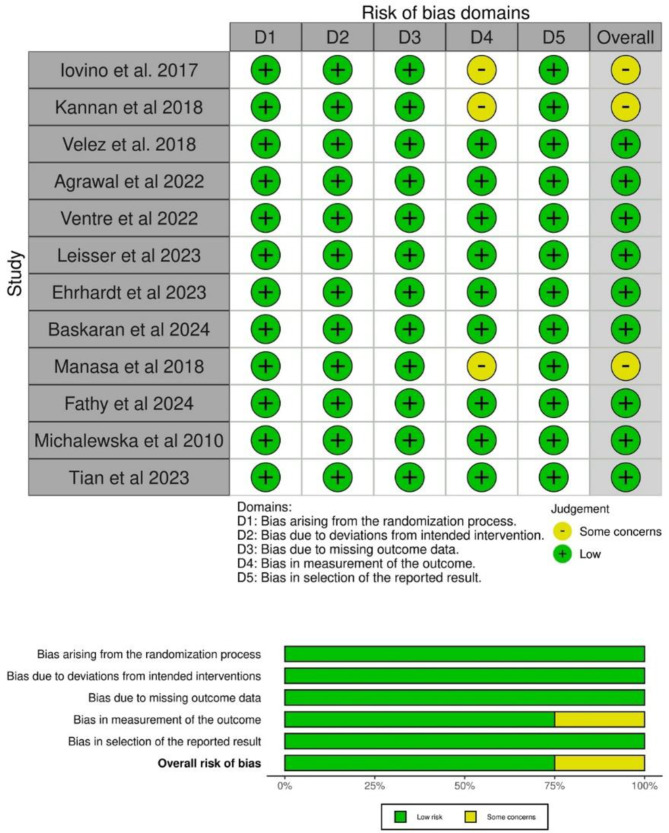
Twelve RCTs involving 719 patients were included. The inverted ILM flap showed superior anatomical closure (OR 0.28; 95% CI: 0.15-0.52; p < 0.0001). VA post-procedure, based on follow-up time (3-, 6-, and 12-month), revealed no statistically significant difference in visual outcomes. Sensitivity analyses confirmed anatomical and visual benefits of the inverted flap in large MHs (≥ 400 μm).
The inverted ILM flap technique offers better anatomical outcomes than ILM peeling, especially for larger MHs. Visual improvement is variable and may depend on MH chronicity and retinal recovery. Further high-quality studies are needed to confirm these findings.
黄斑裂孔(MH)是一种影响黄斑中心的视网膜疾病,会导致进行性视力损害。玻璃体切割联合内界膜(ILM)剥除术是标准的手术治疗方法,而反转ILM瓣技术已成为一种有前景的替代方法。然而,该技术的有效性仍存在争议。
通过检索过去15年的PubMed、ScienceDirect、Cochrane图书馆和ClinicalTrials.gov,确定了比较ILM剥除术和反转ILM瓣治疗MH的随机对照试验(RCT)。主要结局是解剖学上的闭合,次要结局是术后视力(VA)。使用Review Manager(RevMan)5.4.1进行数据合成,解剖学闭合的比值比(OR)和视力的平均差(MD)及其95%置信区间(CI)。当p值低于0.05时具有统计学意义。
纳入了12项涉及719例患者的RCT。反转ILM瓣显示出更好的解剖学闭合效果(OR 0.28;95%CI:0.15 - 0.52;p < 0.0001)。基于随访时间(3个月、6个月和12个月)的术后视力,在视觉结局上没有统计学上的显著差异。敏感性分析证实了反转瓣在大的MH(≥400μm)中的解剖学和视觉益处。
反转ILM瓣技术比ILM剥除术提供更好的解剖学结果,特别是对于较大的MH。视力改善情况不一,可能取决于MH的慢性程度和视网膜恢复情况。需要进一步的高质量研究来证实这些发现。