Wu Yueren, Li Yajun, Yang Qing, He Chaoyong, Tang Jianping, Shi Liyang, Dai Jianwu, Zhang Can
Hunan Research Center of the Basic Discipline for Cell Signaling, College of Biology, Hunan University, Changsha, 410000, China.
Chenxi Xinchuang Biological Technology Co., Ltd, Zhenjiang, 21200, China.
Bioact Mater. 2025 Jun 27;51:807-824. doi: 10.1016/j.bioactmat.2025.06.048. eCollection 2025 Sep.
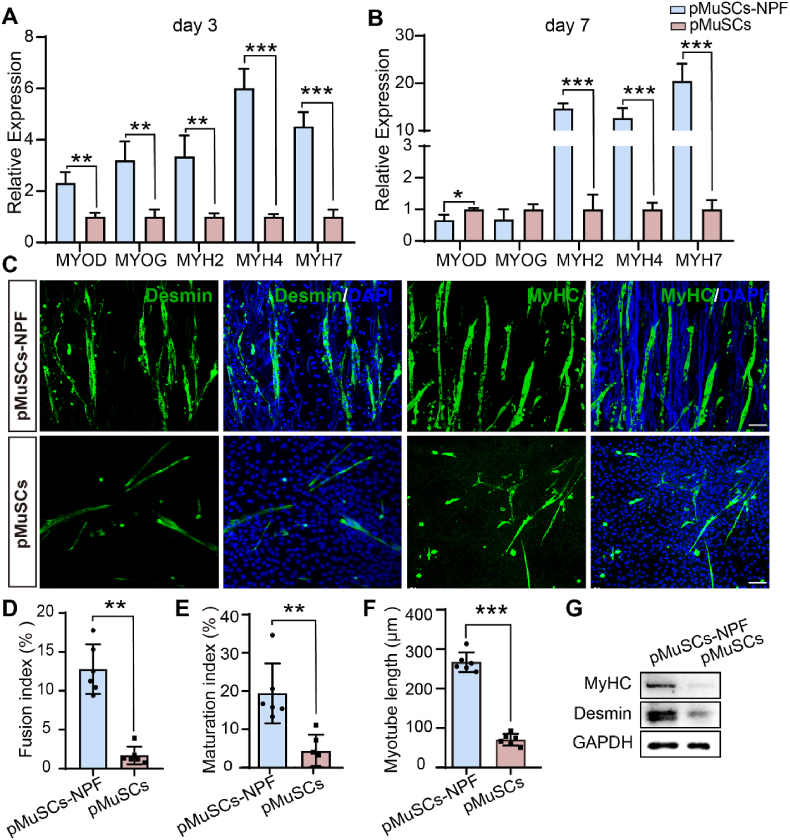
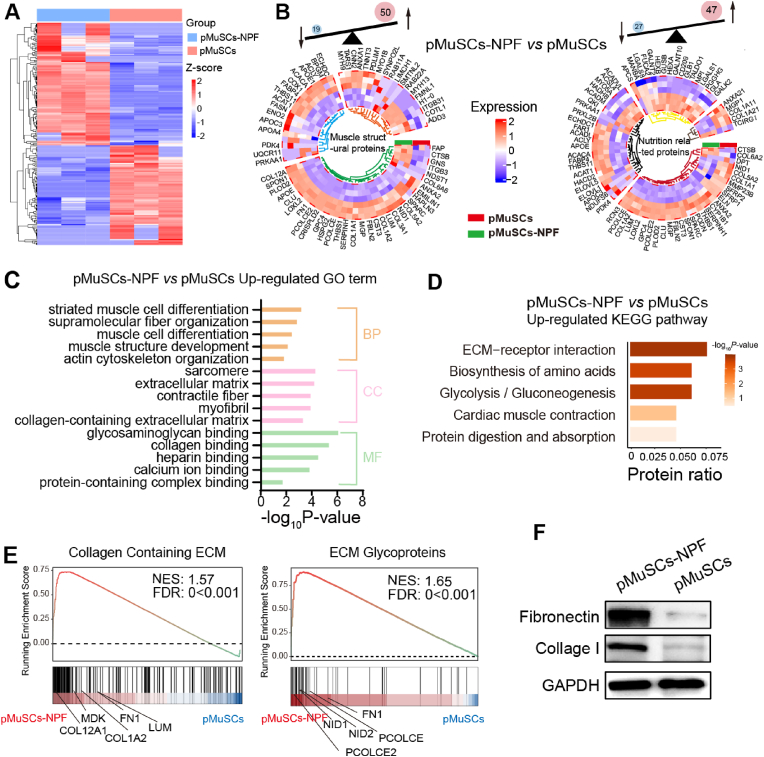
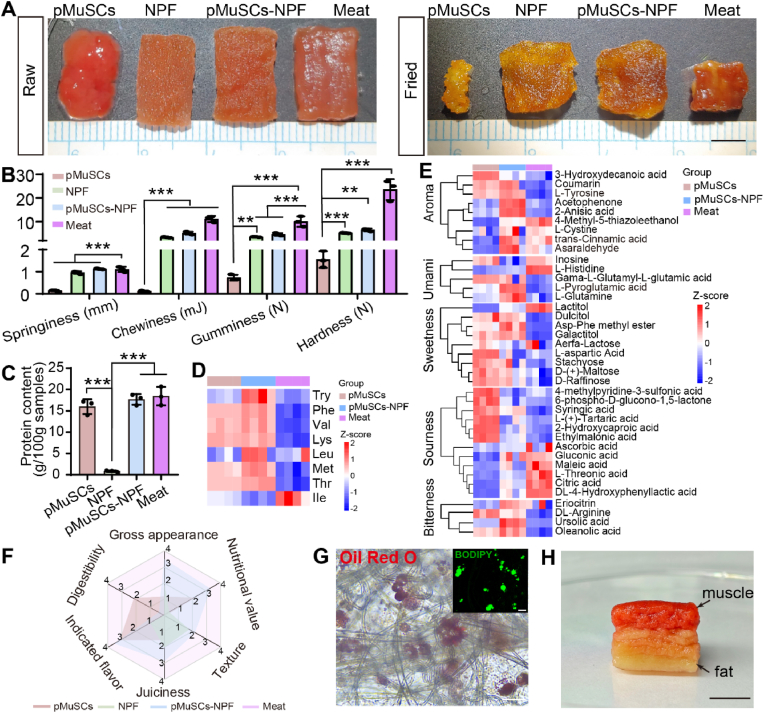
The expanding global population intensifies demand for sustainable protein sources. Cell-cultured meat (CM) offers a promising alternative to conventional meat production but faces challenges in scalability and food-grade scaffold design. Current scaffolds often fail to replicate muscle tissue's structural and mechanical properties or support large-scale CM production. Moreover, the sensory and nutritional qualities of CM remain understudied. Here, we developed a novel lotus fiber-based natural plant fiber (NPF) scaffold mimicking native muscle tissue architecture. Porcine muscle stem cells (pMuSCs) were cultured on the NPF scaffold (pMuSCs-NPF), and their viability, proliferation, and differentiation were evaluated. The NPF scaffolds exhibited high biocompatibility and promoted pMuSCs alignment and differentiation into organized myotubes, as evidenced by enhanced expression of myogenic markers (MYOD, MYOG, MyHC) and extracellular matrix (ECM) components (desmin, fibronectin). Multi-omics analyses revealed substantial upregulation of genes and proteins associated with muscle development and ECM remodeling in pMuSCs-NPF compared to conventional plastic culture. Sensory and nutritional analyses indicated that the resulting CM closely resembled traditional meat in appearance, texture, and nutritional profile, with comparable levels of protein and essential amino acids. Moreover, the NPF scaffold demonstrated scalability and supported adipogenic differentiation, which is vital for imparting meat-like flavor and texture. These findings establish NPF scaffolds as a viable and cost-effective platform for sustainable CM cultivation.
全球人口不断增长,对可持续蛋白质来源的需求日益增加。细胞培养肉(CM)为传统肉类生产提供了一种有前景的替代方案,但在可扩展性和食品级支架设计方面面临挑战。目前的支架往往无法复制肌肉组织的结构和力学性能,也无法支持大规模的细胞培养肉生产。此外,细胞培养肉的感官和营养品质仍未得到充分研究。在此,我们开发了一种新型的基于莲花纤维的天然植物纤维(NPF)支架,其模仿了天然肌肉组织结构。将猪肌肉干细胞(pMuSCs)接种在NPF支架(pMuSCs-NPF)上,并对其活力、增殖和分化进行评估。NPF支架表现出高生物相容性,并促进pMuSCs排列和分化为有组织的肌管,成肌标志物(MYOD、MYOG、MyHC)和细胞外基质(ECM)成分(结蛋白、纤连蛋白)表达增强证明了这一点。多组学分析显示,与传统塑料培养相比,pMuSCs-NPF中与肌肉发育和ECM重塑相关的基因和蛋白质大量上调。感官和营养分析表明,所得的细胞培养肉在外观、质地和营养成分上与传统肉类非常相似,蛋白质和必需氨基酸水平相当。此外,NPF支架显示出可扩展性,并支持脂肪生成分化,这对于赋予肉样风味和质地至关重要。这些发现确立了NPF支架作为可持续细胞培养肉培育的可行且经济高效的平台。