Bryant Edward M, Jordán Andrés, Hartman Joel D, Bayliss Daniel, Sedaghati Elyar, Barkaoui Khalid, Chouqar Jamila, Pozuelos Francisco J, Thorngren Daniel P, Timmermans Mathilde, Almenara Jose Manuel, Chilingarian Igor V, Collins Karen A, Gan Tianjun, Howell Steve B, Narita Norio, Palle Enric, Rackham Benjamin V, Triaud Amaury H M J, Bakos Gaspar Á, Brahm Rafael, Hobson Melissa J, Van Eylen Vincent, Amado Pedro J, Arnold Luc, Bonfils Xavier, Burdanov Artem, Cadieux Charles, Caldwell Douglas A, Casanova Victor, Charbonneau David, Clark Catherine A, Collins Kevin I, Daylan Tansu, Dransfield Georgina, Demory Brice-Olivier, Ducrot Elsa, Fernández-Rodríguez Gareb, Fukuda Izuru, Fukui Akihiko, Gillon Michaël, Gore Rebecca, Hooton Matthew J, Ikuta Kai, Jehin Emmanuel, Jenkins Jon M, Levine Alan M, Littlefield Colin, Murgas Felipe, Nguyen Kendra, Parviainen Hannu, Queloz Didier, Seager S, Sebastian Daniel, Srdoc Gregor, Vanderspek R, Winn Joshua N, de Wit Julien, Zúñiga-Fernández Sebastián
Department of Space and Climate Physics, Mullard Space Science Laboratory, University College London, Holmbury St Mary, UK.
Department of Physics, University of Warwick, Coventry, UK.
Nat Astron. 2025;9(7):1031-1044. doi: 10.1038/s41550-025-02552-4. Epub 2025 Jun 4.
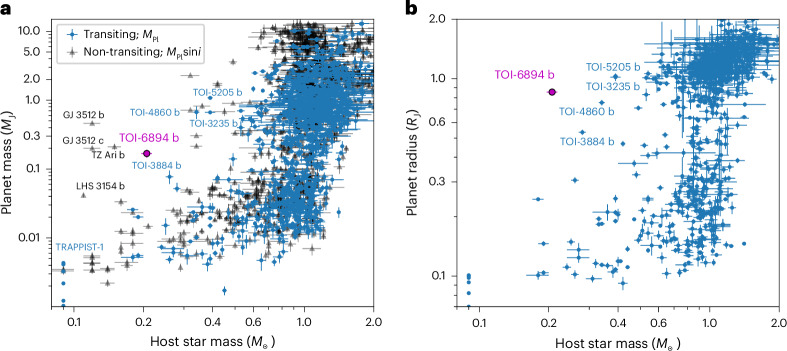
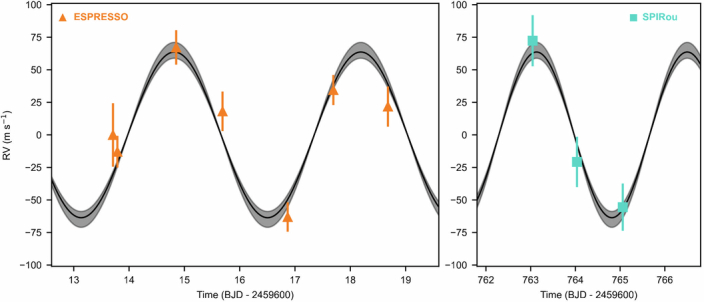
Planet formation models indicate that the formation of giant planets is substantially harder around low-mass stars due to the scaling of protoplanetary disc masses with stellar mass. The discovery of giant planets orbiting such low-mass stars thus imposes strong constraints on giant planet formation processes. Here we report the discovery of a transiting giant planet orbiting a 0.207 ± 0.011 star. The planet, TOI-6894 b, has a mass and radius of = 0.168 ± 0.022 (53.4 ± 7.1 ) and = 0.855 ± 0.022 and probably includes 12 ± 2 of metals. The discovery of TOI-6894 b highlights the need for a better understanding of giant planet formation mechanisms and the protoplanetary disc environments in which they occur. The extremely deep transits (17% depth) make TOI-6894 b one of the most accessible exoplanetary giants for atmospheric characterization observations, which will be key for fully interpreting the formation history of this notable system and for the study of atmospheric methane chemistry.
行星形成模型表明,由于原行星盘质量与恒星质量的比例关系,在低质量恒星周围形成巨行星要困难得多。因此,发现围绕此类低质量恒星运行的巨行星对巨行星形成过程施加了严格限制。在此,我们报告发现一颗凌日巨行星,它围绕一颗质量为0.207±0.011 的恒星运行。这颗行星TOI - 6894 b的质量和半径分别为 = 0.168±0.022 (53.4±7.1 )和 = 0.855±0.022 ,并且可能含有12±2 的金属。TOI - 6894 b的发现凸显了更好地理解巨行星形成机制以及它们所处的原行星盘环境的必要性。极其深的凌日现象(深度达17%)使TOI - 6894 b成为最便于进行大气特征观测的系外巨行星之一,这对于全面解读这个显著系统的形成历史以及研究大气甲烷化学至关重要。