
控释肥料影响叶片氮素分配和光合作用,以提高向日葵田的氮素利用效率和产量。
Controlled-release fertilizer affects leaf nitrogen allocation and photosynthesis to improve nitrogen use efficiency and yield in the sunflower field.
作者信息
Ren Wenhao, Li Xianyue, Liu Tingxi, Chen Ning, Xin Maoxin, Qi Qian, Liu Bin
机构信息
National Key Laboratory of Ecological Environment of Arid Region Water Engineering, Inner Mongolia Agricultural University, Huhhot, China.
Collaborative Innovation Center for Integrated Management of Water Resources and Water Environment in the Inner Mongolia Reaches of the Yellow River, Hohhot, China.
出版信息
Front Plant Sci. 2025 Jul 7;16:1622766. doi: 10.3389/fpls.2025.1622766. eCollection 2025.
INTRODUCTION
Nitrogen (N) can significantly affect the photosynthetic rate (Pn) of plants. Under traditional nitrogen fertilization (TNF) or inappropriate nitrogen application, leaf N is often redistributed to support the seed protein accumulation rather than the photosynthesis in the later stages of crop growth. Controlled-release fertilizers (CRF) have been reported to effectively reduce the nitrogen loss by matching the release pattern with crop N demand, thus increasing the yield. However, the changes in N allocation to enhance the photosynthesis under CRF have rarely been addressed.
METHODS
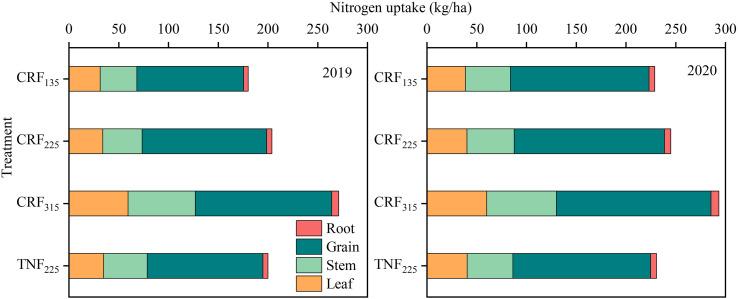
A two-year field experiment was conducted in the Hetao Irrigation District, Inner Mongolia, China from 2019 to 2020 to evaluate the effects of different fertilization strategies on soil NO-N concentration, leaf nitrogen content, photosynthetic characteristics, yield, and nitrogen use efficiency (NUE) in sunflowers. The treatments included the CRF application rates of 135, 225, and 315 kg/ha (CRF, CRF, and CRF), and that of TNF at 225 kg/ha (TNF).
RESULTS
The results demonstrated that applying CRF at an appropriate rate maintained a high level of photosynthetic nitrogen content in the leaves during the later growth stages. This rate ensured a suitable soil NO-N concentration (SNC), resulting in a 76.10% higher proportion of photosynthetic nitrogen (N) than TNF at the same rate, significantly enhancing the photosynthetic nitrogen efficiency (PNUE) and highlighting the crucial role of nitrogen management in improving the crop productivity and NUE. Additionally, at CRF, the net photosynthesis (Pn), stomatal conductance (Gs), and intercellular CO concentration (Ci) at maturity increased by 32.80%, 96.16%, and 13.56%, respectively, compared to TNF, leading to an 11.84% improvement in yield and a 9.70% increase in NUE.
DISCUSSION
The correlation analysis confirmed a strong positive relationship between leaf N redistribution and photosynthetic efficiency, demonstrating the potential of CRF to improve the photosynthetic efficiency, optimize the N management, and promote the environmental sustainability in sunflower cultivation.
引言
氮(N)会显著影响植物的光合速率(Pn)。在传统氮肥施用(TNF)或氮肥施用不当的情况下,叶片中的氮在作物生长后期常被重新分配,以支持种子蛋白质积累,而非光合作用。据报道,控释肥料(CRF)通过使释放模式与作物氮需求相匹配,有效减少了氮素损失,从而提高了产量。然而,关于控释肥料下氮分配变化以增强光合作用的研究却很少。
方法
2019年至2020年在中国内蒙古河套灌区进行了为期两年的田间试验,以评估不同施肥策略对向日葵土壤硝态氮浓度、叶片氮含量、光合特性、产量和氮素利用效率(NUE)的影响。处理包括135、225和315 kg/ha的控释肥料施用量(分别记为CRF、CRF、CRF),以及225 kg/ha的传统氮肥施用量(TNF)。
结果
结果表明,以适当比例施用控释肥料在生长后期能使叶片中的光合氮含量维持在较高水平。这一比例确保了适宜的土壤硝态氮浓度(SNC),使得光合氮(N)的比例比相同施用量的传统氮肥高出76.10%,显著提高了光合氮效率(PNUE),突出了氮管理在提高作物生产力和氮素利用效率方面的关键作用。此外,与传统氮肥相比,控释肥料处理下成熟期的净光合速率(Pn)、气孔导度(Gs)和胞间CO₂浓度(Ci)分别提高了32.80%、96.16%和13.56%,产量提高了11.84%,氮素利用效率提高了9.70%。
讨论
相关性分析证实了叶片氮再分配与光合效率之间存在很强的正相关关系,表明控释肥料在提高光合效率、优化氮管理以及促进向日葵种植的环境可持续性方面具有潜力。


 Zotero 插件