Kulkarni Tejaswini, Santiaguel Joel, Aul Raminder, Harnett Mark, Krop Julie, Chen Michael C, Graham Camilla S, Maher Toby M
Division of Pulmonary and Critical Care Medicine, Department of Medicine, University of Alabama at Birmingham, Birmingham, AL, USA.
Division of Pulmonary Medicine, Department of Medicine, Philippine General Hospital, Manila, Philippines.
ERJ Open Res. 2025 Jul 21;11(4). doi: 10.1183/23120541.01142-2024. eCollection 2025 Jul.
The pathophysiology of respiratory complications in post-acute sequelae of severe acute respiratory syndrome coronavirus 2 (SARS-CoV-2) infection (PASC) is poorly understood, but a high incidence of progressive pulmonary fibrosis was anticipated. Deupirfenidone (LYT-100) is a selectively deuterated form of pirfenidone that retains antifibrotic and anti-inflammatory activity but with improved tolerability. This study evaluated the safety and efficacy of deupirfenidone in PASC patients with respiratory complications.
Global, double-blind, randomised placebo-controlled trial evaluating 750 mg deupirfenidone twice daily placebo for 3 months in PASC patients with respiratory complications following hospitalisation for acute COVID-19 infection severe enough to necessitate supplemental oxygen (NCT04652518).
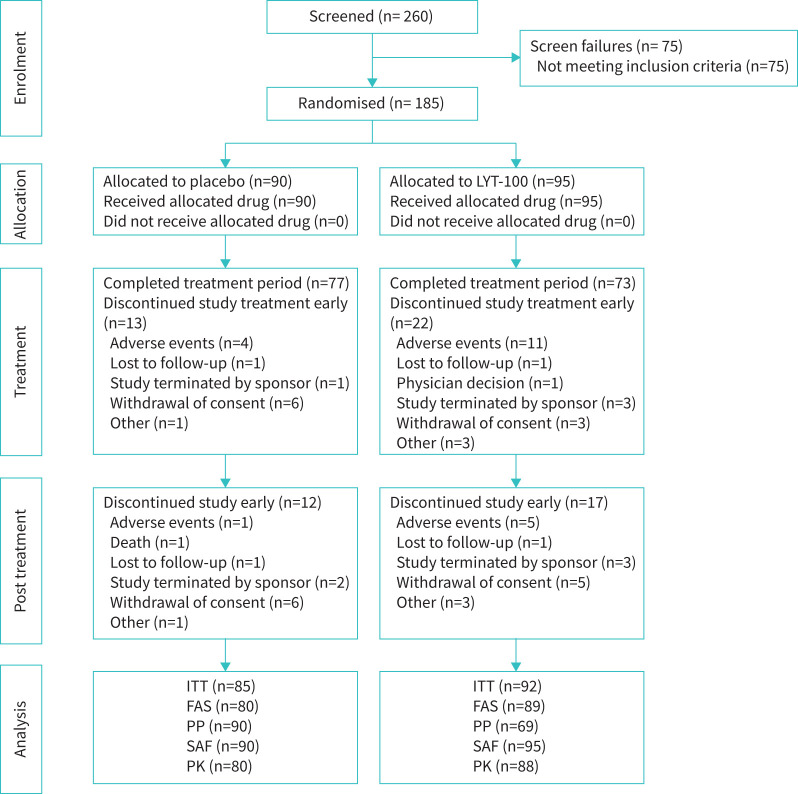
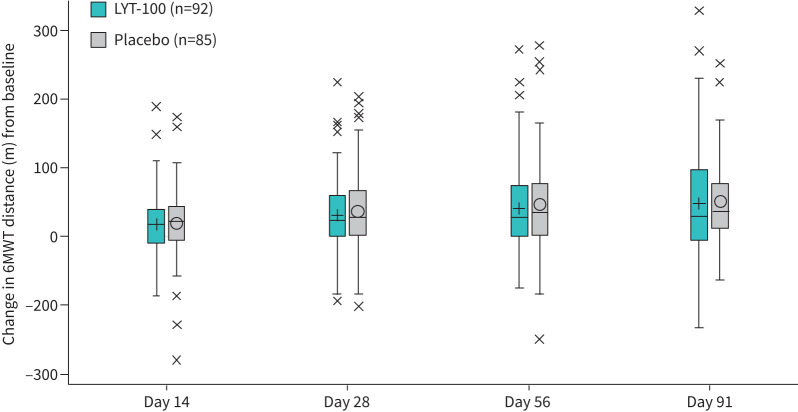
185 patients were randomised and treated (95 with deupirfenidone, 90 with placebo), with 177 included in the modified intention-to-treat population. The mean age was 54.5 years, 62.7% were male and 10.7% had prior mechanical ventilation. The 6-min walk distance improved across both arms between baseline and day 91 (deupirfenidone 44.3 m (95% CI 24.8-63.8 m) placebo 48.8 m (95% CI 29.2-68.4 m); p=0.70). The most common treatment-emergent adverse events (TEAEs) for deupirfenidone placebo were nausea (9.5% 1.1%), upper abdominal discomfort (5.3% 2.2%) and dyspepsia (6.3% 1.1%). TEAEs leading to trial drug discontinuation were 11.6% for deupirfenidone and 4.4% for placebo. The proportion of discontinuations considered at least possibly related to treatment was 8.6% for deupirfenidone and 2.4% for placebo.
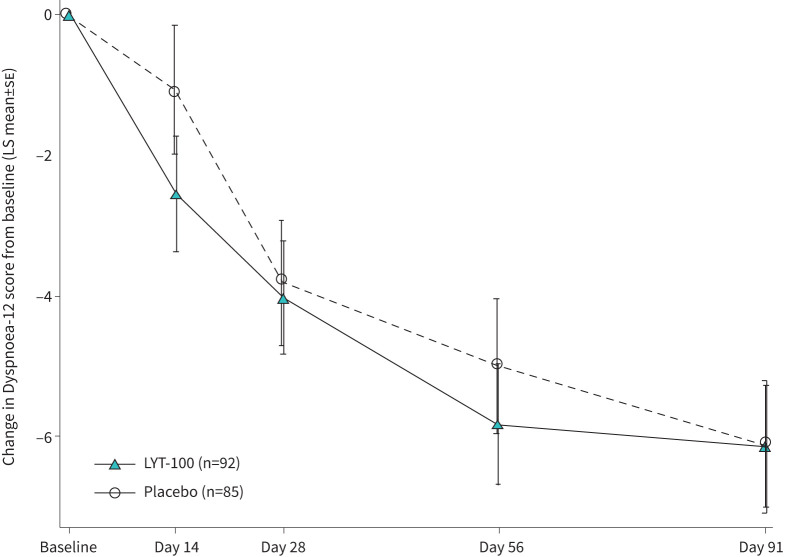
Most patients with PASC and respiratory complications showed significant improvement over 91 days irrespective of treatment assignment. Deupirfenidone was well tolerated, with low rates of TEAEs, which supports further investigation in patients with idiopathic pulmonary fibrosis.
严重急性呼吸综合征冠状病毒2(SARS-CoV-2)感染后急性后遗症(PASC)中呼吸并发症的病理生理学尚不清楚,但预计进行性肺纤维化的发生率较高。氘吡非尼酮(LYT-100)是吡非尼酮的一种选择性氘代形式,保留了抗纤维化和抗炎活性,但耐受性有所改善。本研究评估了氘吡非尼酮在患有呼吸并发症的PASC患者中的安全性和有效性。
一项全球、双盲、随机、安慰剂对照试验,对因急性COVID-19感染住院且严重到需要补充氧气的患有呼吸并发症的PASC患者,每日两次服用750mg氘吡非尼酮或安慰剂,为期3个月(NCT04652518)。
185名患者被随机分组并接受治疗(95名接受氘吡非尼酮治疗,90名接受安慰剂治疗),177名被纳入改良意向性治疗人群。平均年龄为54.5岁,62.7%为男性,10.7%曾接受过机械通气。在基线至第91天期间,两组患者的6分钟步行距离均有所改善(氘吡非尼酮组改善44.3m(95%CI 24.8 - 63.8m),安慰剂组改善48.8m(95%CI 29.2 - 68.4m);p = 0.70)。氘吡非尼酮组和安慰剂组最常见的治疗中出现的不良事件(TEAE)分别为恶心(9.5%对1.1%)、上腹部不适(5.3%对2.2%)和消化不良(6.3%对1.1%)。导致试验药物停用的TEAE在氘吡非尼酮组为11.6%,在安慰剂组为4.4%。被认为至少可能与治疗相关的停药比例在氘吡非尼酮组为8.6%,在安慰剂组为2.4%。
大多数患有PASC和呼吸并发症的患者在91天内无论治疗分配如何均有显著改善。氘吡非尼酮耐受性良好,TEAE发生率低,这支持在特发性肺纤维化患者中进一步研究。