Xinpeng Xie, Xiaoting Wei, Sheng Lin
Department of Surgical Intensive Care Unit, Yantaishan Hospital Affiliated to Binzhou Medical University, Yantai, Shandong Province, China.
Medicine (Baltimore). 2025 Jul 18;104(29):e43517. doi: 10.1097/MD.0000000000043517.
Serotonin syndrome (SS) is a potentially life-threatening condition characterized by autonomic and muscular hyperactivity resulting from the use of serotonergic drugs that bind to peripheral or central postsynaptic serotonin receptors. This syndrome can be easily confused with other clinical conditions, leading to delays in diagnosis and jeopardizing vital prognosis. Linezolid is utilized in the clinical management of gram-positive coccal infections, while pentazocine, an opioid analgesic, is frequently employed for pain relief in trauma patients. Currently, there are limited reports documenting the occurrence of SS associated with linezolid and pentazocine. In this report, we present the case of a 32-year-old man who developed SS following simultaneous administration of linezolid and pentazocine; his symptoms were effectively managed upon discontinuation of these medications.
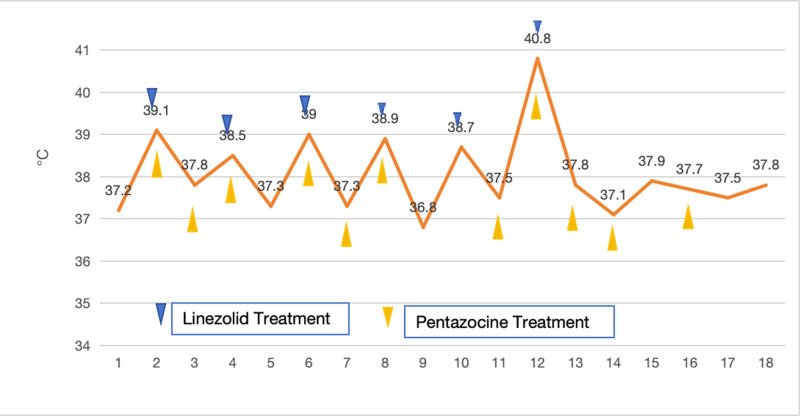
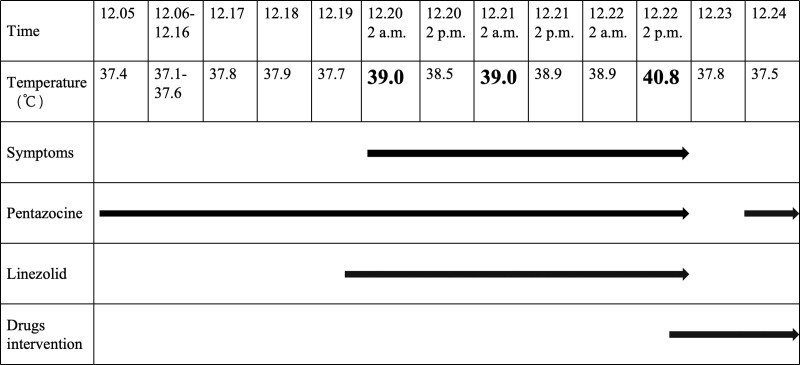
A 32-year-old male patient was treated with pentazocine and linezolid for pain management related to trauma as well as for a gram-positive coccal infection. One hour after administration, he exhibited tremors in his right limb along with hand tremors, profuse sweating, and sinus tachycardia; his body temperature subsequently rose to 40°C. Laboratory tests including white blood cell count, procalcitonin levels, and C-reactive protein, showed no significant changes compared to previous results. A follow-up computed tomography scan of the head revealed no new ischemic lesions.
The patient's physical examination, vital signs, and laboratory results were consistent with SS.
Linezolid and pentazocine were discontinued immediately. Midazolam (3-6 µg/kg/h) and dexmedetomidine (0.1-0.3 µg/kg/h) were administered, and oral diazepam (2.5 mg 3 times daily) was gradually continued.
Following this treatment regimen, the patient's profuse sweating improved significantly, and he became stable overall; his body temperature gradually returned to normal levels. Subsequently, the patient was transferred from the surgical intensive care unit to a general ward after 7 days of treatment.
Although SS is not very common in patients using pentazocine and linezolid separately, it is important because it is an emergency condition that can result in death if not treated appropriately. This clinical case highlights the importance of thoroughly understanding the clinical manifestations of SS to ensure early and appropriate treatment management.
血清素综合征(SS)是一种潜在的危及生命的疾病,其特征为使用与外周或中枢突触后血清素受体结合的血清素能药物后出现自主神经和肌肉活动亢进。该综合征容易与其他临床病症混淆,导致诊断延误并危及重要预后。利奈唑胺用于革兰氏阳性球菌感染的临床治疗,而阿片类镇痛药喷他佐辛常用于创伤患者的疼痛缓解。目前,关于利奈唑胺和喷他佐辛联用导致血清素综合征的报道有限。在本报告中,我们呈现了一名32岁男性在同时服用利奈唑胺和喷他佐辛后发生血清素综合征的病例;停用这些药物后其症状得到有效控制。
一名32岁男性患者因创伤相关疼痛以及革兰氏阳性球菌感染接受喷他佐辛和利奈唑胺治疗。用药1小时后,他出现右上肢震颤、手部震颤、大汗淋漓以及窦性心动过速;随后体温升至40°C。包括白细胞计数、降钙素原水平和C反应蛋白在内的实验室检查结果与之前相比无显著变化。头部的后续计算机断层扫描未发现新的缺血性病变。
患者的体格检查、生命体征和实验室检查结果与血清素综合征相符。
立即停用利奈唑胺和喷他佐辛。给予咪达唑仑(3 - 6 μg/kg/h)和右美托咪定(0.1 - 0.3 μg/kg/h),并逐渐持续口服地西泮(每日3次,每次2.5 mg)。
经过该治疗方案,患者的大汗淋漓情况显著改善,总体情况趋于稳定;体温逐渐恢复正常水平。随后,治疗7天后患者从外科重症监护病房转至普通病房。
虽然血清素综合征在单独使用喷他佐辛和利奈唑胺的患者中并不常见,但它很重要,因为这是一种紧急情况,若治疗不当可能导致死亡。该临床病例凸显了全面了解血清素综合征临床表现以确保早期和适当治疗管理的重要性。