Ruas Cassio V, Carlos Bruna M, Feitosa Saulo, Silva Márcio Vinícius, Vazquez Pedro, Pontes Larissa L, Silvestre Jayne, Almeida Sara R M, Brandão Alexandre F, Castellano Gabriela
Brazilian Institute of Neuroscience and Neurotechnology (BRAINN), University of Campinas (UNICAMP), São Paulo, Campinas, Brazil.
Institute of Physics Gleb Wataghin, University of Campinas (UNICAMP), São Paulo, Campinas, Brazil.
Neural Plast. 2025 Jul 15;2025:5688648. doi: 10.1155/np/5688648. eCollection 2025.
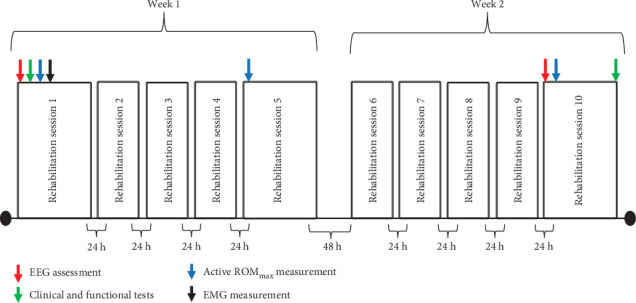
Rehabilitation methods that include anodal transcranial direct current stimulation (tDCS) and extended reality (XR) exercises have been used to enhance neural networks and improve functional performance in stroke patients, but the neuromuscular and neurophysiological mechanisms underlying these improvements are not fully understood. The purpose of this study was to examine the effects of tDCS during XR rehabilitation exercises on cortical, neuromuscular, and clinical outcomes of stroke survivors. Nineteen chronic stroke survivors were placed into either a transcranial direct current stimulation (tDCS) or a group, without significant ( > 0.73) differences in the baseline levels of disability between groups. The tDCS group received active tDCS and the group received sham tDCS applied on the ipsilesional primary motor cortex (M1) while performing a 10-session XR rehabilitation program. Surface electromyography (EMG) activity was recorded from deltoid and rectus femoris of the paretic limb without and with the application of active/sham tDCS on the M1. Shoulder abduction and hip flexion active maximum joint range of motion (ROM), electroencephalography (EEG)-derived brain symmetry index (BSI) and functional/clinical tests were assessed before and after the rehabilitation program. EMG activity was ~ 31% greater during hip flexion of the paretic limb with the application of active tDCS than without tDCS (=0.04). Paretic hip flexion ROM increased by ~ 26%, BSI decreased by ~ 72% (indicating greater brain symmetry) and timed up and go (TUG) functional test improved by ~ 11% from before to after the rehabilitation program for the tDCS group only ( < 0.05). No other significant differences ( > 0.05) were observed. It seems that the application of active tDCS targeted the ipsilesional M1 representation of the quadriceps, which potentiated muscle activation in the paretic rectus femoris during XR exercises and resulted in greater motor recovery in hip flexion movements. The EEG-derived BSI results also indicate that tDCS was effective in reorganizing the ipsilesional hemisphere brain activity after stroke.
包括阳极经颅直流电刺激(tDCS)和扩展现实(XR)训练在内的康复方法已被用于增强中风患者的神经网络并改善其功能表现,但这些改善背后的神经肌肉和神经生理机制尚未完全明确。本研究的目的是探讨在XR康复训练期间进行tDCS对中风幸存者的皮质、神经肌肉和临床结局的影响。19名慢性中风幸存者被分为经颅直流电刺激(tDCS)组或对照组,两组之间的残疾基线水平无显著差异(>0.73)。tDCS组接受主动tDCS,对照组在进行为期10节的XR康复计划时,在患侧初级运动皮层(M1)施加伪tDCS。在M1施加主动/伪tDCS时和未施加时,记录患侧肢体三角肌和股直肌的表面肌电图(EMG)活动。在康复计划前后评估肩部外展和髋关节屈曲的主动最大关节活动范围(ROM)、脑电图(EEG)衍生的脑对称指数(BSI)以及功能/临床测试。与未施加tDCS相比,施加主动tDCS时患侧肢体髋关节屈曲期间的EMG活动增加了约31%(P=0.04)。仅tDCS组从康复计划前到康复计划后,患侧髋关节屈曲ROM增加了约26%,BSI降低了约72%(表明脑对称性增强),定时起立行走(TUG)功能测试改善了约11%(P<0.05)。未观察到其他显著差异(P>0.05)。似乎主动tDCS的应用针对了股四头肌在患侧M1的代表区,这增强了XR训练期间患侧股直肌的肌肉激活,并导致髋关节屈曲运动中更大程度的运动恢复。EEG衍生的BSI结果还表明,tDCS在中风后重组患侧半球脑活动方面是有效的。