Wada Ken, Oga Kenichi, Minao Nozomu, Sugita Takahiro
Department of Psychiatry, Hiroshima Citizens Hospital Hiroshima City Hospital Organization Hiroshima Japan.
Department of Psychiatry Cocoro Hospital Kusatsu Hiroshima Japan.
PCN Rep. 2025 Jul 21;4(3):e70149. doi: 10.1002/pcn5.70149. eCollection 2025 Sep.
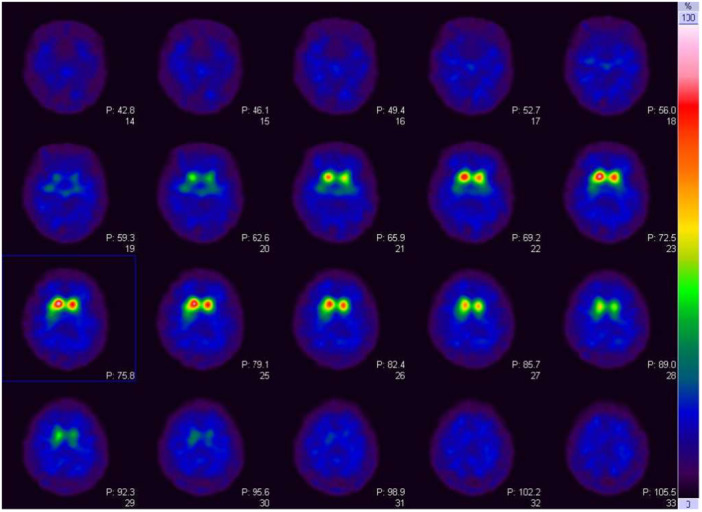
In rare instances, Parkinson's disease may develop in patients with schizophrenia receiving antipsychotic treatment, highlighting the need for comprehensive clinical evaluation and imaging investigations. We present a case of schizophrenia coexisting with suspected familial Parkinson's disease, characterized by a discrepancy between dopamine transportor single photon emission computed tomography (DAT SPECT) and I meta-iodo benzylguanidine (MIBG) myocardial scintigraphy results.
The patient was a woman in her 50s who first exhibited paranoid delusions and auditory hallucinations in her 20s and was continuously treated on an outpatient basis for schizophrenia. Three years ago, she sought consultation at a neurology clinic due to resting tremor in the right upper limb and difficulty walking. Given the asymmetry of her symptoms and the notable decrease in left-sided uptake observed on the DAT SPECT, she was diagnosed with Parkinson's disease, and her symptoms improved with levodopa therapy. One year later, she developed lower limb rigidity and weakness, and was seen at another hospital's neurology department. Despite these findings, MIBG myocardial scintigraphy revealed no significant uptake reduction, leading to a diagnosis of drug-induced parkinsonism. After reducing both anti-Parkinson's and antipsychotic medications, her auditory hallucinations and motor difficulties worsened, prompting her referral to our department for inpatient care. On reassessment, Parkinson's disease was confirmed and anti-Parkinson's medication was reintroduced, leading to improvement in her motor symptoms without exacerbation of psychiatric symptoms, and she was discharged home.
Prompt and accurate diagnosis through detailed clinical evaluation and appropriate imaging studies is crucial for the effective management of both schizophrenia and parkinsonism, ensuring optimal control of both conditions. . This report is not a clinical trial.
在罕见情况下,接受抗精神病药物治疗的精神分裂症患者可能会患上帕金森病,这凸显了进行全面临床评估和影像学检查的必要性。我们报告一例精神分裂症与疑似家族性帕金森病共存的病例,其特征为多巴胺转运体单光子发射计算机断层扫描(DAT SPECT)和碘代苄胍(MIBG)心肌闪烁显像结果存在差异。
患者为一名50多岁的女性,20多岁时首次出现妄想和幻听,一直在门诊接受精神分裂症治疗。三年前,她因右上肢静止性震颤和行走困难到神经科门诊就诊。鉴于其症状的不对称性以及DAT SPECT显示左侧摄取明显减少,她被诊断为帕金森病,左旋多巴治疗后症状有所改善。一年后,她出现下肢僵硬和无力,到另一家医院的神经科就诊。尽管有这些表现,但MIBG心肌闪烁显像显示摄取无明显减少,诊断为药物性帕金森综合征。在减少抗帕金森病药物和抗精神病药物剂量后,她的幻听和运动困难加重,促使她转诊至我院住院治疗。再次评估后,确诊为帕金森病并重新使用抗帕金森病药物,运动症状改善且精神症状未加重,随后出院回家。
通过详细的临床评估和适当的影像学研究进行及时准确的诊断,对于有效管理精神分裂症和帕金森病至关重要,可确保对两种疾病进行最佳控制。 本报告并非临床试验。