Cordeiro Rita, Francisco Rafaela, Pelerito Ana, Lopes de Carvalho Isabel, Núncio Maria Sofia
Emergency Response and Biopreparedness Unit, Department of Infectious Diseases, National Institute of Health Doutor Ricardo Jorge, 1649-016 Lisbon, Portugal.
Institute of Environmental Health, Faculty of Medicine, University of Lisbon, 1649-028 Lisbon, Portugal.
Infect Dis Rep. 2025 Jul 21;17(4):86. doi: 10.3390/idr17040086.
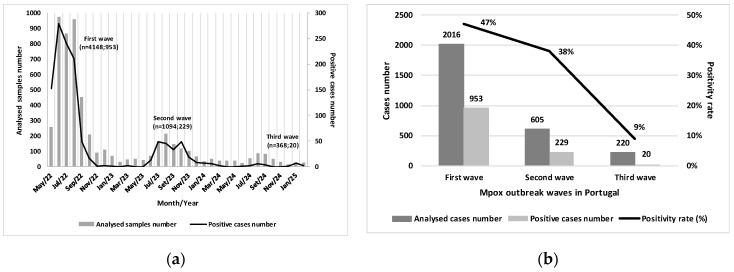
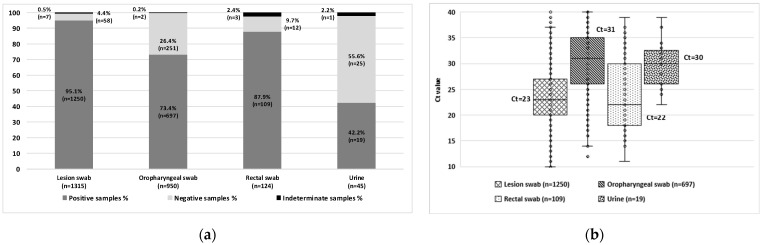
: Mpox re-emerged in 2022 as a global health concern. Between 2022 and 2025, Portugal experienced three distinct outbreak waves, highlighting the critical role of laboratory surveillance and public health interventions. This study describes the epidemiological trends, diagnostic performance, and key lessons learned to improve outbreak preparedness. A total of 5610 clinical samples from 2802 suspected cases were analyzed at the National Institute of Health Doutor Ricardo Jorge using real-time PCR methods. Positivity rates and viral loads (Ct values) were assessed across different clinical specimen types, including lesion, anal, oropharyngeal swabs, and urine samples. Mpox was confirmed in 1202 patients. The first outbreak accounted for 79.3% of cases (n = 953), followed by a significant reduction in transmission during subsequent waves. Lesion and rectal swabs provided the highest diagnostic sensitivity (95.1% and 87.9%, respectively). Oropharyngeal swabs contributed to diagnosis in cases without visible lesions, while urine samples showed limited utility. This study underscores the importance of sustained laboratory surveillance and adaptive public health strategies in controlling mpox outbreaks. Optimizing specimen collection enhances diagnostic accuracy, supporting early detection. Continuous monitoring, combined with targeted vaccination and effective risk communication, is essential to prevent resurgence and ensure rapid response in non-endemic regions.
猴痘于2022年再次出现,成为全球卫生关注的问题。在2022年至2025年期间,葡萄牙经历了三次不同的疫情暴发浪潮,凸显了实验室监测和公共卫生干预措施的关键作用。本研究描述了流行病学趋势、诊断性能以及为改善疫情应对准备工作而吸取的关键经验教训。在里卡多·豪尔赫国立卫生研究院,使用实时聚合酶链反应方法对来自2802例疑似病例的总共5610份临床样本进行了分析。评估了不同临床标本类型(包括皮损、肛门、口咽拭子和尿液样本)的阳性率和病毒载量(Ct值)。1202例患者确诊为猴痘。首次疫情占病例的79.3%(n = 953),随后几波疫情期间传播显著减少。皮损和直肠拭子的诊断敏感性最高(分别为95.1%和87.9%)。口咽拭子有助于对无可见皮损的病例进行诊断,而尿液样本的作用有限。本研究强调了持续实验室监测和适应性公共卫生策略在控制猴痘疫情中的重要性。优化样本采集可提高诊断准确性,有助于早期发现。持续监测,结合有针对性的疫苗接种和有效的风险沟通,对于防止疫情复发以及确保在非流行地区迅速做出反应至关重要。