Bah Muhammed S, Htet Kyaw Ko Ko, Bisson Gregory P, Khosa Celso, Masekela Refiloe, Meghji Jamilah, Mochankana Kagiso, Rachow Andrea, Navuluri Neelima
Department of Population Health Science, Duke University, Durham, North Carolina, United States of America.
Department of Epidemiology, Faculty of Medicine, Prince of Songkla University, Hat Yai, Songkhla, Thailand.
PLOS Glob Public Health. 2025 Jul 23;5(7):e0004935. doi: 10.1371/journal.pgph.0004935. eCollection 2025.
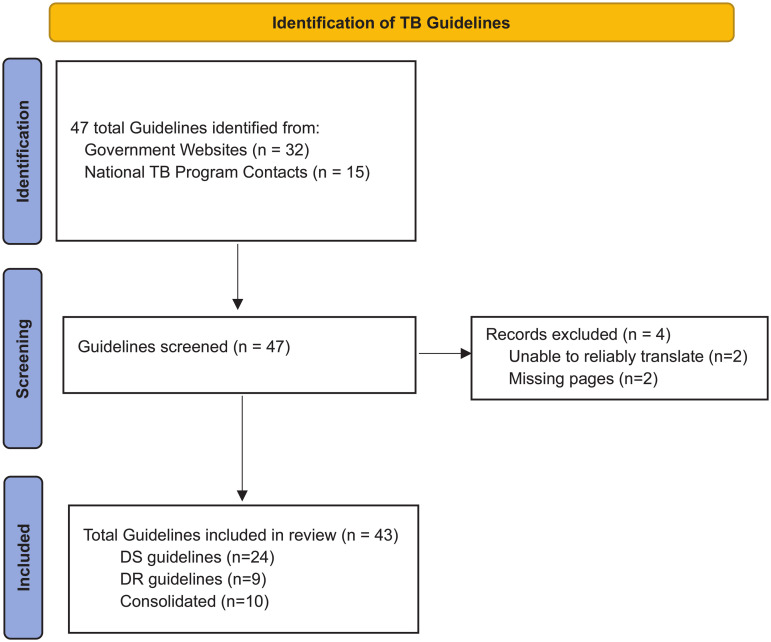
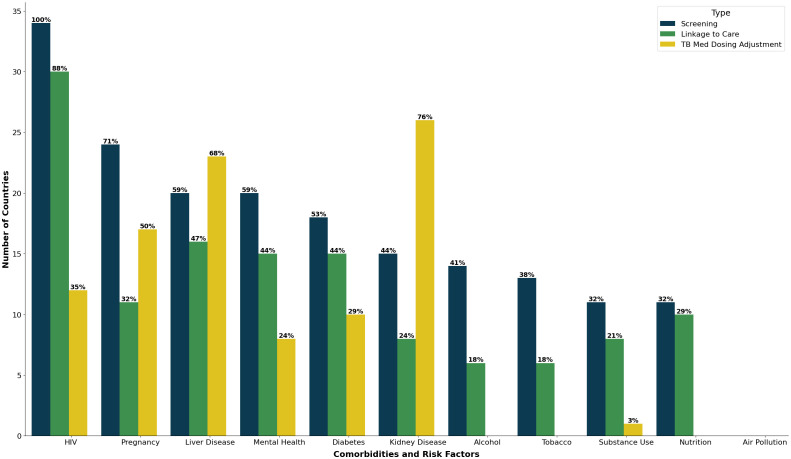
Tuberculosis (TB) remains a major public health issue across the world and national TB guidelines are an important resource for diagnosis and treatment. This scoping review aimed to analyze how countries with the highest TB burdens approach the integration of comorbidity and risk factor screening, diagnosis and treatment, TB recurrence, and post-TB lung disease (PTLD) diagnosis and management, within their TB guidelines. We used the Arksey and O'Malley methodological framework to conduct a scoping review of TB guidelines among the WHO list of highest-TB burden countries. We identified drug-susceptible, drug-resistant, and consolidated guidelines through web searches and personal contacts within TB programs. We translated guidelines into English as needed and systematically extracted, recorded, and reviewed the guidelines to aggregate and describe our findings. Among the 49 countries with the highest TB burden, we successfully identified, translated, and analyzed 43 guidelines (24 drug-sensitive, 9 drug-resistance, and 10 consolidated) from 34 countries. Recommendations for screening varied by comorbidity or risk factor with the four most recommended being HIV/AIDS (100%), pregnancy (73%) and liver disease (59%) and mental health (59%). Recommendations for linkage to care were more infrequent and also varied with the top four being HIV (88%), liver disease (47%), diabetes (44%), and mental health (44%). Only 27 (79%) countries specified diagnostic tests to assess for TB recurrence among individuals presenting with symptoms post-TB treatment, with 25 recommending GeneXpert MTB/RIF. Notably, only 7 (21%) countries mentioned PTLD in their guidelines, with wide variations in their specific recommendations regarding screening, diagnosis, and management. Our findings highlight the lack of detailed guidance on how to properly diagnose and refer patients to appropriate care for various comorbidities or risk factors which may significantly impact microbiological and clinical TB treatment outcomes, including PTLD and ultimately point to an important opportunity for improvement in future guidelines.
结核病(TB)仍然是全球主要的公共卫生问题,国家结核病指南是诊断和治疗的重要资源。本范围综述旨在分析结核病负担最高的国家如何在其结核病指南中纳入合并症和危险因素筛查、诊断和治疗、结核病复发以及结核病后肺部疾病(PTLD)的诊断和管理。我们使用阿克西和奥马利的方法框架,对世界卫生组织结核病负担最高国家名单中的结核病指南进行范围综述。我们通过网络搜索和结核病项目中的个人联系,确定了药物敏感、耐药和综合指南。我们根据需要将指南翻译成英文,并系统地提取、记录和审查指南,以汇总和描述我们的发现。在49个结核病负担最高的国家中,我们成功地从34个国家识别、翻译和分析了43份指南(24份药物敏感、9份耐药和10份综合)。不同合并症或危险因素的筛查建议各不相同,最常被推荐的四项是艾滋病毒/艾滋病(100%)、妊娠(73%)、肝病(59%)和心理健康(59%)。与护理联系的建议较少,也各不相同,前四项是艾滋病毒(88%)、肝病(47%)、糖尿病(44%)和心理健康(44%)。只有27个(79%)国家指定了诊断测试,以评估结核病治疗后出现症状的个体中的结核病复发情况,其中25个推荐使用GeneXpert MTB/RIF。值得注意的是,只有7个(21%)国家在其指南中提到了PTLD,关于筛查、诊断和管理的具体建议差异很大。我们的研究结果凸显了在如何正确诊断并将患者转介至针对各种合并症或危险因素的适当护理方面缺乏详细指导,这些合并症或危险因素可能会显著影响结核病的微生物学和临床治疗结果,包括PTLD,最终指出了未来指南改进的一个重要机会。