Wang Chen, Liu Min
School of Rehabilitation Medicine, Shandong University of Traditional Chinese Medicine, Jinan, China.
Department of Rehabilitation Medicine, Shandong Provincial Third Hospital, 11 Wuyingshan Middle Road, Jinan, 250031, China, 86 18660126767.
J Med Internet Res. 2025 Jul 24;27:e73687. doi: 10.2196/73687.
In recent years, digital technologies have shown possibilities for improving cognitive function after stroke, but their effectiveness and treatment options vary, the optimal treatment remains unclear, and the current evidence is somewhat contradictory.
This study aimed to evaluate the efficacy of various digital interventions in improving poststroke cognitive function and provide evidence-based support for clinical decision-making.
A systematic search was conducted across PubMed, Web of Science, Cochrane Library, Scopus, Embase, and CNKI databases from their inception to January 2025, with no restrictions on language or publication year. Randomized controlled trials evaluating digital interventions (eg, virtual reality [VR], computer-assisted cognitive therapy [CACT], and robot-assisted therapy [RAT]) for poststroke cognitive impairment in adults (aged≥18 y) were included. Eligible studies reported outcomes measured by the Montreal Cognitive Assessment (MoCA) or the Mini-Mental State Examination (MMSE), with cognitive improvement quantified through pre- to postintervention scores. Multiple researchers independently extracted data. Network meta-analysis was performed using R software, incorporating consistency or inconsistency models (based on Deviance Information Criterion differences), random-effects models, and I² statistics to assess heterogeneity. Sources of heterogeneity were analyzed through sensitivity analyses, subgroup analyses, and meta-regression. Intervention efficacy was ranked using Surface Under the Cumulative Ranking Curve (SUCRA) values. Robustness and consistency were validated via Egger test, sensitivity analyses, and node-splitting methods. Evidence quality was assessed using the Grading of Recommendations Assessment, Development, and Evaluation framework.
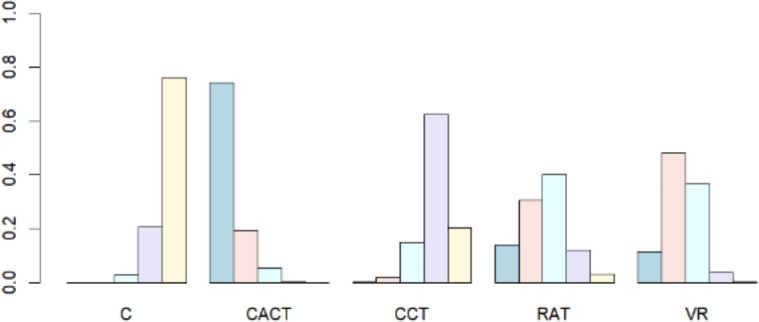
A total of 2128 articles were retrieved, with 27 meeting the inclusion criteria. Compared to conventional rehabilitation or care (C), CACT demonstrated significant superiority in MoCA scores (mean difference [MD]=3.03, 95% CI 1.69 to 4.38; SUCRA=91.53%); while cognitive training (CCT) demonstrated no statistical difference (MD=0.70, 95% CI -0.88 to 2.28). The ordering is CACT>VR>RAT>CCT. For MMSE scores, RAT ranked highest in efficacy (MD=5.99, 95% CI 3.20 to 8.79; SUCRA=99.44%); whereas both VR (MD=1.34, 95% CI -0.94 to 3.62) and CCT (MD=1.12, 95% CI -1.46 to 3.69) showed no significant improvement. The ordering is RAT>CACT>CCT>VR.
Digital therapies are effective in improving cognitive functioning in patients post stroke. CACT showed superior efficacy on the MoCA (emphasizing executive functioning), while RAT had the highest efficacy in the MMSE (focusing on basic cognition), suggesting different domain-specific effects. However, caution is warranted due to the heterogeneity of the included studies, risk of bias, and limited sample sizes in some studies. Future research should focus on optimizing intervention protocols, integrating neuromodulation or traditional rehabilitation techniques, and exploring cost-effective clinical implementation strategies.

近年来,数字技术已显示出改善中风后认知功能的可能性,但其有效性和治疗方案各不相同,最佳治疗方法仍不明确,且目前的证据存在一定矛盾。
本研究旨在评估各种数字干预措施在改善中风后认知功能方面的疗效,并为临床决策提供循证支持。
对PubMed、Web of Science、Cochrane图书馆、Scopus、Embase和中国知网数据库从建库至2025年1月进行系统检索,对语言和发表年份无限制。纳入评估针对成人(年龄≥18岁)中风后认知障碍的数字干预措施(如虚拟现实[VR]、计算机辅助认知治疗[CACT]和机器人辅助治疗[RAT])的随机对照试验。符合条件的研究报告了通过蒙特利尔认知评估(MoCA)或简易精神状态检查表(MMSE)测量的结果,认知改善通过干预前后的分数进行量化。多名研究人员独立提取数据。使用R软件进行网络荟萃分析,纳入一致性或不一致性模型(基于偏差信息准则差异)、随机效应模型和I²统计量以评估异质性。通过敏感性分析、亚组分析和荟萃回归分析异质性来源。使用累积排序曲线下面积(SUCRA)值对干预疗效进行排名。通过Egger检验、敏感性分析和节点拆分方法验证稳健性和一致性。使用推荐分级评估、制定和评价框架评估证据质量。
共检索到2128篇文章,其中27篇符合纳入标准。与传统康复或护理(C)相比,CACT在MoCA评分方面显示出显著优势(平均差[MD]=3.03,95%置信区间1.69至4.38;SUCRA=91.53%);而认知训练(CCT)无统计学差异(MD=0.70,95%置信区间-0.88至2.28)。排序为CACT>VR>RAT>CCT。对于MMSE评分,RAT的疗效排名最高(MD=5.99,95%置信区间3.20至8.79;SUCRA=99.44%);而VR(MD=1.34,95%置信区间-0.94至3.62)和CCT(MD=1.12,95%置信区间-1.46至3.69)均未显示出显著改善。排序为RAT>CACT>CCT>VR。
数字疗法对改善中风后患者的认知功能有效。CACT在MoCA(强调执行功能)方面显示出卓越疗效,而RAT在MMSE(侧重于基本认知)方面疗效最高,表明存在不同的领域特异性效应。然而,由于纳入研究存在异质性、偏倚风险以及部分研究样本量有限,仍需谨慎。未来研究应专注于优化干预方案、整合神经调节或传统康复技术,并探索具有成本效益的临床实施策略。