Wan Zhenyu, Qin Xucong, Wan Qirong, Xu Baohua, Lin Hong, Ouyang Fangcheng, Wang Gaohua
Department of Psychiatry, Renmin Hospital of Wuhan University, No. 99 Zhangzhidong Street, Wuchang District, Wuhan, AH 553, China, 86 15872722863.
Department of Psychiatry, Yichang City Clinical Research Center for Mental Disorders, Yichang, China.
J Med Internet Res. 2025 Jul 24;27:e63485. doi: 10.2196/63485.
The effects of smartphone use on mental health and brain activity in adolescents have received much attention; however, the effects on older adults have received little attention. As more and more older adults begin to use smartphones, exploring the effects of nonaddictive smartphone use on mental health, cognitive function, and brain activity in older adults is imperative.
This study aimed to examine differences in cognitive performance, emotional symptoms (depression, anxiety, and insomnia), and brain functional activity between older adults who use smartphones and those who do not.
A total of 1014 community-dwelling older adults aged 60 years and above were surveyed in a rural area of China. Participants were categorized into 2 groups based on their smartphone use status. The Patient Health Questionnaire, Generalized Anxiety Disorder Scale, Insomnia Severity Index, and Montreal Cognitive Assessment-Basic were used to evaluate the symptoms of depression, anxiety, insomnia, and cognitive function of the participants by trained medical staff. To explore neural mechanisms, a subsample of 130 participants (89 smartphone users and 41 nonusers) was selected using stratified random sampling for resting-state functional magnetic resonance imaging scanning. Participants with contraindications for magnetic resonance imaging (eg, metal implants or claustrophobia) or who refused to participate were excluded. Functional brain activity was analyzed and compared between groups.
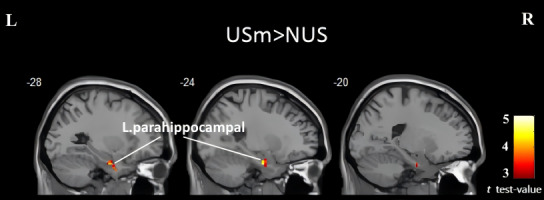
Among all 1015 older adults, 641 reported using smartphones, while 373 reported never using smartphones. Older adults who use smartphones exhibited better cognitive function compared with those who never use smartphones (z=3.806, P<.001), especially in the domains of fluency (z=3.025, P=.002) and abstraction (z=5.311, P<.001). However, there were no significant differences in levels of depression (z=0.689, P=.49), anxiety (z=0.934, P=.35), and insomnia (z=0.340, P=.73). In terms of the magnetic resonance imaging findings, a total of 130 participants completed functional magnetic resonance imaging scanning, including 89 who use smartphones and 41 who never use smartphones, and results showed that older adults who were smartphone users exhibited higher degree centrality values in the left parahippocampal gyrus.
These findings suggest that smartphone use among older adults is associated with better cognitive performance and fewer emotional symptoms, potentially linked to enhanced brain activity in key cognitive regions. Promoting digital engagement may offer cognitive and emotional benefits for aging populations. Longitudinal studies are warranted to examine causal relationships.
智能手机使用对青少年心理健康和大脑活动的影响已备受关注;然而,其对老年人的影响却鲜受关注。随着越来越多的老年人开始使用智能手机,探究非成瘾性智能手机使用对老年人心理健康、认知功能和大脑活动的影响势在必行。
本研究旨在探讨使用智能手机的老年人与不使用智能手机的老年人在认知表现、情绪症状(抑郁、焦虑和失眠)及大脑功能活动方面的差异。
在中国农村地区对1014名60岁及以上的社区居住老年人进行了调查。参与者根据其智能手机使用状况分为两组。由经过培训的医务人员使用患者健康问卷、广泛性焦虑障碍量表、失眠严重程度指数和蒙特利尔认知评估基础版来评估参与者的抑郁、焦虑、失眠症状及认知功能。为探究神经机制,采用分层随机抽样从130名参与者(89名智能手机使用者和41名非使用者)中选取子样本进行静息态功能磁共振成像扫描。排除有磁共振成像禁忌证(如金属植入物或幽闭恐惧症)或拒绝参与者。对两组之间的大脑功能活动进行分析和比较。
在所有1015名老年人中,641人报告使用智能手机,而373人报告从未使用过智能手机。与从未使用智能手机的老年人相比,使用智能手机的老年人表现出更好的认知功能(z = 3.806,P <.001),尤其是在流畅性(z = 3.025,P =.002)和抽象能力(z = 5.311,P <.001)方面。然而,在抑郁水平(z = 0.689,P =.49)、焦虑水平(z = 0.934,P =.35)和失眠水平(z = 0.340,P =.73)方面没有显著差异。在磁共振成像结果方面,共有130名参与者完成了功能磁共振成像扫描,其中89名使用智能手机,41名从未使用智能手机,结果显示使用智能手机的老年人在左侧海马旁回表现出更高的中心性值。
这些发现表明,老年人使用智能手机与更好的认知表现和更少的情绪症状相关,这可能与关键认知区域大脑活动增强有关。促进数字参与可能为老年人群带来认知和情绪方面的益处。有必要进行纵向研究以检验因果关系。