
从地诺单抗转换后使用罗莫单抗治疗24个月的影响:三例病例报告
Impact of romosozumab treatment for 24 months after switching from denosumab: three case reports.
作者信息
Ahn Seong Hee, Lee Seung-Eun, Lee Seung Hun, Kim Ha Young, Hong Seongbin, Koh Jung-Min
机构信息
Division of Endocrinology and Metabolism, Department of Internal Medicine, Inha University Hospital, Inha University School of Medicine, Incheon 22332, South Korea.
Department of Internal Medicine, Ulsan University Hospital, University of Ulsan College of Medicine, Ulsan 44033, South Korea.
出版信息
JBMR Plus. 2025 Apr 23;9(8):ziaf070. doi: 10.1093/jbmrpl/ziaf070. eCollection 2025 Aug.
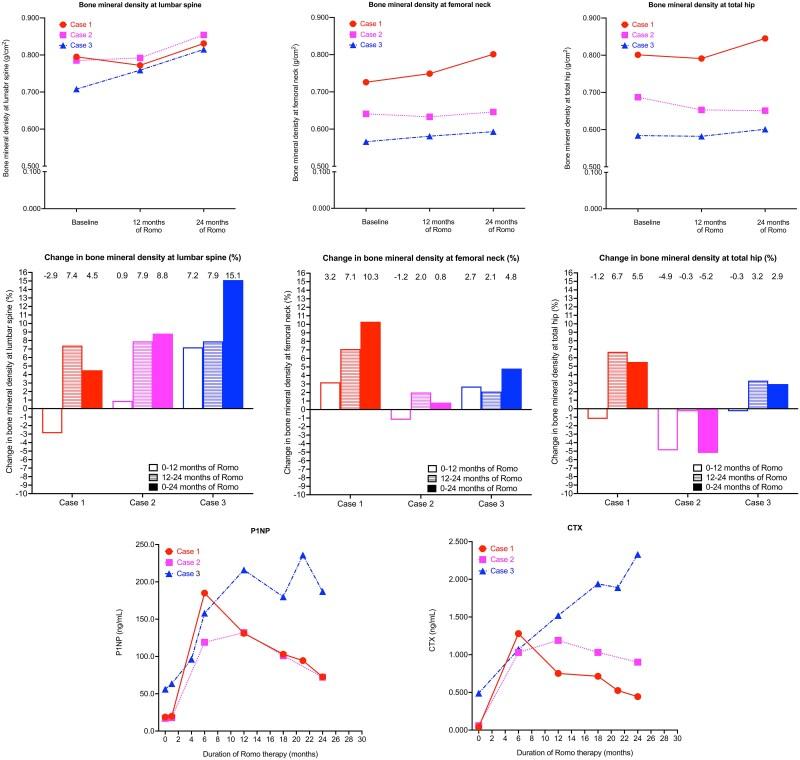
Prior denosumab use in osteoporosis patients diminishes the BMD gains from a subsequent 12-mo romosozumab regimen. However, few studies have explored BMD gains after 24 mo of romosozumab therapy. BMD at the LS-BMD, FN-BMD, and TH-BMD and P1NP and C-terminal telopeptide of type I collagen (CTX) levels were measured after 24 mo of romosozumab therapy in 3 osteoporosis cases with prior denosumab use. The changes in cases 1-3 at 12 and 24 mo, respectively, were as follows: LS-BMD (-2.9% and 7.4%, 0.9% and 7.9%, 7.2% and 7.9%), FN-BMD (3.2% and 7.1%, -1.2% and 2.0%, 2.7% and 2.1%), and TH-BMD (-1.2% and 6.7%, -4.9% and -0.3%, -0.3% and 3.2%). The P1NP and CTX levels in case 1 (18.80 ng/mL, 0.042 ng/mL) peaked at 6 mo (185.00 ng/mL, 1.280 ng/mL) and then decreased at 24 mo by 60.8% and 65.3%, respectively. The P1NP and CTX levels in case 2 (17.10 ng/mL, 0.059 ng/mL) peaked at 12 mo (132.00 ng/mL, 1.190 ng/mL) and then decreased at 24 mo by 65.3% and 24.3%, respectively. In case 3, the P1NP and CTX levels (56.10 ng/mL, 0.490 ng/mL) increased at 24 mo by 233.3% and 375.5%, respectively. This is the first report of a 24-mo romosozumab regimen in a small group of osteoporosis patients with prior denosumab use having varied effects on BMD and bone turnover. Nonetheless, larger controlled studies are needed to confirm these findings.
骨质疏松症患者先前使用地诺单抗会减少后续12个月罗莫佐单抗治疗方案带来的骨密度增加。然而,很少有研究探讨罗莫佐单抗治疗24个月后的骨密度增加情况。在3例先前使用过地诺单抗的骨质疏松症患者中,测量了罗莫佐单抗治疗24个月后的腰椎骨密度(LS-BMD)、股骨颈骨密度(FN-BMD)、全髋骨密度(TH-BMD)以及I型胶原氨基端前肽(P1NP)和I型胶原羧基端肽(CTX)水平。病例1 - 3在12个月和24个月时的变化分别如下:LS-BMD(-2.9%和7.4%、0.9%和7.9%、7.2%和7.9%),FN-BMD(3.2%和7.1%、-1.2%和2.0%、2.7%和2.1%),以及TH-BMD(-1.2%和6.7%、-4.9%和-0.3%、-0.3%和3.2%)。病例1中的P1NP和CTX水平(18.80 ng/mL,0.042 ng/mL)在6个月时达到峰值(185.00 ng/mL,1.280 ng/mL),然后在24个月时分别下降了60.8%和65.3%。病例2中的P1NP和CTX水平(17.10 ng/mL,0.059 ng/mL)在12个月时达到峰值(132.00 ng/mL,1.190 ng/mL),然后在24个月时分别下降了65.3%和24.3%。在病例3中,P1NP和CTX水平(56.10 ng/mL,0.490 ng/mL)在24个月时分别增加了233.3%和375.5%。这是关于一小群先前使用过地诺单抗的骨质疏松症患者接受24个月罗莫佐单抗治疗方案对骨密度和骨转换产生不同影响的首次报告。尽管如此,仍需要更大规模的对照研究来证实这些发现。
 Zotero 插件