Li Xuejing, Chen Sihan, Meng Meiqi, Wang Ziyan, Jiang Hongzhan, Hao Yufang
School of Nursing, Beijing University of Chinese Medicine, Beijing, China.
Evidence-Based Nursing Research Center, School of Nursing, Beijing University of Chinese Medicine, Beijing, China.
Front Public Health. 2025 Jul 10;13:1605212. doi: 10.3389/fpubh.2025.1605212. eCollection 2025.
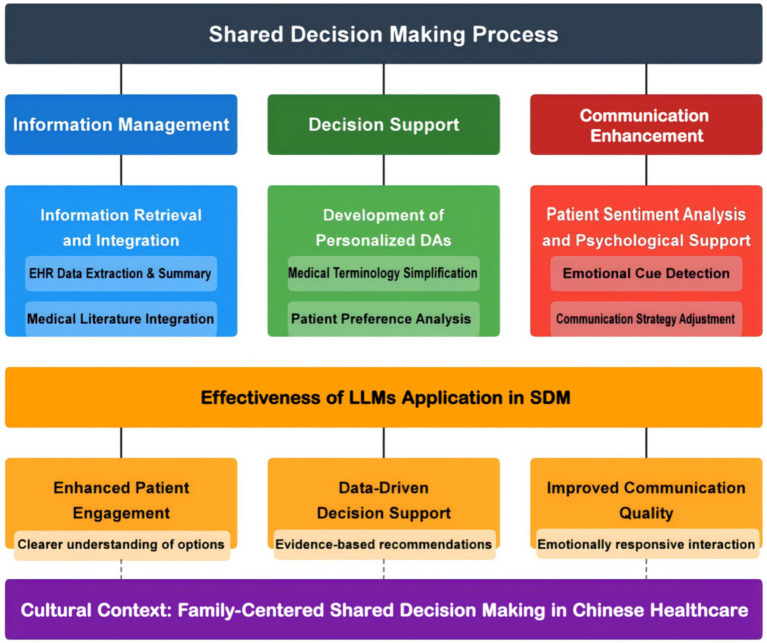
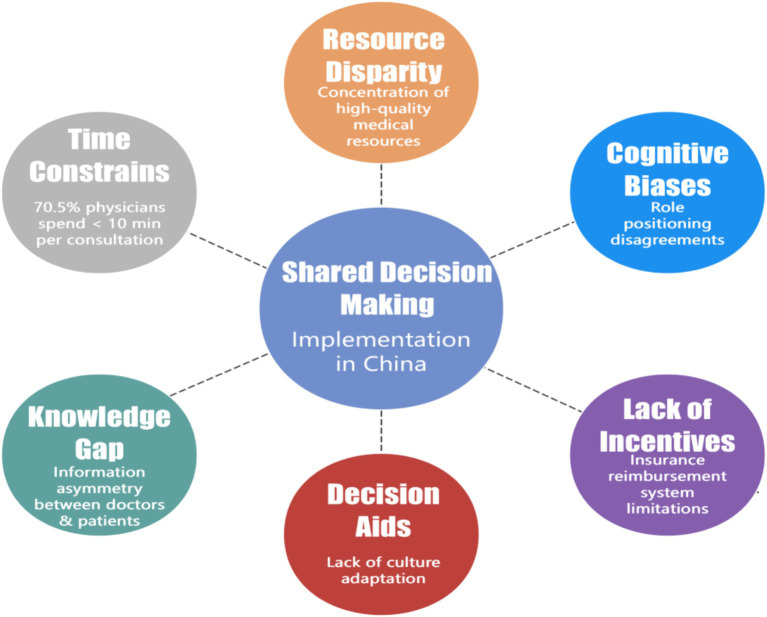
Shared Decision Making (SDM), as a modern medical decision-making model emphasizing patient participation, faces multidimensional challenges in China, including uneven distribution of medical resources, knowledge gaps, and inadequate cultural adaptation. The implementation of SDM in China is hindered by time constraints, insufficient patient willingness to participate, a lack of standardized decision support tools, and structural barriers such as healthcare reimbursement systems. Large Language Models (LLMs), with their powerful natural language processing capabilities, demonstrate unique advantages in enhancing communication efficiency, supporting personalized decision-making, and promoting multi-party collaboration. Key functionalities such as information integration, personalized support tools, and sentiment analysis significantly improve patient engagement and decision quality. However, LLMs still face limitations in localization, decision-chain completeness, and handling complex scenarios, particularly in understanding traditional Chinese medicine (TCM) knowledge and supporting family-oriented decision-making models. Future efforts should focus on constructing integrated knowledge graphs of biomedicine and Traditional Chinese Medicine, optimizing multi-layered expression capabilities, and improving model interpretability to promote LLMs' in-depth application in SDM within China, ultimately enhancing healthcare quality and patient satisfaction.
共享决策(SDM)作为一种强调患者参与的现代医疗决策模式,在中国面临多方面挑战,包括医疗资源分配不均、知识差距以及文化适应性不足等。中国SDM的实施受到时间限制、患者参与意愿不足、缺乏标准化决策支持工具以及医疗报销系统等结构性障碍的阻碍。大语言模型(LLMs)凭借其强大的自然语言处理能力,在提高沟通效率、支持个性化决策以及促进多方协作方面展现出独特优势。信息整合、个性化支持工具和情感分析等关键功能显著提升了患者参与度和决策质量。然而,LLMs在本地化、决策链完整性以及处理复杂场景方面仍面临局限,尤其是在理解中医知识和支持家庭导向决策模式方面。未来的努力应集中在构建生物医药与中医的综合知识图谱、优化多层表达能力以及提高模型可解释性,以促进LLMs在中国SDM中的深入应用,最终提升医疗质量和患者满意度。