Kanter Jenny E, Hsu Cheng-Chieh, Kramer Farah, Shao Baohai, Vaisar Tomas, den Hartigh Laura J, Reed Abigail, Luo Jason, Tran Alan, Tang Jingjing, Mangalapalli Henry, Cervantes Jocelyn, Shimizu-Albergine Masami, Reaven Peter D, Koska Juraj, Jensen Majken K, Davies Brandon S J, Fisher Edward A, Davidson Nicholas O, Stitziel Nathan O, Mullick Adam E, Goldberg Ira J, Bornfeldt Karin E
Department of Medicine, Division of Metabolism, Endocrinology and Nutrition, University of Washington, Seattle, WA 98109.
UW Medicine Diabetes Institute, University of Washington, Seattle, WA 98109.
Res Sq. 2025 Jul 16:rs.3.rs-6979508. doi: 10.21203/rs.3.rs-6979508/v1.
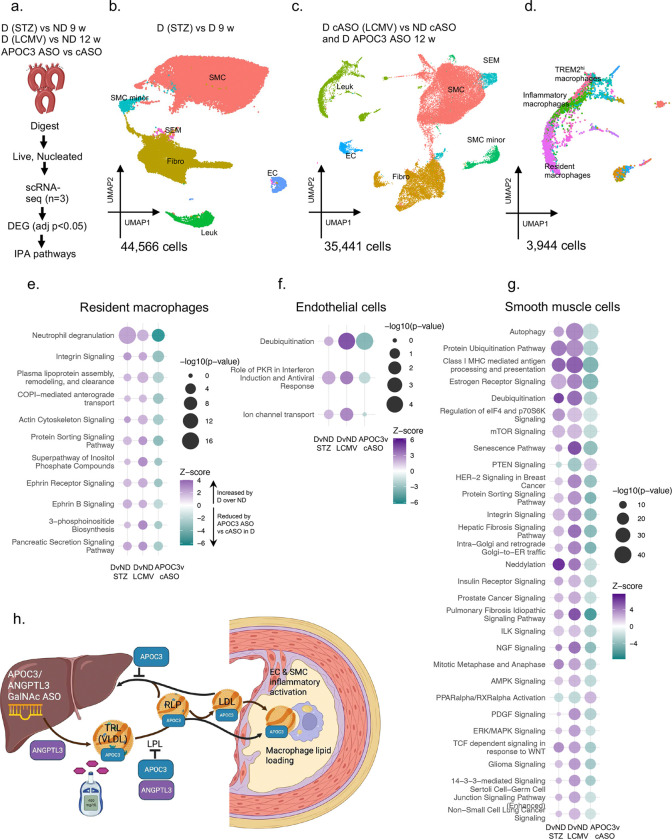
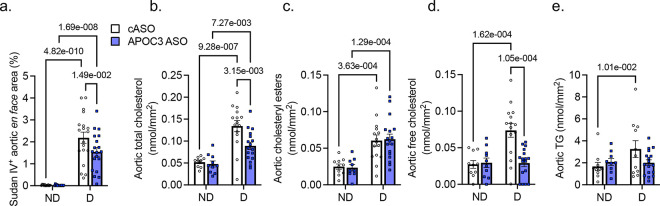
Cardiovascular outcome trials are being considered for therapeutics that silence apolipoprotein C3 (APOC3) or angiopoietin-like 3 (ANGPTL3) because of their abilities to lower triglyceride-rich lipoproteins (TRLs) and their remnants in individuals with increased cardiovascular disease (CVD) risk. Here we demonstrate that plasma APOC3 predicts CVD events in individuals with diabetes more strongly than in those without diabetes. Accordingly, plasma APOC3 levels are elevated, clearance of TRLs/remnants is slowed, and plasma TRL remnants are increased in two mouse models of diabetes-accelerated atherosclerosis. Silencing mouse APOC3 by a liver-targeted antisense oligonucleotide lowers both cholesterol and triglycerides carried by TRL/remnants and LDL and prevents aortic free cholesterol accumulation in diabetes, while ANGPTL3 silencing reduces triglycerides. Single-cell RNA-sequencing revealed that APOC3 silencing prevents a majority of diabetes-induced pathways in macrophages, endothelial cells, and smooth muscle cells, with inflammation as a major predicted upstream regulator, adding promise to APOC3 as a CVD target in diabetes.
由于某些疗法能够降低心血管疾病(CVD)风险增加个体中富含甘油三酯的脂蛋白(TRL)及其残粒水平,因此正在考虑针对沉默载脂蛋白C3(APOC3)或血管生成素样3(ANGPTL3)的疗法开展心血管结局试验。在此,我们证明,与无糖尿病个体相比,血浆APOC3在糖尿病个体中对CVD事件的预测作用更强。相应地,在两种糖尿病加速动脉粥样硬化小鼠模型中,血浆APOC3水平升高,TRL/残粒清除减慢,血浆TRL残粒增加。通过肝脏靶向反义寡核苷酸沉默小鼠APOC3可降低TRL/残粒以及低密度脂蛋白(LDL)携带的胆固醇和甘油三酯,并防止糖尿病小鼠主动脉游离胆固醇积聚,而沉默ANGPTL3可降低甘油三酯水平。单细胞RNA测序显示,沉默APOC3可阻止巨噬细胞、内皮细胞和平滑肌细胞中大多数由糖尿病诱导的信号通路,炎症是主要的预测上游调节因子,这为将APOC3作为糖尿病中的CVD靶点增添了希望。