Blanco-Llamero Cristina, García-García Paz, Señoráns Francisco Javier
Facultad de Ciencias de la Salud, Universidad Francisco de Vitoria, Ctra. Pozuelo-Majadahonda Km 1, 800, Pozuelo de Alarcón, 28223 Madrid, Spain.
Department of Food Science, Aarhus University, Aarhus Centrum, 8000 Aarhus, Denmark.
Mar Drugs. 2025 Jun 23;23(7):263. doi: 10.3390/md23070263.
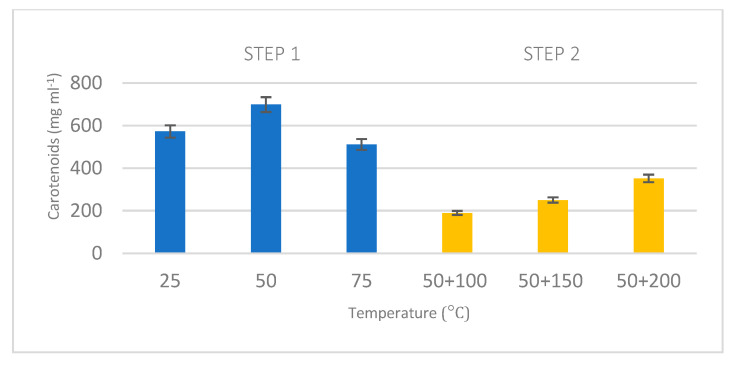
Biorefinery is gaining attention as a promising approach to valorize natural resources and promote a circular bioeconomy. This study aimed to recover high-value molecules, such as xanthophylls and polar lipids with nutraceutical applications, through enzymatic pretreatment and sequential pressurized liquid extraction (PLEseq), by reusing the residual biomass of after each processing step. Remarkably, pure glycolipids (102.95 ± 1.10 mg g dry weight) were obtained immediately after enzymatic pretreatment, facilitating their easy recovery. Furthermore, two alternative sequential extraction processes were successfully developed, using ethanol and water as green solvents at varying temperatures and in different orders. The most effective PLEseq conditions yielded up to 48 mg mL of carbohydrates using water at 50 °C, and up to 44 mg mL of proteins via subcritical water extraction at 100 °C, prior to conventional lipid extraction with ethanol to produce various concentrated extracts. In the inverted PLEseq process-starting with ethanol extraction followed by successive water washes-isolated and purified fractions of lutein and astaxanthin were obtained, contributing to the complete depletion of the residual biomass. Overall, the development of an integrated and sequential biorefinery protocol that enables the extraction of multiple high-value compounds holds significant potential for application in the food industry.
生物炼制作为一种使自然资源增值并促进循环生物经济的有前景的方法正受到关注。本研究旨在通过酶预处理和顺序加压液体萃取(PLEseq)回收高价值分子,如具有营养保健应用的叶黄素和极性脂质,并在每个加工步骤后重复利用剩余生物质。值得注意的是,酶预处理后立即获得了纯糖脂(102.95±1.10毫克/克干重),便于其轻松回收。此外,成功开发了两种替代的顺序萃取工艺,使用乙醇和水作为绿色溶剂,在不同温度和不同顺序下进行。最有效的PLEseq条件是在50℃用水萃取时可得到高达48毫克/毫升的碳水化合物,在100℃通过亚临界水萃取可得到高达44毫克/毫升的蛋白质,然后用乙醇进行常规脂质萃取以生产各种浓缩提取物。在反向PLEseq工艺中(先进行乙醇萃取,随后依次用水洗涤),获得了分离和纯化的叶黄素和虾青素馏分,使剩余生物质完全耗尽。总体而言,开发一种能够提取多种高价值化合物的综合顺序生物炼制方案在食品工业中具有巨大的应用潜力。