Cáceres Eder, Divani Afshin A, Olivella-Gomez Juan, Di Napoli Mario, Reyes Luis F
Bioscience PhD. School of Engineering, Universidad de La Sabana, Chía, Colombia.
Unisabana Center for Translational Science, School of Medicine, Universidad de La Sabana, Chía, Colombia.
Scand J Trauma Resusc Emerg Med. 2025 Jul 26;33(1):131. doi: 10.1186/s13049-025-01430-2.
Traumatic brain injury (TBI) continues to be a major cause of death and disability worldwide. Biomarkers for treatment and prognostication are needed for counseling and clinical management.
In this study, we evaluated the ability of serum IL-6 to predict mortality and disability in a population whith moderate and severe TBI (msTBI).
Adult patients with msTBI were included consecutively from December 2019 to August 2023. Clinical data were collected during hospital stays and functional outcome was established at 6 months using GOSE. Serum IL-6 levels were measured on day 0, day 3 and day 7 after injury.
Eighty-eight patients were recruited and completed 6-month follow-up. Clinical variables associated with the 6-month adverse outcome were admission GCS (OR 0.77 95% CI 0.67-0.87, p < 0.001), age (OR 1.10 95% CI 1.03-1.1, p = 0.001), Rotterdam score (OR 2.8 95% CI 1.7-5.0, p < 0.001), hospital infections (OR 4.7 95% CI 1.9-12.1, p < 0.001) and day-0 IL-6 (OR 1.1 95% CI 1.08-1.13, p < 0.001). When adjusted for age, severity of injury,and the presence of a hospital infection, day-0 IL-6 was significantly associated with the adverse outcome at 6 months (OR 1.15 95% CI 1.1-1.2, p = 0.031). Area under the curve (AUC) of 89% (95% CI 82%-96%). Calculated sensitivity and specificity were 75% and 89%, respectively, at a cut-off point of 59 pg/ml.
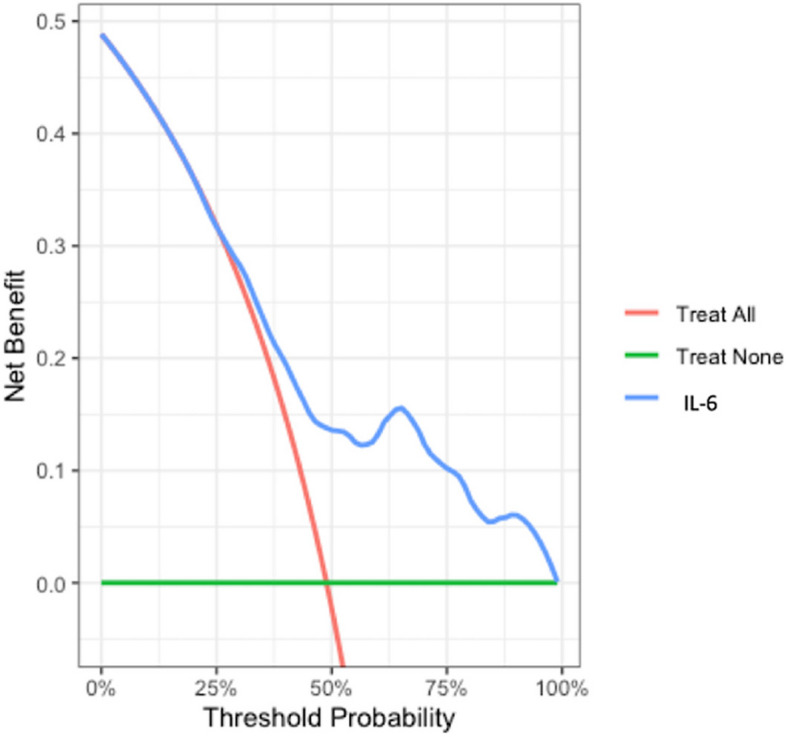
In a population of msTBI, levels of serum interleukin-6 within the first 24 h after injury is an independent predictor of 6-month mortality and disability with a net benefit in clinical decision-making across relevant threshold probabilities.
创伤性脑损伤(TBI)仍是全球范围内死亡和残疾的主要原因。治疗和预后的生物标志物对于咨询和临床管理是必要的。
在本研究中,我们评估了血清白细胞介素-6(IL-6)预测中度和重度创伤性脑损伤(msTBI)患者死亡率和残疾情况的能力。
连续纳入2019年12月至2023年8月期间的成年msTBI患者。在住院期间收集临床数据,并在6个月时使用总体结局量表(GOSE)确定功能结局。在受伤后第0天、第3天和第7天测量血清IL-6水平。
招募了88例患者并完成了6个月的随访。与6个月不良结局相关的临床变量包括入院时的格拉斯哥昏迷量表(GCS)评分(比值比[OR]0.77,95%置信区间[CI]0.67 - 0.87,p < 0.001)、年龄(OR 1.10,95% CI 1.03 - 1.1,p = 0.001)、鹿特丹评分(OR 2.8,95% CI 1.7 - 5.0,p < 0.001)、医院感染(OR 4.7,95% CI 1.9 - 12.1,p < 0.001)和第0天的IL-6水平(OR 1.1,95% CI 1.08 - 1.13,p < 0.001)。在调整年龄、损伤严重程度和医院感染的存在情况后,第0天的IL-6与6个月时的不良结局显著相关(OR 1.15,95% CI 1.1 - 1.2,p = 0.031)。曲线下面积(AUC)为89%(95% CI 82% - 96%)。在截断值为59 pg/ml时,计算出的敏感性和特异性分别为75%和89%。
在msTBI患者群体中,受伤后24小时内的血清白细胞介素-6水平是6个月死亡率和残疾的独立预测指标,在跨越相关阈值概率的临床决策中具有净效益。