Unisabana Center for Translational Science, Universidad de La Sabana, Chía, Colombia.
School of Medicine, Universidad de La Sabana, Chía, Colombia.
Curr Neurol Neurosci Rep. 2024 Dec;24(12):593-609. doi: 10.1007/s11910-024-01382-7. Epub 2024 Oct 29.
This review aims to comprehensively examine the immune response following traumatic brain injury (TBI) and how its disruption can impact healing and recovery.
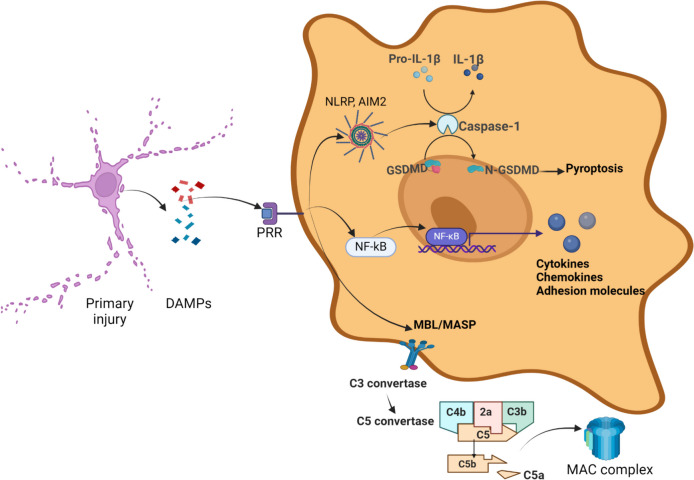
The immune response is now considered a key element in the pathophysiology of TBI, with consequences far beyond the acute phase after injury. A delicate equilibrium is crucial for a healthy recovery. When this equilibrium is disrupted, chronic inflammation and immune imbalance can lead to detrimental effects on survival and disability. Globally, traumatic brain injury (TBI) imposes a substantial burden in terms of both years of life lost and years lived with disability. Although its epidemiology exhibits dynamic trends over time and across regions, TBI disproportionally affects the younger populations, posing psychosocial and financial challenge for communities and families. Following the initial trauma, the primary injury is succeeded by an inflammatory response, primarily orchestrated by the innate immune system. The inflammasome plays a pivotal role during this stage, catalyzing both programmed cell death pathways and the up-regulation of inflammatory cytokines and transcription factors. These events trigger the activation and differentiation of microglia, thereby intensifying the inflammatory response to a systemic level and facilitating the migration of immune cells and edema. This inflammatory response, initially originated in the brain, is monitored by our autonomic nervous system. Through the vagus nerve and adrenergic and cholinergic receptors in various peripheral lymphoid organs and immune cells, bidirectional communication and regulation between the immune and nervous systems is established.
本篇综述旨在全面研究创伤性脑损伤(TBI)后的免疫反应,以及其失调如何影响创伤愈合和恢复。
目前认为,免疫反应是 TBI 病理生理学的关键因素,其后果远不止于损伤后的急性期。健康恢复需要一个微妙的平衡。当这种平衡被打破时,慢性炎症和免疫失衡可能导致对生存和残疾的有害影响。在全球范围内,创伤性脑损伤(TBI)在生命损失年数和残疾生存年数方面都造成了巨大负担。尽管其流行病学在时间和区域上表现出动态趋势,但 TBI 不成比例地影响年轻人群,给社区和家庭带来心理社会和经济挑战。在初始创伤后,原发性损伤被炎症反应所取代,炎症反应主要由固有免疫系统调控。炎性小体在这一阶段发挥关键作用,既催化程序性细胞死亡途径,又上调炎症细胞因子和转录因子。这些事件触发小胶质细胞的激活和分化,从而将炎症反应加剧到全身水平,并促进免疫细胞和水肿的迁移。最初起源于大脑的这种炎症反应,由我们的自主神经系统监测。通过迷走神经和各种外周淋巴器官和免疫细胞中的肾上腺素能和胆碱能受体,建立了免疫和神经系统之间的双向通信和调节。