Wu Yingzhuo, Xu Jialuo, Li Junming, Gu Jia, Shang Xuequn, Li Xingyi
School of Computer Science, Northwestern Polytechnical University, Xi'an, 710072 Shaanxi, China.
School of Software, Northwestern Polytechnical University, Xi'an, 710072 Shaanxi, China.
Brief Bioinform. 2025 Jul 2;26(4). doi: 10.1093/bib/bbaf364.
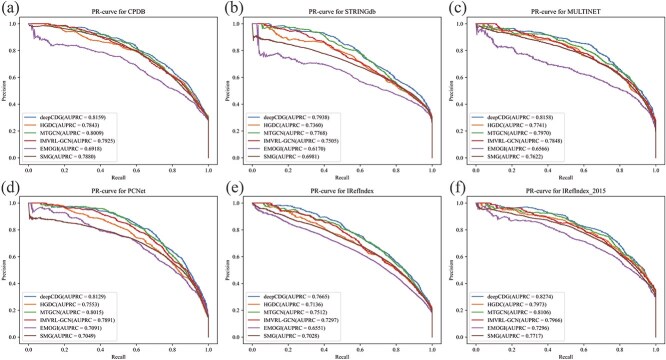
Cancer driver genes play a pivotal role in understanding cancer development, progression, and therapeutic discovery. The plenty of accumulation of multi-omics data and biological networks provides a data foundation for graph neural network (GNN) frameworks. However, most existing methods directly concatenate multi-omics data as features, which may lead to limited performance. To address this limitation, we propose deepCDG, a deep graph convolutional network (GCN)-based multi-omics integration model for cancer driver gene identification. The model first employs shared-parameter GCN encoders to extract representations from three omics perspectives, followed by feature integration through an attention layer, and finally utilizes a residual-connected GCN predictor for cancer driver gene identification. Additionally, deepCDG employs GNNExplainer for cancer driver gene module identification. Experimental results demonstrate the effective predictive performance, model robustness, and computational efficiency of deepCDG. Additionally, biological interpretability analysis further validates the reliability of the identification of cancer driver genes of our framework, and the identified gene modules provide profound insights into complex inter-gene relationships and interactions. We believe our method offers enhanced applicability for cancer driver gene identification and could be extended to other biological research fields in future studies.
癌症驱动基因在理解癌症的发生、发展及治疗方法发现方面起着关键作用。多组学数据和生物网络的大量积累为图神经网络(GNN)框架提供了数据基础。然而,大多数现有方法直接将多组学数据连接起来作为特征,这可能导致性能受限。为解决这一局限性,我们提出了deepCDG,这是一种基于深度图卷积网络(GCN)的用于癌症驱动基因识别的多组学整合模型。该模型首先采用共享参数GCN编码器从三个组学角度提取表征,接着通过注意力层进行特征整合,最后利用残差连接的GCN预测器进行癌症驱动基因识别。此外,deepCDG采用GNNExplainer进行癌症驱动基因模块识别。实验结果证明了deepCDG有效的预测性能、模型稳健性和计算效率。此外,生物学可解释性分析进一步验证了我们框架中癌症驱动基因识别的可靠性,且所识别的基因模块为复杂的基因间关系和相互作用提供了深刻见解。我们相信我们的方法在癌症驱动基因识别方面具有更高的适用性,并且在未来研究中可扩展到其他生物学研究领域。