Seale Tarren, Brözel Volker S, Potgieter Sarah C, Rupp Oliver, Blom Jochen, Steenkamp Emma T, Venter Stephanus N
Department of Biochemistry, Genetics and Microbiology, University of Pretoria, Pretoria, 0002, South Africa.
Department of Biology and Microbiology, South Dakota State University, Brookings, SD, 57007, USA.
Curr Microbiol. 2025 Jul 28;82(9):414. doi: 10.1007/s00284-025-04402-y.
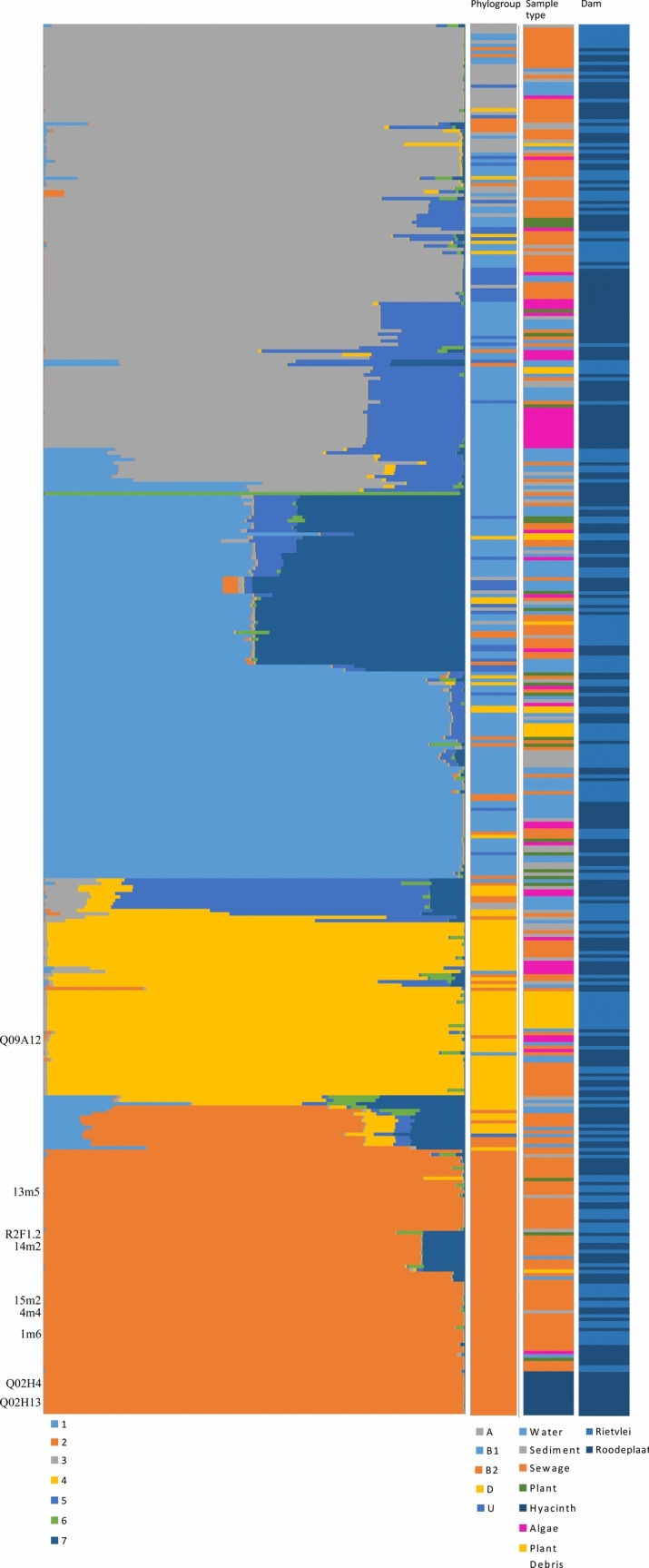
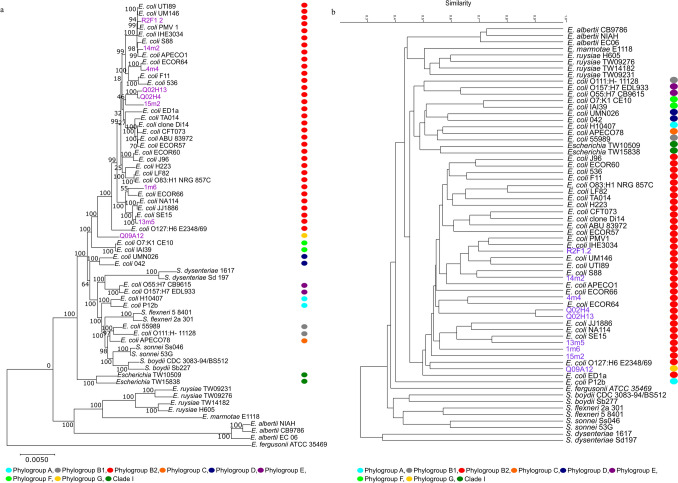
Escherichia coli is widely used as an indicator of faecal contamination, as it is assumed that faeces from warm-blooded animals is the primary source of E. coli in the environment. However, various studies have shown that E. coli can survive and multiply in environmental niches, including soil, sand and sediment. E. coli can be assigned to eight main phylogroups but environmental E. coli are associated primarily with phylogroups A and B1. In this study, 410 E. coli were isolated from different niches within two peri-urban catchments in the Gauteng province of South Africa. To represent the E. coli circulating within the human population, E. coli was also isolated from sewage before treatment and released into these reservoirs. To capture the diversity of E. coli among these isolates, the β-D-glucuronidase (uidA) and mismatch repair (mutS) genes were sequenced. While isolates linked to phylogroup B1 dominated as was expected, the recovery of many isolates linked to phylogroup B2, the second most dominant group, was unanticipated. To further investigate this observation, the genomes of representative phylogroup B2 isolates were sequenced and subjected to phylogenetic and functional analyses. The results showed that phylogroup B2 isolates formed a distinct phylogenetic cluster, apparently independent of niche or geographic origin. Our findings also showed that while isolates seem to be associated with environmental samples, they could have the ability to colonize the gut and cause disease as they harboured several virulence factors associated with extraintestinal E. coli.
大肠杆菌被广泛用作粪便污染的指示菌,因为人们认为温血动物的粪便 是环境中大肠杆菌的主要来源。然而,各种研究表明,大肠杆菌能够在包括土壤、沙子和沉积物在内的环境生态位中存活和繁殖。大肠杆菌可分为八个主要系统发育群,但环境中的大肠杆菌主要与A群和B1群有关。在本研究中,从南非豪登省两个城郊集水区的不同生态位中分离出410株大肠杆菌。为了代表人群中传播的大肠杆菌,还在污水处理前从污水中分离出大肠杆菌,并排放到这些水库中。为了捕捉这些分离株中大肠杆菌的多样性,对β-D-葡萄糖醛酸酶(uidA)和错配修复(mutS)基因进行了测序。虽然与B1系统发育群相关的分离株如预期的那样占主导地位,但许多与第二大主导群B2系统发育群相关的分离株的回收却出乎意料。为了进一步研究这一观察结果,对代表性的B2系统发育群分离株的基因组进行了测序,并进行了系统发育和功能分析。结果表明,B2系统发育群分离株形成了一个独特的系统发育簇,显然独立于生态位或地理来源。我们的研究结果还表明,虽然分离株似乎与环境样本有关,但它们可能有能力在肠道中定殖并引起疾病,因为它们含有几种与肠外大肠杆菌相关的毒力因子。