Wybranska Joanna M, Pieper Lorenz, Wybranski Christian, Genseke Philipp, Wuestemann Jan, Varghese Julian, Kreissl Michael C, Mitura Jakub
Division of Nuclear Medicine, Department of Radiology & Nuclear Medicine, Faculty of Medicine, Otto von Guericke University Magdeburg, 39120 Magdeburg, Germany.
Institut für Medical Data Science, Medical Faculty, Otto von Guericke University Magdeburg, 39120 Magdeburg, Germany.
Cancers (Basel). 2025 Jul 9;17(14):2285. doi: 10.3390/cancers17142285.
BACKGROUND/OBJECTIVES: This study evaluates whether combining Ga-PSMA-11-PET/CT derived imaging biomarkers with clinical risk factors improves the prediction of early biochemical recurrence (eBCR) or clinical progress in patients with high-risk prostate cancer (PCa) after primary treatment, using machine learning (ML) models.
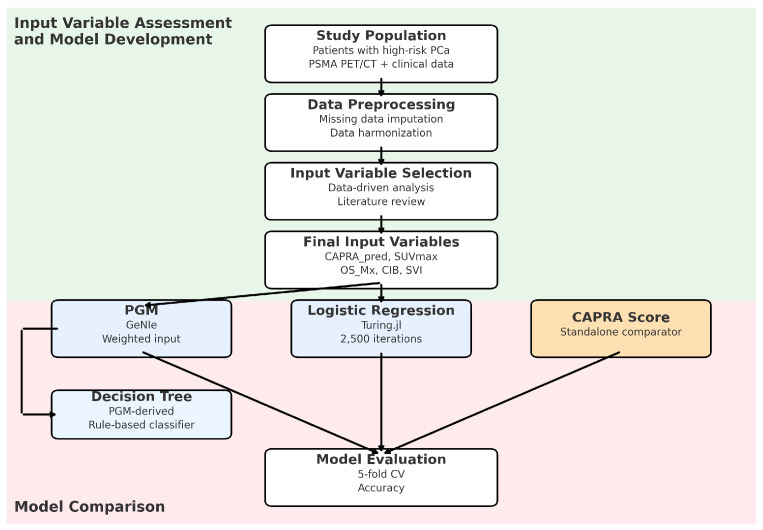
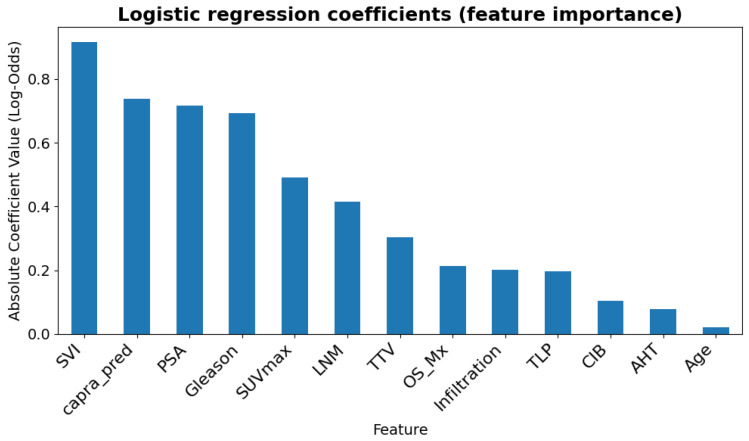
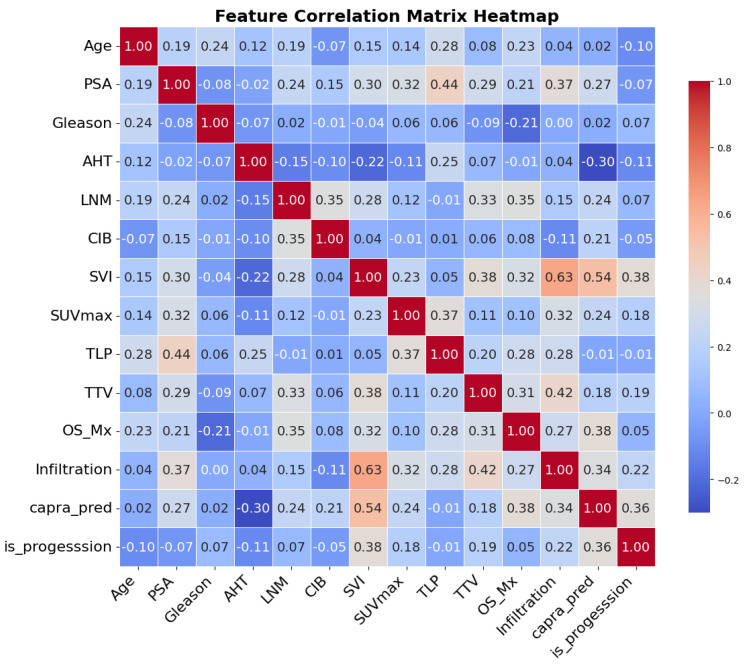
We analyzed data from 93 high-risk PCa patients who underwent Ga-PSMA-11 PET/CT and received primary treatment at a single center. Two predictive models were developed: a logistic regression (LR) model and an ML derived probabilistic graphical model (PGM) based on a naïve Bayes framework. Both models were compared against each other and against the CAPRA risk score. The models' input variables were selected based on statistical analysis and domain expertise including a literature review and expert input. A decision tree was derived from the PGM to translate its probabilistic reasoning into a transparent classifier.
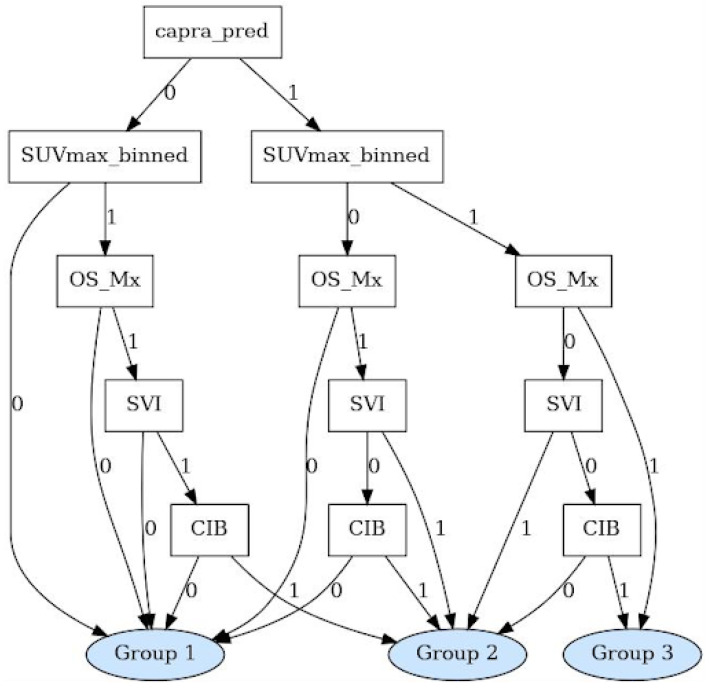
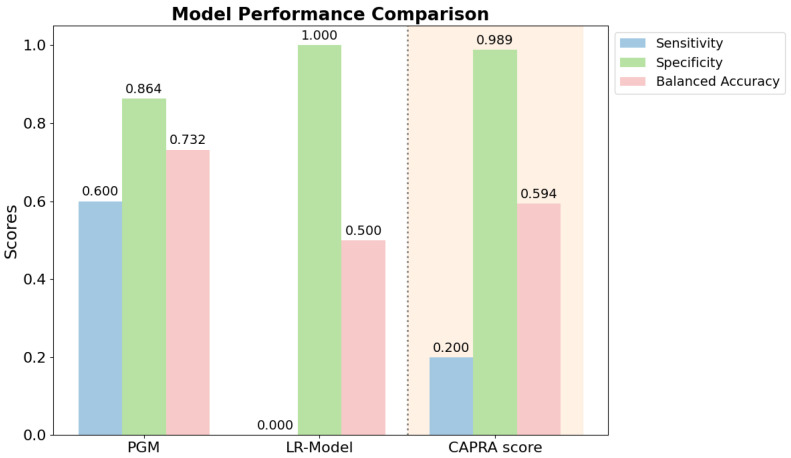
The five key input variables were as follows: binarized CAPRA score, maximal intraprostatic PSMA uptake intensity (SUVmax), presence of bone metastases, nodal involvement at common iliac bifurcation, and seminal vesicle infiltration. The PGM achieved superior predictive performance with a balanced accuracy of 0.73, sensitivity of 0.60, and specificity of 0.86, substantially outperforming both the LR (balanced accuracy: 0.50, sensitivity: 0.00, specificity: 1.00) and CAPRA (balanced accuracy: 0.59, sensitivity: 0.20, specificity: 0.99). The decision tree provided an explainable classifier with CAPRA as a primary branch node, followed by SUVmax and specific PET-detected tumor sites.
Integrating Ga-PSMA-11 imaging biomarkers with clinical parameters, such as CAPRA, significantly improves models to predict progression in patients with high-risk PCa undergoing primary treatment. The PGM offers superior balanced accuracy and enables risk stratification that may guide personalized treatment decisions.
背景/目的:本研究使用机器学习(ML)模型评估,将镓-PSMA-11-PET/CT衍生的影像生物标志物与临床风险因素相结合,是否能改善对高危前列腺癌(PCa)患者初次治疗后早期生化复发(eBCR)或临床进展的预测。
我们分析了93例在单一中心接受镓-PSMA-11 PET/CT检查并接受初次治疗的高危PCa患者的数据。开发了两种预测模型:逻辑回归(LR)模型和基于朴素贝叶斯框架的ML衍生概率图形模型(PGM)。将这两种模型相互比较,并与CAPRA风险评分进行比较。基于统计分析和领域专业知识(包括文献综述和专家意见)选择模型的输入变量。从PGM导出决策树,将其概率推理转化为透明分类器。
五个关键输入变量如下:二值化CAPRA评分、前列腺内PSMA最大摄取强度(SUVmax)、骨转移的存在、髂总动脉分叉处的淋巴结受累以及精囊浸润。PGM实现了卓越的预测性能,平衡准确率为0.73,灵敏度为0.60,特异性为0.86,显著优于LR(平衡准确率:0.50,灵敏度:0.00,特异性:1.00)和CAPRA(平衡准确率:0.59,灵敏度:0.20,特异性:0.99)。决策树提供了一个可解释的分类器,以CAPRA作为主要分支节点,其次是SUVmax和特定PET检测到的肿瘤部位。
将镓-PSMA-11影像生物标志物与临床参数(如CAPRA)相结合,可显著改善预测接受初次治疗的高危PCa患者病情进展的模型。PGM具有卓越的平衡准确率,并能进行风险分层,可能指导个性化治疗决策。