Yakobson Alexander, Brenner Ronen, Gothelf Itamar, Maimon Rabinovich Natalie, Cohen Ahron Yehonatan, Abu Jama Ashraf, Abu Yasin Nashat, Abu Ghalion Fahmi, Agbarya Abed, Shalata Walid
The Legacy Heritage Cancer Center, Dr. Larry Norton Institute, Soroka Medical Center, Beer Sheva 84105, Israel.
Faculty of Health Sciences, Ben Gurion University of the Negev, Beer Sheva 84105, Israel.
Int J Mol Sci. 2025 Jul 19;26(14):6939. doi: 10.3390/ijms26146939.
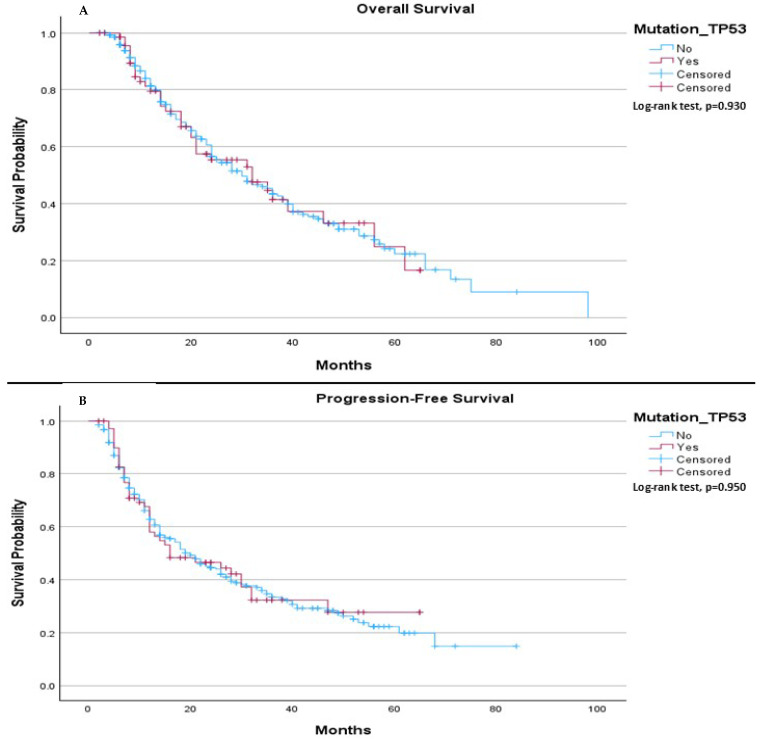
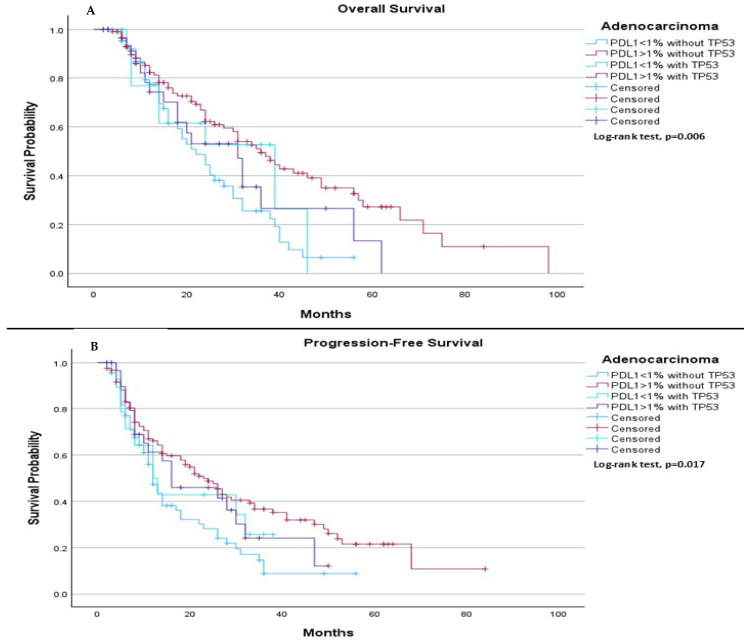
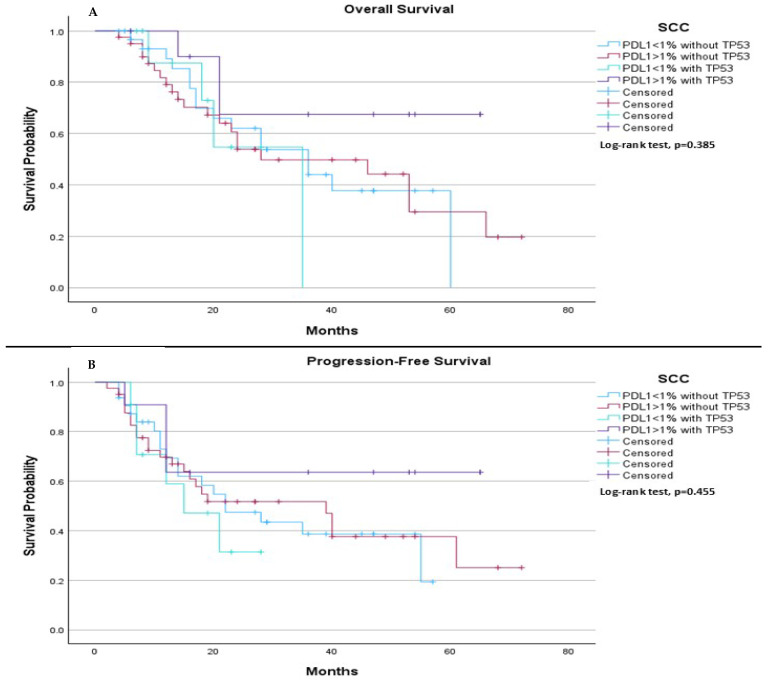
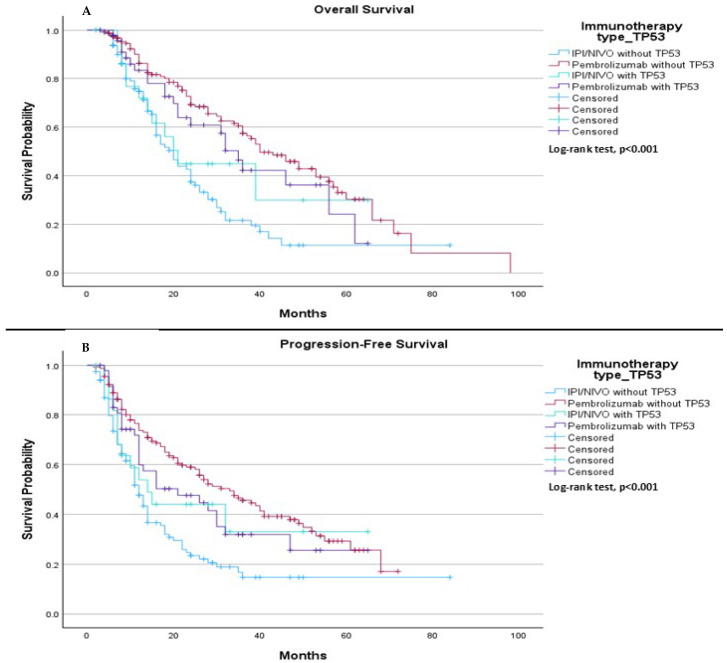
TP (tumor protein) 53 mutation status plays a critical role in cancer progression and may influence survival outcomes in non-small cell lung cancer (NSCLC) patients receiving immunotherapy. This study investigates the impact of TP53 mutation status and immunotherapy treatment on survival in NSCLC patients. This retrospective study analyzed NSCLC patients treated with pembrolizumab or ipilimumab plus nivolumab, stratified by TP53 mutation status and PD-L1 (programmed death-ligand 1) expression (<1%, 1-49%, >50%). Survival outcomes (overall survival (OS) and progression free survival (PFS) were assessed using Kaplan-Meier curves and log-rank tests, with subgroup analysis by histological subtype. In squamous cell cancer (SCC) patients, no significant differences in OS or PFS were found based on TP53 mutation status or treatment type. A trend toward improved survival was observed with pembrolizumab ( = 0.088). In adenocarcinoma patients, significant differences in OS and PFS were observed based on TP53 mutation status. Pembrolizumab showed superior survival outcomes compared to ipilimumab plus nivolumab in TP53 wild-type patients ( < 0.001). PD-L1 ≥ 1% also predicted better outcomes, especially in adenocarcinoma patients. TP53 mutation status and immunotherapy type significantly influence survival outcomes in NSCLC, particularly in adenocarcinoma patients. Pembrolizumab demonstrated superior efficacy in TP53 wild-type patients, with PD-L1 expression further refining survival predictions. These findings underscore the importance of personalized treatment strategies based on TP53 status and PD-L1 expression in NSCLC. Further studies are needed to validate these results and optimize treatment approaches.
肿瘤蛋白(TP)53突变状态在癌症进展中起着关键作用,可能会影响接受免疫治疗的非小细胞肺癌(NSCLC)患者的生存结果。本研究调查了TP53突变状态和免疫治疗对NSCLC患者生存的影响。这项回顾性研究分析了接受派姆单抗或伊匹单抗加纳武单抗治疗的NSCLC患者,按TP53突变状态和程序性死亡配体1(PD-L1)表达(<1%、1%-49%、>50%)进行分层。使用Kaplan-Meier曲线和对数秩检验评估生存结果(总生存期(OS)和无进展生存期(PFS)),并按组织学亚型进行亚组分析。在鳞状细胞癌(SCC)患者中,基于TP53突变状态或治疗类型,未发现OS或PFS有显著差异。派姆单抗观察到生存改善的趋势(P = 0.088)。在腺癌患者中,基于TP53突变状态观察到OS和PFS有显著差异。在TP53野生型患者中,派姆单抗显示出优于伊匹单抗加纳武单抗的生存结果(P < 0.001)。PD-L1≥1%也预示着更好的结果,尤其是在腺癌患者中。TP53突变状态和免疫治疗类型显著影响NSCLC患者的生存结果,特别是在腺癌患者中。派姆单抗在TP53野生型患者中显示出卓越疗效,PD-L1表达进一步优化生存预测。这些发现强调了基于TP53状态和PD-L1表达的个性化治疗策略在NSCLC中的重要性。需要进一步研究来验证这些结果并优化治疗方法。